


 English
  русский
  Français
  Indonesia
  عربى
عربى  中文简体
中文简体


Emergency Construction Generator Cooling: Radiator Sizing and Selection
Content
- 1 What an Emergency Construction Generator Actually Has to Do
- 2 How Much Heat a Standby Set Pours Into Its Radiator
- 3 Ambient Temperature and Dust Decide the Real Radiator Size
- 4 Tube-and-Fin or Plate-and-Fin: Match the Core to the Site
- 5 Five Installation Details That Decide Whether the Radiator Works
- 6 Replacing a Radiator on an Existing Site
- 7 Maintenance Intervals That Keep a Standby Set Cool
- 8 FAQ: Emergency Construction Generator Cooling
What an Emergency Construction Generator Actually Has to Do
An emergency construction generator is a standby diesel generating set sized to carry life-safety, dewatering and lifting loads within seconds of a utility failure, and it must do that at whatever ambient temperature and dust level the site presents, not the level printed on the test certificate.
An emergency construction generator is a diesel genset rated for standby duty and installed to supply temporary power to site safety systems, pumps, hoists and lighting when the grid fails, usually between 100 kVA and 800 kVA on commercial and infrastructure projects.
Standby duty changes the cooling requirement in three ways that a prime-power datasheet does not capture:
- Start and load acceptance: Level 1 life-safety systems require a start and rated load acceptance within about 10 seconds, which means full-load heat rejection begins within a minute of a cold start.
- Long idle periods: weeks at zero load with only weekly exercise runs, so belts, seals and coolant sit static between events.
- Site conditions: earthworks dust, acoustic canopy louvres and summer temperatures above the engine manufacturer's published rating point.
A core that meets a 25 degree laboratory rating can still fail on a construction site. The numbers, the core structure and the installation details decide whether it does.
How Much Heat a Standby Set Pours Into Its Radiator
A 500 kVA (400 kWe) turbocharged diesel set rejects roughly 290 to 300 kW of heat at full load, and about 60% of that arrives in the jacket water circuit that the radiator has to remove.
The chart is a planning baseline for a set with a water-cooled oil cooler, not a substitute for the engine manufacturer's heat rejection curve. Read the curve first, then size the core.
Two circuits, two rules: when the charge air cooler sits on a separate circuit, the radiator becomes a dual-circuit core and each circuit needs its own pressure cap rating. Merging both into one circuit lifts coolant temperature by 8 to 12 K at full load, which is often the whole margin.
Ambient Temperature and Dust Decide the Real Radiator Size
Radiator capacity falls as ambient temperature rises, and a core selected at 25 degrees Celsius loses roughly 1.5% to 2% of its usable heat rejection for every degree above that rating.
| Site ambient | Capacity retained | Practical radiator response |
| 35 degrees C | 88 to 92% | One core size up, or a wider fin pitch |
| 40 degrees C | 82 to 86% | Oversized core and a higher-airflow fan |
| 45 degrees C | 78 to 82% | Oversized core plus ducted discharge |
| 50 degrees C | 70 to 74% | Remote radiator or heat exchanger |
Rule of thumb: a core selected at 25 degrees Celsius needs about 15% more face area to hold full load at 45 degrees Celsius, and about 25% more at 50 degrees. Altitude compounds it, since air density drops roughly 10% per 1,000 m and mass airflow through the same core falls with it.
Dust is the second selector. Earthworks, concrete batching and haul roads load the air with fines that pack the fin gaps from the outside in. A core at 8 fins per inch, roughly a 3 mm pitch, survives that service. A dense 12 fin per inch core clogs within weeks and then needs a pressure wash that folds the fins over.
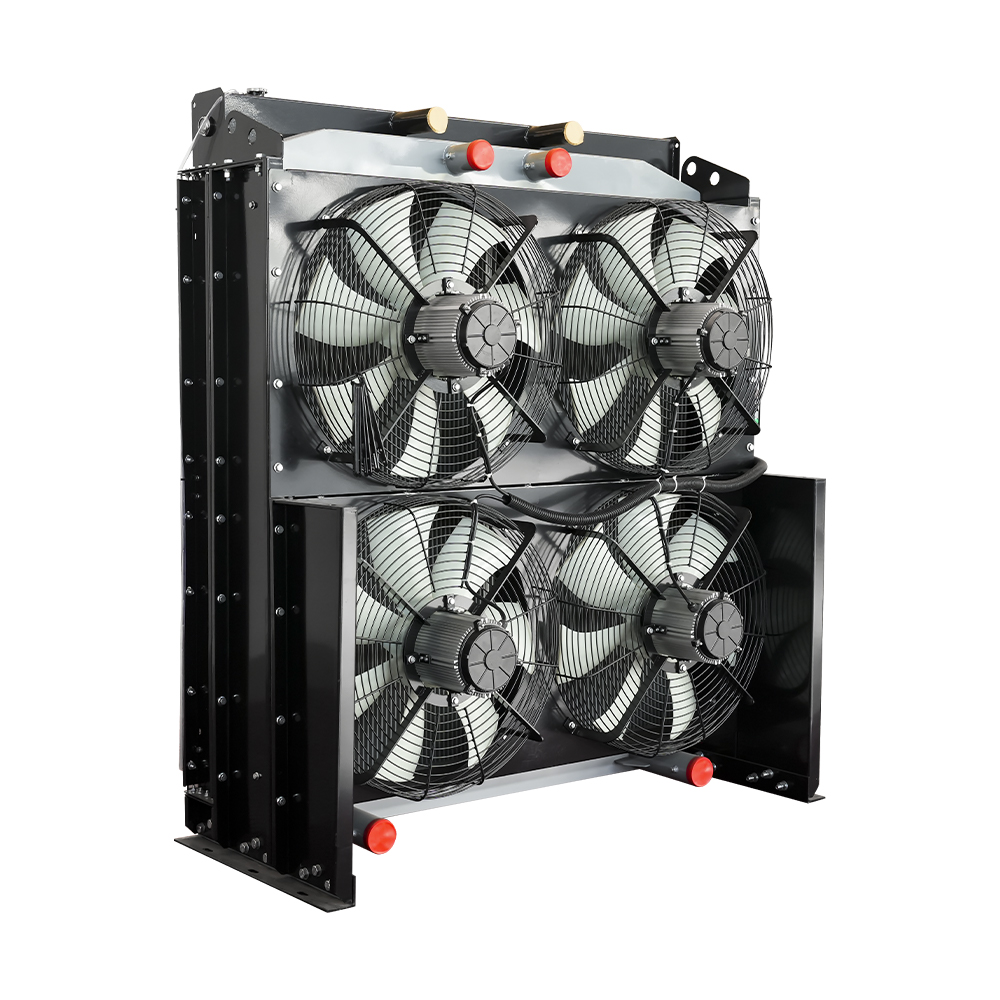 Desert High-Temperature Generator Radiator RangeFor hot, dusty sites, this range uses enlarged cores, wide-spaced fins and high-capacity fans to support reliable generator cooling.View Product →
For sites that run above 45 degrees Celsius for months, the oversized core is cheaper than the downtime, and the fan and drive must be specified with it rather than after it.
Tube-and-Fin or Plate-and-Fin: Match the Core to the Site
Use a tube-and-fin core for construction sites unless the set sits in a clean plant room, because a tube-and-fin core can be cleaned repeatedly and re-cored, while a brazed plate-and-fin core cannot.
Tube-and-fin
- Cleanable with water or air at 3 to 5 bar without crushing tubes
- Fin pitch of 3 to 4 mm tolerates dust loading
- Repairable: individual tubes can be plugged or replaced
- 10 to 15% heavier and larger for the same heat rejection
Plate-and-fin, brazed
- 25 to 35% more compact for the same duty
- Higher heat transfer per unit of face area
- Hard to clean; brazed seams do not survive repeated pressure washing
- Best for clean air, fixed installation and tight enclosures
A construction enclosure is a dust trap with a fan attached. If the set runs inside an acoustic canopy, add a mesh screen or pre-cleaner on the louvre and set the fin cleaning interval by running hours, not by the calendar.
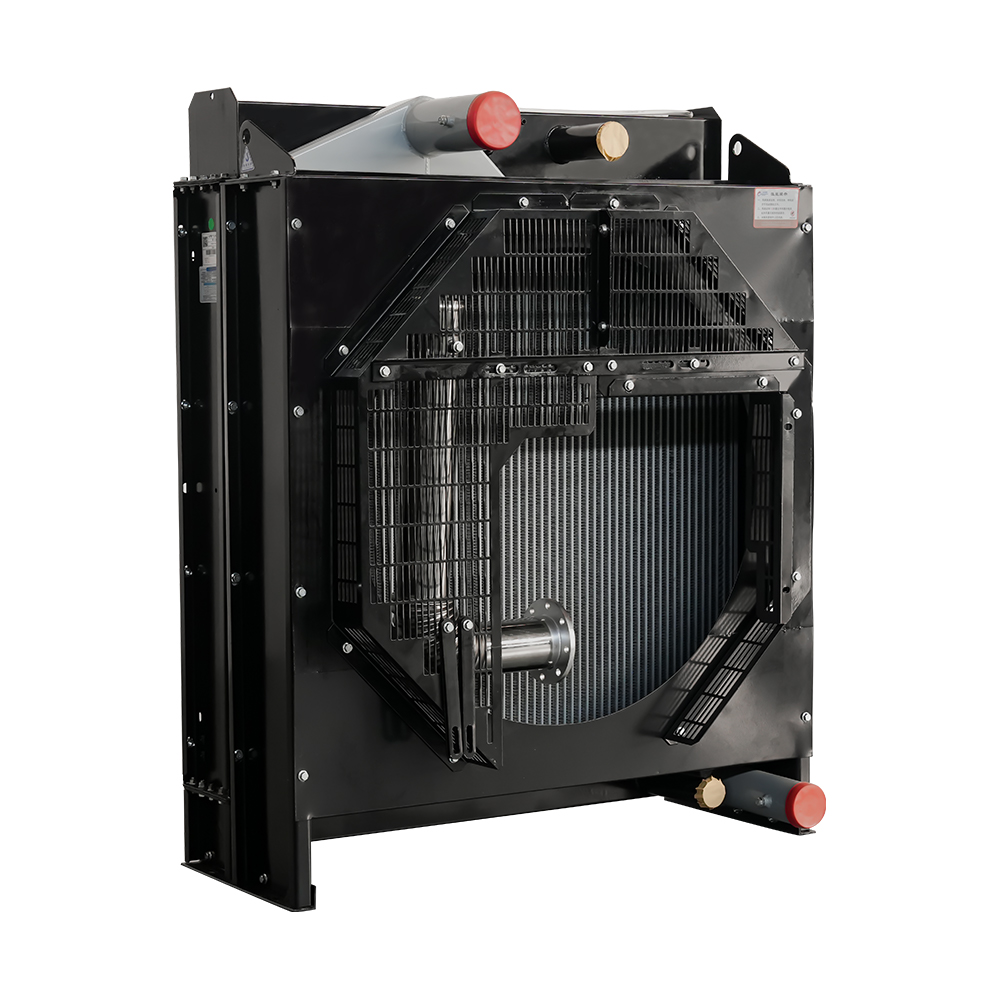 Tube-and-Fin Radiators for Generator CoolingA cost-effective, maintainable radiator design with closely spaced fins, suited to varied generator sizes and installation airflow checks.View Product →
Five Installation Details That Decide Whether the Radiator Works
Airflow, clearance and hot air recirculation cause more construction-site overheating than core size, and all three are fixed at installation rather than at purchase.
- Louvre free area: give the louvre at least 1.25 times the radiator face area. Below that, static pressure climbs past 100 Pa and the fan moves less air than the curve promises.
- Clearance: keep one fan diameter between the core face and any wall, and half a fan diameter between two sets. Radiators facing each other across a 1 m gap pull each other's hot air.
- Discharge direction: push hot air away from the intake side and above the enclosure line. A 2 to 3 m outlet duct costs less than a season of nuisance trips.
- Fan drive: check belt tension at 250 hours and again at 500 hours. A slipping belt costs 10 to 15% of fan speed, which is equivalent to losing a fifth of the core.
- Coolant: run 50% glycol with a cap rated to system pressure. Glycol lifts the boiling point to about 108 degrees Celsius at 1 bar, which is the margin that carries the set through a 45 degree afternoon.
Commissioning check: hold the set at 75% load for 30 minutes, then step to 100%. Coolant temperature should stabilise within about 8 K of the thermostat set point. If it keeps climbing after ten minutes at full load, the fault is on the air side, not in the core.
Replacing a Radiator on an Existing Site
Most construction-site radiator replacements are matched on dimensions and connection layout rather than part number, because site records rarely survive the project handover.
Four measurements decide the match: core envelope, connection bore and position, fan diameter with shroud depth, and the mounting footprint on the base frame.
Cross-reference checklist
- Core width, height and thickness in millimetres, measured at the tanks
- Inlet and outlet bore, plus the centre distance between them
- Fan diameter, blade count and rotation direction
- Tank orientation and the position of the filler neck
- Mounting hole centres and isolator type
- Pressure cap rating and thermostat set point
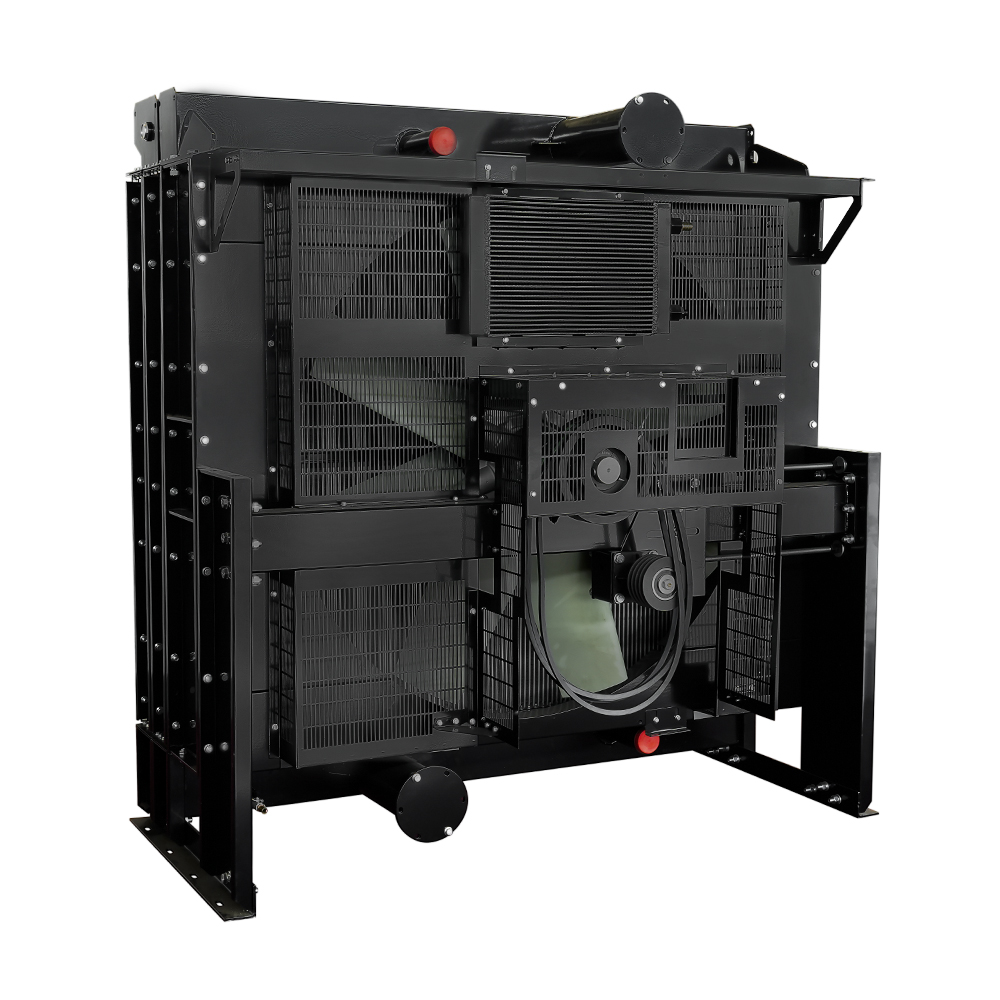 Emergency Standby Generator Radiator SolutionsFor backup power, these radiators support quick startup cooling and fit replacement or retrofit needs across hospitals, data centers and telecom sites.View Product →
Standby sets should be specified on standby duty rather than continuous duty, because the core sees full load in bursts and must recover between events. Jiangsu Weichuang Radiator Manufacturing Co., Ltd. builds replacement cores for sets in this range, and the specification conversation normally starts with the four measurements above. Where no catalogue core fits the frame, custom-built cores sized to the measured envelope usually cost less than modifying the base frame, hoses and fan shroud.
Maintenance Intervals That Keep a Standby Set Cool
A standby radiator fails from neglect long before it fails from wear, and the four tasks below prevent most site outages.
| Task | Interval | What failure looks like |
| Fin cleaning and straightening | 250 hours or monthly in dusty service | Coolant temperature up 5 K at the same load |
| Glycol concentration and pH | 500 hours | Scale in the core, lower boiling point |
| Pressure cap and hose clamps | 12 months | Coolant loss with no visible leak |
| Belt tension and fan bearing | 250 hours, then 500 hours | Fan noise, glazed belt, slow temperature rise |
The cheapest diagnostic on a standby set is a temperature log: one reading per week, same load, same time of day. A drift of 5 K over a month points at the air side, not the water side.
When temperature climbs under load, work through the causes in order: air, coolant, then core. This breakdown of generator overheating causes and fixes follows the same sequence.
FAQ: Emergency Construction Generator Cooling
How quickly must an emergency construction generator carry full load?
Level 1 life-safety systems require the set to start and accept rated load within about 10 seconds of a utility failure, so the cooling system must handle full-load heat rejection within a minute of a cold start, with cold coolant and a stationary fan before the first revolution.
Can a standard radiator handle a 45 degree Celsius site ambient?
Not at rated output. A core selected at 25 degrees Celsius retains only about 78 to 82% of its capacity at 45 degrees, so full load needs roughly 15% more face area, a higher-airflow fan and a ducted discharge to avoid recirculation.
Why does the set only overheat in the afternoon?
Three effects stack up: peak ambient removes capacity, upwind air is hotter than morning air, and dust loosened by the day's haul traffic has already packed the fins. If the fan also pulls its own discharge back through the core, the inlet air can sit 8 to 10 K above ambient.
How do I order a replacement radiator without a part number?
Measure the core envelope, the inlet and outlet bore with centre distances, the fan diameter with shroud depth, and the mounting hole centres on the base frame. Those four measurements, plus the pressure cap rating and thermostat set point, are enough to match or build a core.

- Product Categories
- Contact Us
-
- wcradiator@jswcsrq.com
- +86-514-400-180-4088
- +86-15152759383
- +86-15152759383
- No. 6 Road, Shaobo Industrial Concentration Zone, Jiangdu District, Yangzhou City, Jiangsu Province, China

