


 English
  русский
  Français
  Indonesia
  عربى
عربى  中文简体
中文简体

Custom Aluminum Radiators for Generators: Specs, Costs & Lead Times
Content
- 1 What Is a Custom Aluminum Radiator and When Do You Need One?
- 2 Key Parameters in Custom Aluminum Radiator Design
- 3 Material and Process Comparison: All-Aluminum vs. Aluminum-Plastic, TIG vs. Vacuum Brazing
- 4 Step-by-Step Custom Ordering Process (From Drawing to Delivery)
- 5 Application-Specific Design Tips: Desert, Coastal, Mining, and Generator Use
- 6 Cost and Lead Time Estimation: What Affects the Price?
- 7 How to Verify Quality: Testing Standards for Custom Radiators
What Is a Custom Aluminum Radiator and When Do You Need One?
A generator running in 50°C ambient air needs roughly 60% more cooling capacity than the same engine at 25°C, yet many standard radiators fail to deliver under these conditions. Custom aluminum radiators are built to a specific set of dimensional, thermal, and environmental requirements — not pulled from a stock list. They match non-standard mounting envelopes, higher-than-OEM heat loads, aggressive duty cycles, or corrosive environments that mass-produced units cannot handle.
Standard replacement radiators assume the engine will operate inside the original design envelope. A custom unit becomes necessary when any of those assumptions break: an engine upgrade raises heat rejection, a generator enclosure restricts airflow, or the site sits in a coastal zone demanding superior corrosion resistance. The choice always ties back to three core factors — performance gap, physical fitment, and environmental durability.
| Factor | Standard OEM-Style Radiator | Custom Aluminum Radiator |
|---|---|---|
| Fitment | Matches OEM drawing | Built to your frame rails, enclosure, or mounting points |
| Cooling capacity | Sufficient for original engine rating | Sized to actual heat rejection, often 20-50% higher |
| Material options | Usually fixed (copper-brass or aluminum-plastic) | Choice of all-aluminum welded, aluminum-plastic, tube-and-fin |
| Lead time | Off-the-shelf (days) | 5–15 working days after drawing approval |
| Cost | Lower upfront | Higher but avoids repeated failures and downtime |
Custom radiators become the only practical solution when a standard part fails within months. You see this in mining sites where vibration cracks plastic tanks, in desert gensets that overheat under full load, and in repowered marine generator packages that no longer share the original mounting layout.
Key Parameters in Custom Aluminum Radiator Design
Every custom radiator order starts with a handful of measurable decisions. Leave any of them undefined and you risk getting a unit that fits physically but fails thermally or chokes airflow. The five parameters below drive at least 90% of the final performance.
- Core face area (width x height) — The primary heat-exchange surface. For a given fin density and tube count, doubling the face area nearly doubles the heat rejection, though diminishing returns kick in if airflow is not scaled simultaneously.
- Number of tube rows — Adding a second or third row boosts heat transfer but increases air-side pressure drop. Going from 2 to 3 rows typically improves heat rejection by 15–20% at the same face area, provided the fan can overcome the extra resistance.
- Fin density (fins per inch, FPI) — Each additional fin adds surface area. As a rule of thumb, every 10% increase in fin density raises heat rejection by roughly 8%, but the payoff plateaus above 16 FPI in dirty or dusty air.
- Inlet and outlet location and size — Misplaced connections force complex hose routing that can trap air pockets. Custom radiators allow you to place nipples exactly where the OEM plumbing expects them, reducing bleed time and installation cost.
- Mounting brackets and structural features — Vibration kills radiators faster than heat. Custom brackets designed for the specific generator frame, with isolation bushings, double the service life in high-vibration mining or mobile applications.
Manufacturers will request these parameters on a drawing or specification sheet. The best approach is to supply a dimensioned sketch with the core size, row count, fin pitch, nipple sizes and positions, plus any clear envelope constraints. That single sheet cuts quoting time from weeks to three working days.
Material and Process Comparison: All-Aluminum vs. Aluminum-Plastic, TIG vs. Vacuum Brazing
All-Aluminum vs. Aluminum-Plastic Construction
Weight, repairability, and corrosion behavior decide the split between these two families. All-aluminum radiators consist of welded or brazed aluminum cores with aluminum tanks, while aluminum-plastic designs use an aluminum core crimped to glass-reinforced nylon tanks.
| Property | All-Aluminum (welded/brazed) | Aluminum-Plastic (crimped) |
|---|---|---|
| Weight (same core area) | 30% lighter than aluminum-plastic | Heavier due to thicker tube walls and plastic end tanks |
| Salt-spray resistance (ISO 9227) | Excellent with proper coating; bare aluminum can pit | Superior out-of-the-box — nylon tanks do not galvanically corrode |
| Repairability | TIG-weldable in the field; tanks can be replaced | Plastic tanks crack permanently; core can be re-crimped but not welded |
| Cost premium | Baseline | 5–10% lower |
All-aluminum construction dominates in generator sets because of field-weldability and lighter weight under continuous vibration. Aluminum-plastic finds a niche in maritime or coastal standby generators where salt spray embrittles aluminum tanks despite coatings — the nylon tank simply shrugs off the chloride attack.
TIG Welding vs. Vacuum Brazing
The joining method determines both thermal efficiency and long-term pressure-holding capacity. TIG (tungsten inert gas) welding fuses components with a filler rod, while vacuum brazing joins them in a furnace using a lower-melting-point filler metal.
| Characteristic | TIG Welding | Vacuum Brazing |
|---|---|---|
| Joint tensile strength | Up to 80% of base metal strength | Lower; braze joint strength ~50–60% of base metal |
| Heat-affected zone | Localized, can distort thin tubes | Uniform, minimal distortion — ideal for high-FPI thin-wall cores |
| Typical cost adder | +20% over baseline | +15% over baseline for the same core size |
| Best application | Thick-walled end tanks; heavy-duty industrial radiators | High-efficiency compact cores where tube wall thickness is 0.3 mm or less |
In practice, a generator radiator with a large, thick-walled bottom tank is TIG-welded to withstand impact and vibration. A high-density core for a sound-attenuated enclosure, where space is tight, benefits from vacuum brazing to keep fins and tubes perfectly aligned without warping.
Step-by-Step Custom Ordering Process (From Drawing to Delivery)
Custom radiator procurement follows a predictable sequence that avoids costly back-and-forth. The timeline below assumes a complete drawing or specification sheet is provided up front.
- Submit drawing, sketch, or sample — Include core dimensions, row count, fin pitch, connection sizes and locations, bracket layout, and special coating requirements.
- Technical review — Manufacturer’s engineering team checks thermal calculations, flow compatibility, and pressure rating. Expect 3 working days for a straightforward core; complex multi-pass designs take 5 days.
- Quotation and approval — You receive a formal quote with line items for core construction, process (TIG or brazing), coatings, and lead time. Approve via purchase order.
- Production — Build time ranges from 5 working days for simple single-row designs to 15 working days for large, multi-row units with complex bracketry and special coatings.
- Quality control — Each radiator undergoes pressure testing (2X working pressure, 5-minute hold) and, for critical units, flow-rate verification on a calibrated test bench.
- Shipping — Crating and dispatch. Domestic transit adds 2–5 days depending on destination.
Total turnaround from drawing submission to delivery typically falls between 10 and 25 working days, depending on complexity. Rush service can cut production time by up to 50% for an additional 25% charge, but rush slots are limited.
Application-Specific Design Tips: Desert, Coastal, Mining, and Generator Use
Desert and High-Ambient Environments
When ambient temperature moves past 45°C, the air’s ability to absorb heat drops sharply. A rule of thumb for pre-sizing: core face area (m²) = Engine heat rejection (kW) × 1.5 (safety factor) / Ambient correction factor. At 50°C, the correction factor is approximately 0.7 — meaning your core must be over 40% larger than a standard 25°C design. Use 7–8 FPI to avoid clogging from fine desert dust, and specify a built-in shroud that guarantees 80% or more fan coverage on the core face.
Coastal and High-Salinity Environments
Salt spray attacks aluminum at the brazed or welded joints most aggressively. Request a marine-grade epoxy coating (typically +10% cost) over the entire core and brackets. Better yet, select an aluminum-plastic construction — the nylon tanks are immune to galvanic corrosion. If the unit will operate within 500 meters of breaking surf, insist on at least 1,000 hours of salt-spray testing per ISO 9227 before acceptance.
Mining and Heavy-Duty Mobile Equipment
Mining generators face continuous vibration and impact from rock fragments. Vibration-resistant features are non-negotiable: bolt-on steel mounting brackets with isolation bushings, reinforced tube-to-header joints, and a minimum tube wall thickness of 0.45 mm. A all-aluminum radiator with TIG-welded tanks holds up far better than a crimped plastic-tank unit. Add a 12 FPI core with protective guard to survive debris strikes.
Generator Set Applications
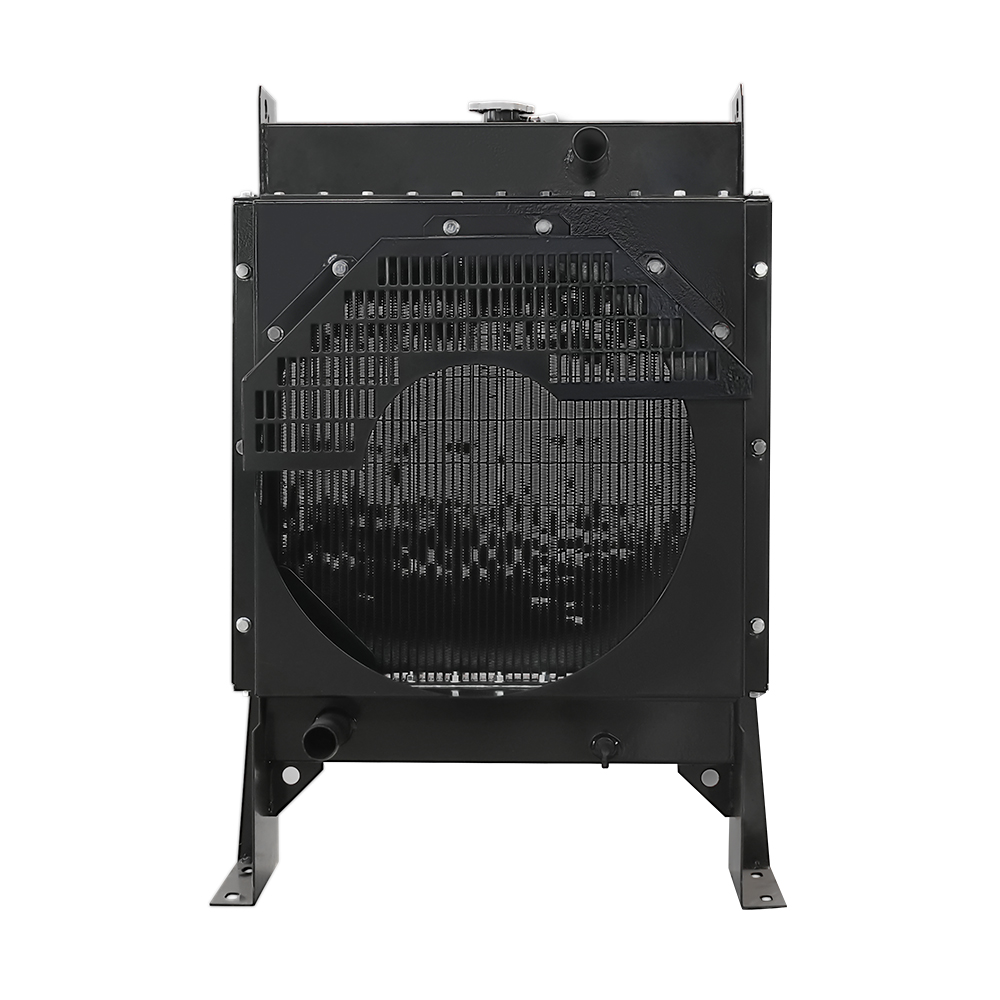
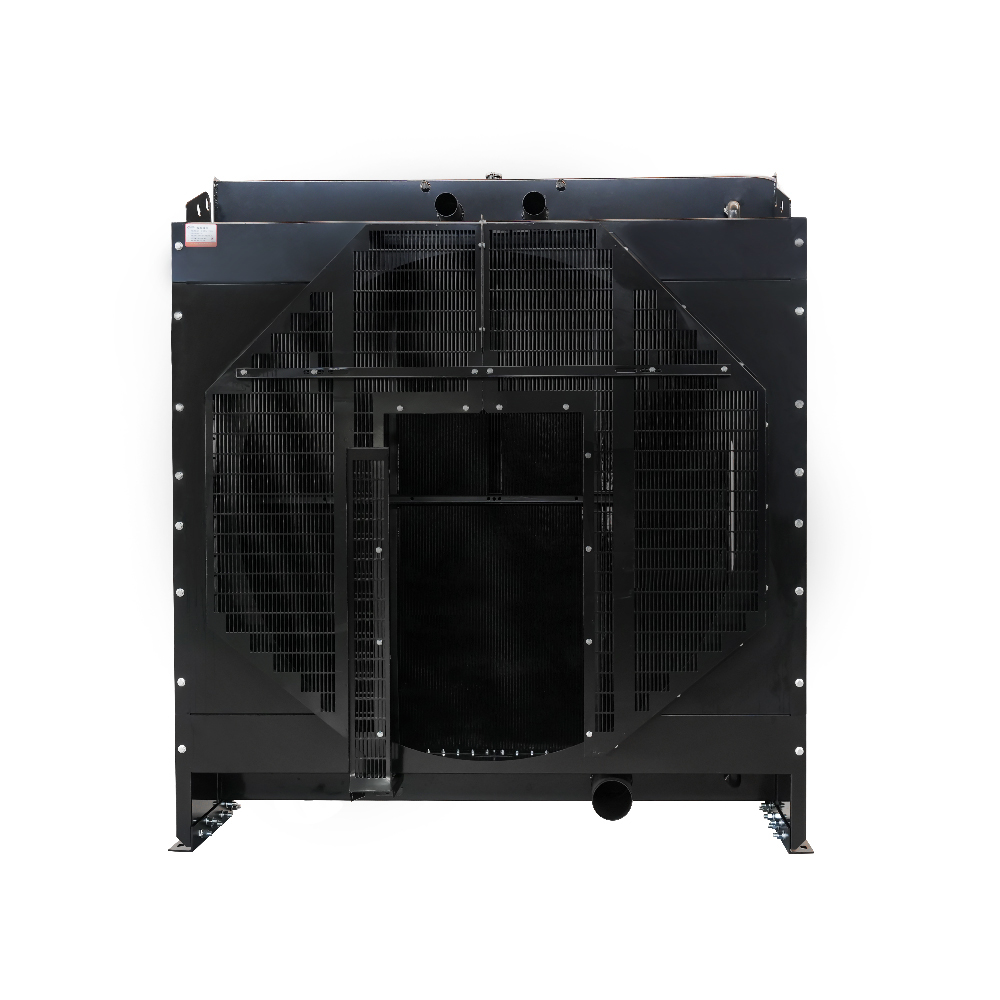
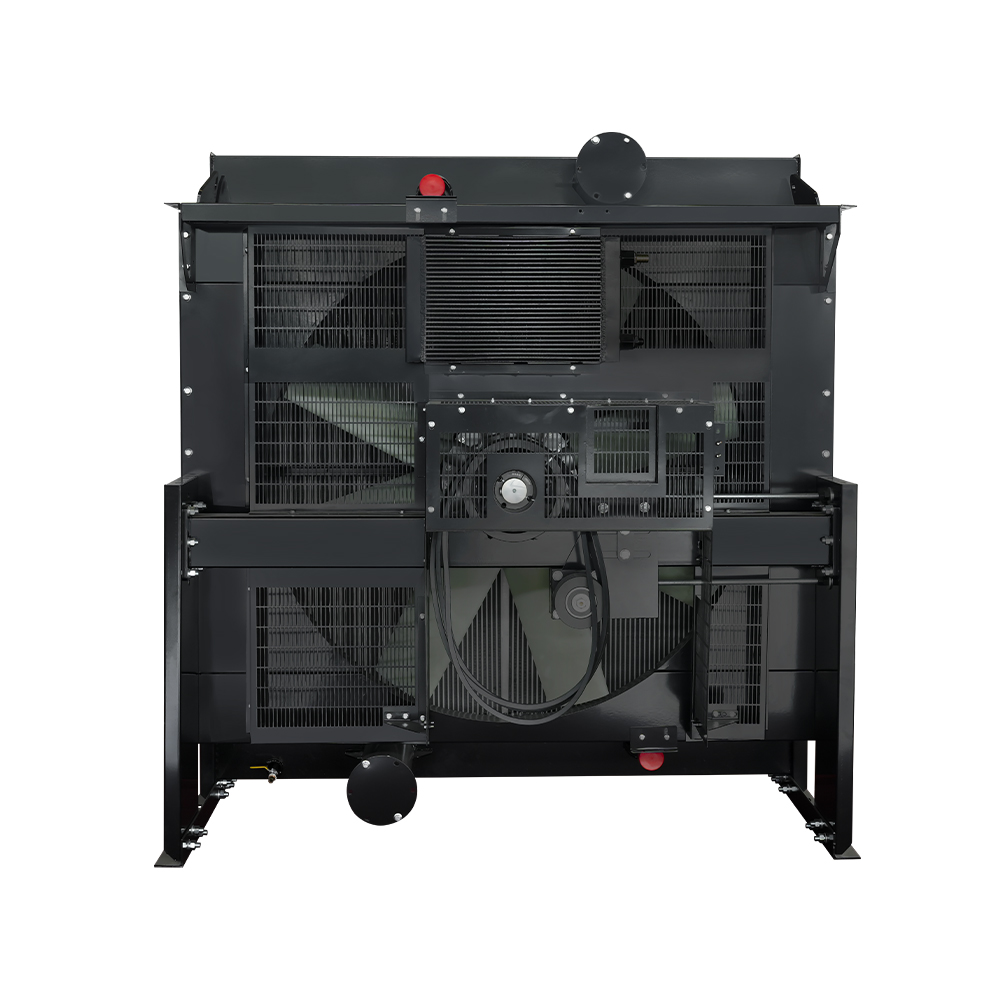
Standby and prime-power generator radiators combine many of these challenges: they sit still for months, then run flat-out for hours. The core must resist internal scaling from stagnant coolant and external blockage from insect nests. A removable debris screen and a zinc or magnesium sacrificial anode in the coolant circuit prevent this. For common engine platforms, dimensional standards help. Our Cummins generator radiator and Perkins Engine radiator pages provide interface dimensions and heat rejection data that shortcut the initial quoting process.
Cost and Lead Time Estimation: What Affects the Price?
Custom radiator pricing scales almost linearly with core size, but three multipliers — joining process, coating, and schedule — create the final figure. The model below uses a baseline price per 100 cm² of core face area for a 2-row tube-and-fin core without coating.
| Cost Element | Multiplier / Adder | Typical Lead Time Impact |
|---|---|---|
| Baseline core (TIG welded, no coating) | 1.00 × base price | 5–10 working days |
| Vacuum-brazed core | +15% | Adds 1–2 days |
| TIG-welded (already included in baseline) | +0% | — |
| Marine epoxy coating | +10% | Adds 3–4 days for curing |
| Rush production (50% faster) | +25% | Deducts 40–50% of build days |
| Extra row (3-row core) | +20–25% | Adds 2–3 days |
| Custom mounting brackets (non-standard) | Quote item | Adds 3–5 days for fabrication |
For a mid-sized, 600 mm × 800 mm face area, 2-row TIG-welded core with basic brackets, expect a price in the low four-figure USD range and a 10-working-day lead time. A fully optioned unit with vacuum brazing, marine coating, and rush delivery can push cost up by 50% while pulling delivery forward by a week.
How to Verify Quality: Testing Standards for Custom Radiators
No specification sheet matters if the radiator cannot hold pressure or deliver the promised heat rejection under load. Reputable manufacturers test every custom unit against these four criteria, referencing SAE J1468 and internal acceptance protocols.
- Pressure integrity test — Pressurize the fully assembled radiator to 2 times the rated working pressure (minimum 200 kPa) for 5 minutes. Zero visible leakage and less than 1% permanent deformation on the tank walls is a pass.
- Flow rate verification — With water at 20°C and a head of 1 meter, measure the coolant-side flow. The actual flow must fall within 10% of the theoretical value for the given tube count and cross-section, confirming that no tubes are blocked.
- Heat rejection calorimeter test (spot check) — Run the radiator on a hot (90°C) water-to-air rig at rated airflow. The measured heat rejection must achieve 95% or better of the design target at the specified air-on temperature.
- Thermal cycle test (for prototype or first article) — Cycle coolant temperature between ambient and 110°C 500 times and repeat the pressure test. This exposes incipient joint fatigue before the unit reaches the field.
Request a copy of the pressure test report and, for critical applications, a heat rejection test certificate. These two documents transform a trust-based purchase into an auditable quality record.

- Product Categories
- Contact Us
-
- wcradiator@jswcsrq.com
- +86-514-400-180-4088
- +86-15152759383
- +86-15152759383
- No. 6 Road, Shaobo Industrial Concentration Zone, Jiangdu District, Yangzhou City, Jiangsu Province, China

