


 English
  русский
  Français
  Indonesia
  عربى
عربى  中文简体
中文简体


Off-Highway Cooling Systems: Guide for Construction, Mining, Agriculture
Content
- 1 What Are Off-Highway Cooling Systems?
- 2 Key Components of Off-Highway Cooling Systems
- 3 Diesel vs. Electric Off-Highway Cooling: What’s Different?
- 4 How to Select a Cooling System for Extreme Environments
- 5 Engine-Off Cabin Cooling: Options and Cost Analysis
- 6 Maintenance Best Practices for Off-Highway Cooling Systems
- 7 Case Study: Cooling System Design for a Mining Excavator
- 8 Making the Right Choice for Your Fleet
What Are Off-Highway Cooling Systems?
A single bulldozer pushing overburden in a copper mine can shed over 500 kW of waste heat in an hour. That energy must be dumped into the atmosphere, and the cooling system is the critical path. Off-highway equipment—machines designed for unpaved surfaces and extreme workloads—demands thermal management far beyond what a highway truck radiator sees.
These systems serve three distinct circuits inside a single machine: engine cooling, hydraulic oil cooling, and cabin climate control. In a typical large frame excavator or articulated dump truck, the engine produces roughly 60% of total heat load, the hydraulic system adds 25%, and the cabin loop accounts for about 15%. Construction sites, open-pit mines, logging trails, and agricultural fields all push cooling components to their limits with high ambient dust, continuous low-speed operation, and frequent torque peaks.
Common off-highway machines include wheel loaders, bulldozers, hydraulic excavators, motor graders, scrapers, combine harvesters, forage harvesters, mining trucks, and drill rigs. Each has a unique heat rejection profile, but all share a need for cooling components that survive vibration, shock loads, and corrosive debris. The design starts with a single rule: assume the worst operating hour of the worst day will repeat itself every shift.
Key Components of Off-Highway Cooling Systems
A cooling system isn’t one radiator. It’s an integrated set of heat exchangers, pumps, fans, and control valves, often stacked as a cooling module. Most off-highway machines run a belt-driven or hydraulically driven fan pulling air through multiple cores: charge air cooler, radiator, hydraulic oil cooler, and condenser. Electric fan drives are gaining ground in hybrid or battery-electric machines, but hydraulic fan drives still dominate in diesel equipment because of their controllability.
The table below breaks down the three primary cooling loops and their typical parameters in a 250 kW diesel-powered wheel loader.
| Cooling Loop | Coolant / Fluid | Typical Fluid Temperature Range | Heat Load Share | Core Heat Exchanger Type |
|---|---|---|---|---|
| Engine coolant loop | 50/50 ethylene glycol-water | 88–105 °C | 60% | Aluminum bar-plate radiator |
| Hydraulic oil loop | ISO VG 46 hydraulic oil | 80–95 °C | 25% | Tube-and-fin oil cooler |
| Cabin HVAC loop | R-134a / R-1234yf refrigerant | Condenser side 50–70 °C | 15% | Parallel-flow microchannel condenser |
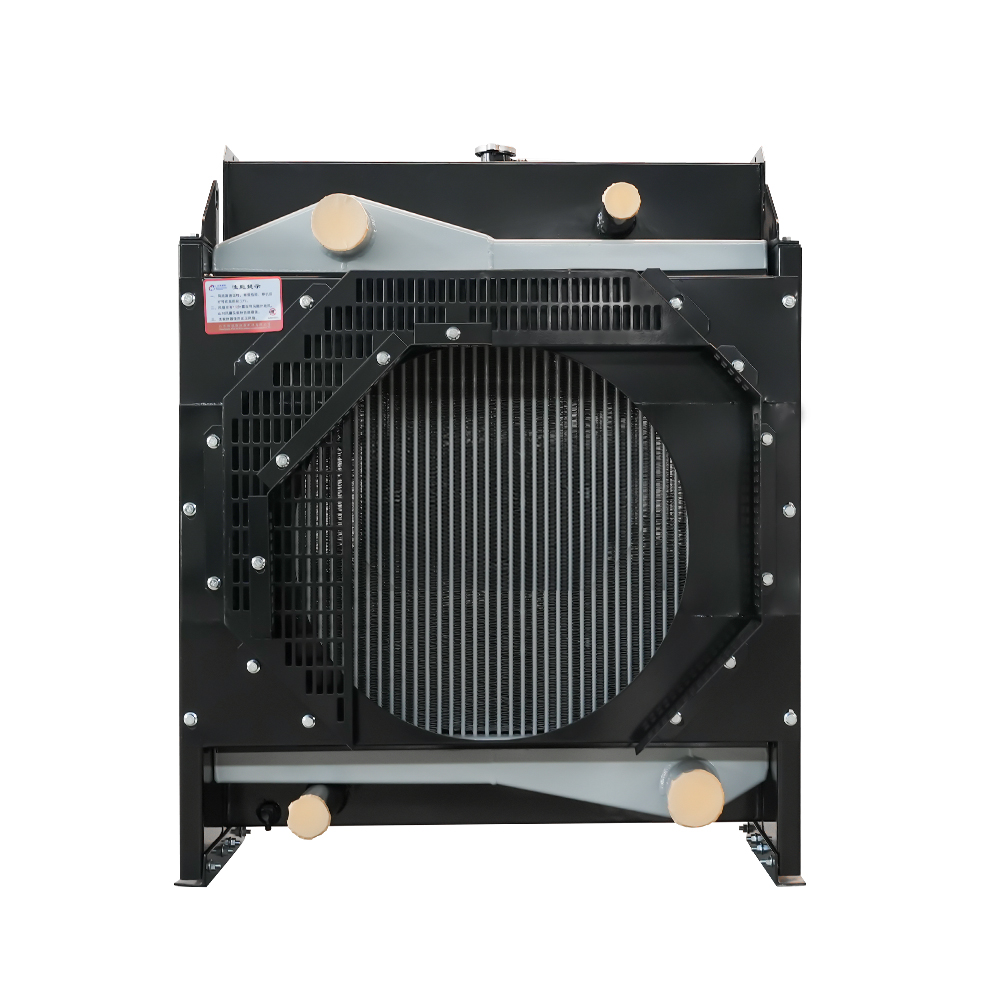
Engine cooling still absorbs most of the thermal design budget. However, hydraulic systems in modern machines generate more heat because of higher system pressures and load-sensing pumps that keep fluid moving even when circuits are idle. This makes the hydraulic oil cooler a primary reliability gate: if it plugs with dust, the machine derates in under 15 minutes. Tube-and-fin construction, with wider fin spacing, often copes better with airborne debris than dense louvered bar-plate cores. For that reason, many OEMs specify a tube-and-fin generator radiator design for auxiliary power units that sit in the same dust cloud.
Diesel vs. Electric Off-Highway Cooling: What’s Different?
A battery-electric excavator does not simply swap the diesel engine for a motor and keep the same cooling package. The thermal architecture flips entirely. A battery electric vehicle (BEV) demands multiple isolated cooling loops, each with its own temperature window, pump strategy, and coolant chemistry. Diesel cooling systems typically manage one target temperature band near 95 °C. Electric machines must manage a motor-inverter loop at 65–75 °C, a battery loop at 25–40 °C, and sometimes a separate cabin heat pump circuit.
Here are five specific differences that change the engineering of an off-highway cooling module when moving from diesel to electric.
- Coolant temperature targets drop by 20–30 °C – While a diesel radiator sees 95 °C inlet, an electric motor drive coolant rarely exceeds 70 °C. This lower approach temperature to ambient demands a larger radiator face area or higher airflow for the same heat rejection.
- Number of cooling loops increases from 1–2 to 3–4 – A BEV off-highway machine typically separates motor, battery, power electronics, and cabin HVAC into independent circuits. Cross-contamination of temperature bands kills battery life.
- Pump power shifts from mechanical to electric – Diesel cooling pumps are belt-driven and parasitic to engine rpm. Electric drives use variable-speed electric water pumps that consume up to 600 W each but can be staged precisely.
- Fan control becomes algorithmic rather than thermostatic – Electric machines rely on the vehicle control unit (VCU) to anticipate heat build-up from upcoming duty cycles, rather than simply reacting to a wax-thermostat valve.
- Coolant chemistry adapts to low-conductivity fluids – Battery cooling loops cannot use standard ethylene glycol mixes that carry ionic contamination. Low-conductivity coolants with dielectric properties are mandatory to prevent cell short circuits.
The shift also impacts service intervals. Electric coolant loops remain sealed longer, but any breach in a low-conductivity system demands a full fluid flush and a sealed refill procedure that most field mechanics are only beginning to learn.
How to Select a Cooling System for Extreme Environments
Standard catalog radiators fail fast in desert mines, Arctic logging camps, or high-altitude construction sites. Altitude thins the air, reducing a fan’s mass flow by roughly 1% for every 100 m above 1,000 m. Ambient temperatures above 45 °C push the approach temperature to the point where a radiator needs a 15–20% larger core area for every additional 10 °C rise. In a copper mine at 2,500 m with daytime peaks of 43 °C, a cooling system must be sized for both thin air and high ambient temperature simultaneously.
A practical selection framework starts with three adjustments.
- Increase core face area – For every 10 °C ambient temperature increase beyond 38 °C, add 15–20% core area. At 50 °C, a machine originally designed for a 0.9 m² core may need 1.3 m².
- Choose the right fin geometry – Straight fins with a pitch of 3.0–4.0 mm resist clogging far better than louvered fins at 2.0 mm. In sandy environments, tube-and-fin cores with wide fin spacing lower air-side pressure drop and are easier to blow out with compressed air.
- Switch to all-aluminum welded construction – All-aluminum radiators with brazed or welded headers withstand the torsional flex of an off-road chassis far better than plastic-tank designs. In -40 °C cold starts, aluminum’s ductility prevents plastic header crack failures.
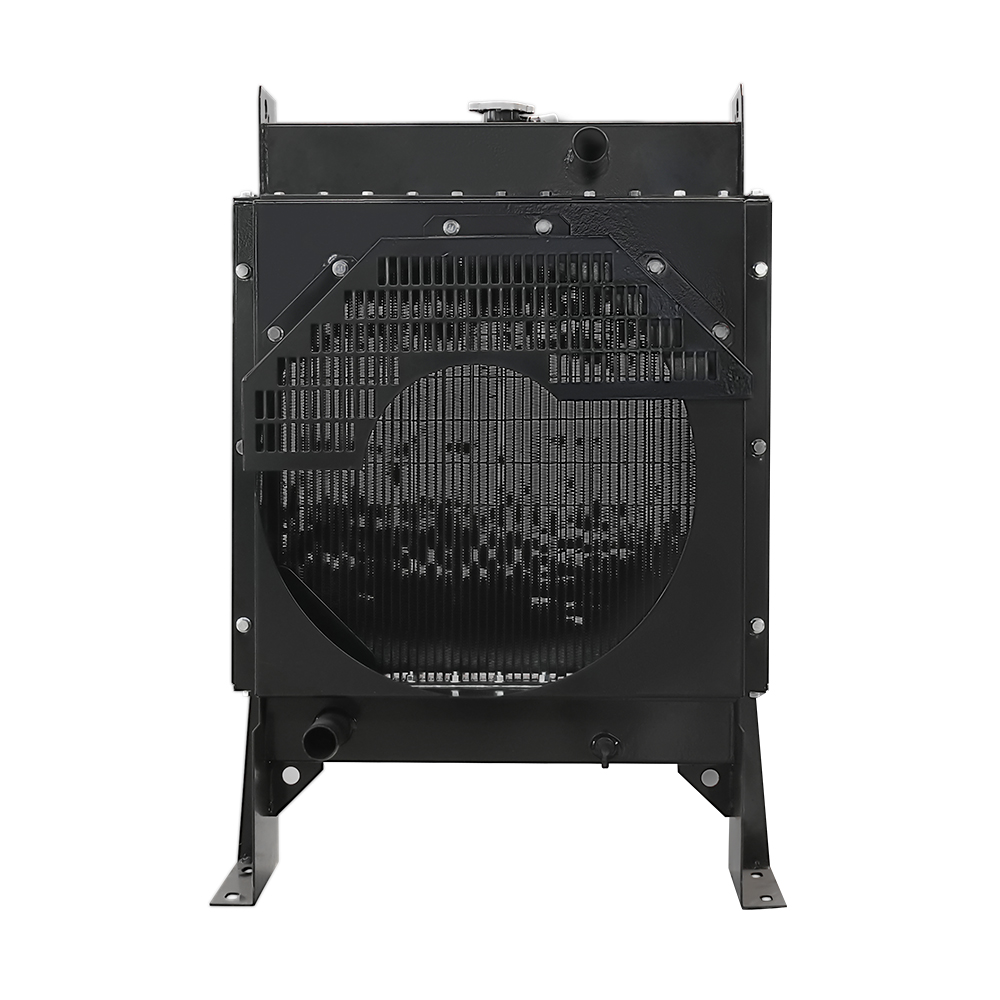
For Arctic operations, coolant freeze protection drives system design. A 60/40 ethylene glycol-water mix lowers the freeze point to -52 °C, but also reduces heat transfer capacity by roughly 8% compared to a 50/50 mix. Adding a thermostatically controlled recirculation loop that bypasses the radiator until the engine warms up becomes necessary to prevent slush formation in the core.
Engine-Off Cabin Cooling: Options and Cost Analysis
In many off-highway duty cycles, the engine idles for extended periods just to keep the operator cool. Idling consumes 1–2 liters of diesel per hour, racks up engine hours, and accelerates oil degradation. Engine-off cooling solutions directly attack this waste, but the right technology depends on the required cooling duration and budget.
The table below compares three common approaches.
| Technology | CapEx (Relative) | OpEx Impact | Best Fit Duration | Main Considerations |
|---|---|---|---|---|
| Battery-driven independent A/C | High | Low – eliminates idle fuel; battery recharges during machine operation | 5–90 minutes | Adds 80–120 kg; requires dedicated battery pack and thermal management |
| Phase-change material (PCM) storage | Medium | Very low – zero fuel, zero moving parts after initial charge | 15–30 minutes | Weight penalty (40–60 kg); only cools while phase change lasts; limited to short breaks |
| Engine idle with elevated fan speed | Low – baseline system | High – burns 1–1.5 L diesel per hour; increases service hours | Unlimited | No extra hardware but violates anti-idle regulations in some regions |
Data from Webasto field studies confirms that cooling intervals of 5 to 90 minutes cover over 90% of off-highway equipment downtime periods. For a mining truck that waits 12 minutes at a shovel seven times a day, a battery-driven A/C unit pays for itself in diesel savings within 18 months, while also cutting engine idle hours by 500–700 per year.
Maintenance Best Practices for Off-Highway Cooling Systems
Cooling system neglect is the fastest path to an unscheduled engine teardown. Off-highway equipment runs in an envelope where radiator fins become air filters by accident. A visible layer of dust on the surface of the core reduces airflow by 20–30% before an operator ever sees a warning light.
A disciplined maintenance schedule tied to operating hours preserves cooling capacity and prevents costly derates.
- Every 500 hours – Inspect fin condition on all heat exchangers. Blow out debris with compressed air from the engine side outward, never from the ambient side inward. Check fan belt tension and hydraulic fan motor leak lines.
- Every 1,000 hours – Drain and replace engine coolant. Flush the system with deionized water before refilling. Inspect hoses for swelling or cracks near clamps. Test the pressure cap.
- Every 2,000 hours – Pressure-test the radiator core and oil cooler circuits. Measure fan blade tip clearance and rebalance if needed. Replace coolant filters and check low-conductivity coolant conductivity in electric machines.
One overlooked indicator is the temperature differential across the radiator. A difference of less than 5 °C between inlet and outlet under load often means internal scaling is insulating the tubes, not external blockage. A chemical flush may restore efficiency if caught before tube failure.
Case Study: Cooling System Design for a Mining Excavator
Consider a 70-ton tracked excavator working at 2,200 m altitude in an open-pit mine with ambient temperatures reaching 46 °C in July. The machine uses a Cummins generator radiator-style engine module, but the full system must be designed from first principles.
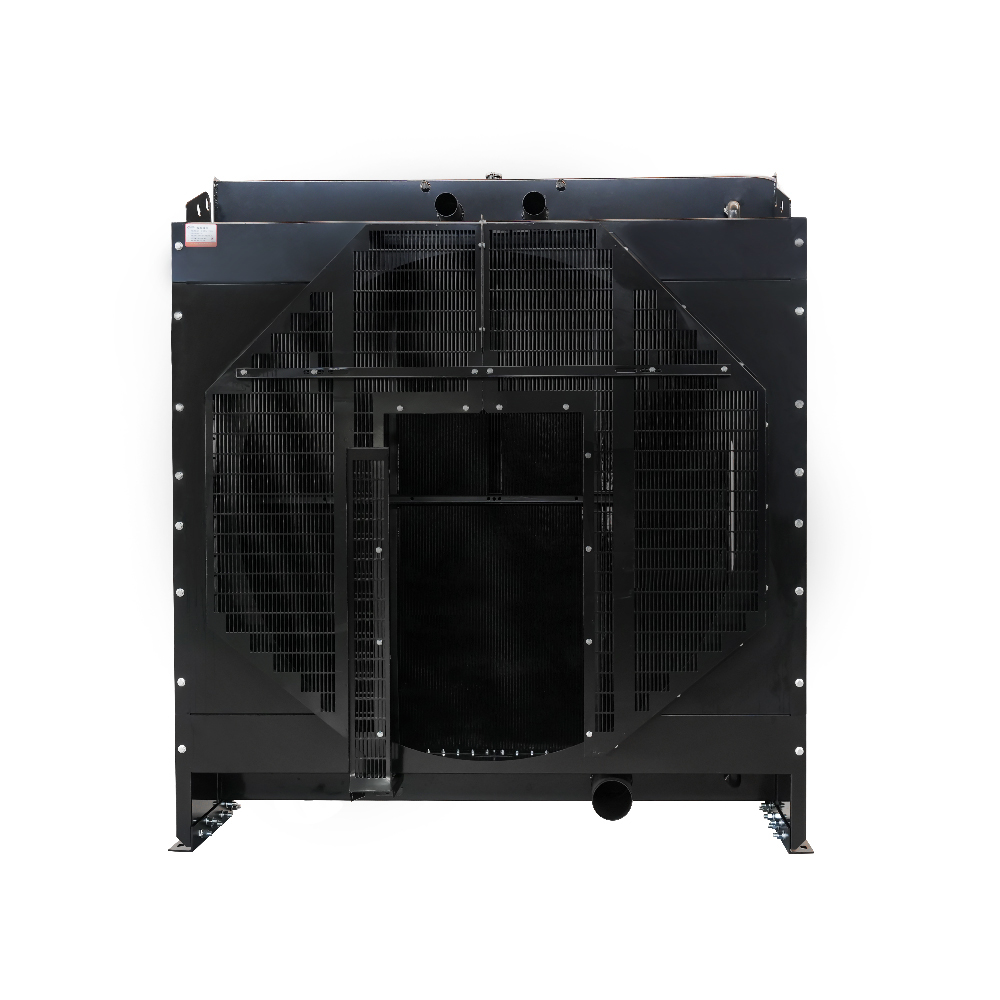
The engine rejects 180 kW to the coolant at rated power. The hydraulic system adds another 65 kW through the oil cooler. The condenser for cabin A/C adds 15 kW. Total heat rejection requirement: 260 kW. At 46 °C ambient, an aluminum bar-plate radiator with a core face area of 1.6 m² and air flow of 6.2 kg/s can handle 215 kW with a coolant inlet temperature of 98 °C. But the other loads demand separate cores.
The solution is a dual-circuit cooling module: the primary circuit cools the engine with a high-capacity radiator, while a secondary low-temperature circuit handles hydraulic oil and charge air cooling with a dedicated tube-and-fin oil cooler. A hydraulically driven suction fan with a variable-speed controller pulls air through both modules. Fan speed ramps based on a map of engine rpm, oil temperature, and intake manifold temperature. To survive cold starts at -25 °C, the system includes a thermostatic bypass that keeps coolant out of the radiator until the engine reaches 75 °C.
Field data after 3,000 operating hours shows coolant temperature stability within ±3 °C of target, zero hydraulic overheat events, and a radiator pressure drop increase of only 8%, confirming the selected fin spacing was appropriate for the dust load.
Making the Right Choice for Your Fleet
Off-highway cooling decisions cascade into fuel consumption, machine uptime, and operator comfort. The right starting point is always a thermal duty cycle analysis based on measured or simulated heat rejection curves, not on a catalog’s “max cooling capacity” number that assumes clean sea-level air.
For mixed fleets running in multiple environments, modular cooling packages with replaceable cores and adjustable fan drives offer the most flexibility. When adding electrified equipment, plan for low-conductivity coolant training and new pump monitoring routines. And in any severe dust or debris setting, prioritize fin geometry and core material selection over price per square meter. The difference between a blocked radiator and a clean one is often a single maintenance interval that was skipped.

- Product Categories
- Contact Us
-
- wcradiator@jswcsrq.com
- +86-514-400-180-4088
- +86-15152759383
- +86-15152759383
- No. 6 Road, Shaobo Industrial Concentration Zone, Jiangdu District, Yangzhou City, Jiangsu Province, China

