


 English
 русский
 Français
 Indonesia
 عربى
 中文简体


Emergency generators commercial: Applications, Selection Criteria, and Practical Guidance
Content
- 1 What Commercial Emergency Generators Are Really Asked to Do
- 2 Reading the Load Profile Before Choosing a Radiator
- 3 Radiator Configurations for Standby Duty
- 4 When the Generator Lives Inside an Enclosure
- 5 Heat, Salt, and Dust: Site Conditions That Eat Margin
- 6 Getting the Fit Right Against the Engine
- 7 Maintenance That Keeps a Backup a Backup
- 8 What We Ask Before Sizing a Radiator
Nobody buys a commercial emergency generator because they enjoy generators. They buy one because a dark data hall, a stalled elevator, or a warming cold store costs far more in an afternoon than the machine cost in total. That makes a standby set a promise, and promises in this industry are kept or broken by details nobody thinks about until the day they matter. Cooling is one of them.
We build generator radiators for a living, so this is the conversation we have most often: will the engine still be sitting at a safe temperature in the sixth hour of an outage, on the hottest afternoon of the year, with dust on the core and a load that stepped up faster than anyone expected? Here is how we approach that question for commercial buildings.
What Commercial Emergency Generators Are Really Asked to Do
Emergency and standby systems usually fall into two rough families. Legally required systems carry life-safety loads such as egress lighting, fire pumps, smoke control, and alarm panels. They are expected to start within seconds and keep running for as long as the incident lasts. Optional standby systems carry business loads instead: server rooms, refrigeration, checkout lanes, lifts, production lines, and water pumping.
Both are judged differently from a prime power plant. A prime-rated set working three shifts is designed for steady, predictable output. An emergency set is designed to do nothing for eleven months and then deliver its full rating without hesitation, often at two in the morning, often while somebody stands beside it with a torch. Everything in the package, from starting batteries to the alternator and the cooling system, has to be comfortable with that rhythm.
Cooling is awkward because it is sized for a duty point rather than a moment. That duty point has to hold through load steps, rising ambient temperature, restricted airflow inside an enclosure, and the slow accumulation of dust and scale. When it does not, the set derates or shuts down, and an outage that was supposed to be invisible becomes the story.
Reading the Load Profile Before Choosing a Radiator
Before anyone argues about core types, it helps to know what kind of building the generator is protecting. The load band, the expected run length, and the site conditions together decide how much margin a radiator needs. The table below is the shorthand we use in early conversations.
| Facility type | Typical standby load band | Cooling consideration at design stage |
|---|---|---|
| Data hall or telecom room | 500 to 2000 kW | Sustained dense load, tight ambient limits, remote radiator often preferred |
| Hospital or clinic | 400 to 1250 kW | Quiet operation, long unattended runs, easy core inspection |
| Cold store or food plant | 300 to 1000 kW | High local heat, dust, generous service access |
| Retail mall or supermarket | 250 to 800 kW | Compact footprint, enclosure airflow, noise limits |
| Warehouse or logistics hub | 200 to 600 kW | Abrasive dust, vibration, simple maintenance |
| Water treatment or pumping station | 150 to 600 kW | Variable load steps, remote and unmanned sites |
Two rows matter more than they look. A dense, sustained load in a data hall or a cold store leaves no room for a cooling system running at its limit; those sites want headroom. And any site where the generator must run unattended for hours needs cores that can be inspected and cleaned quickly, because the maintenance visit you cannot make is the one that causes the failure.
Radiator Configurations for Standby Duty
Most commercial standby sets arrive with an engine-mounted radiator, and for plenty of buildings that is the right answer: one package, one supplier, one warranty, and a simple installation.
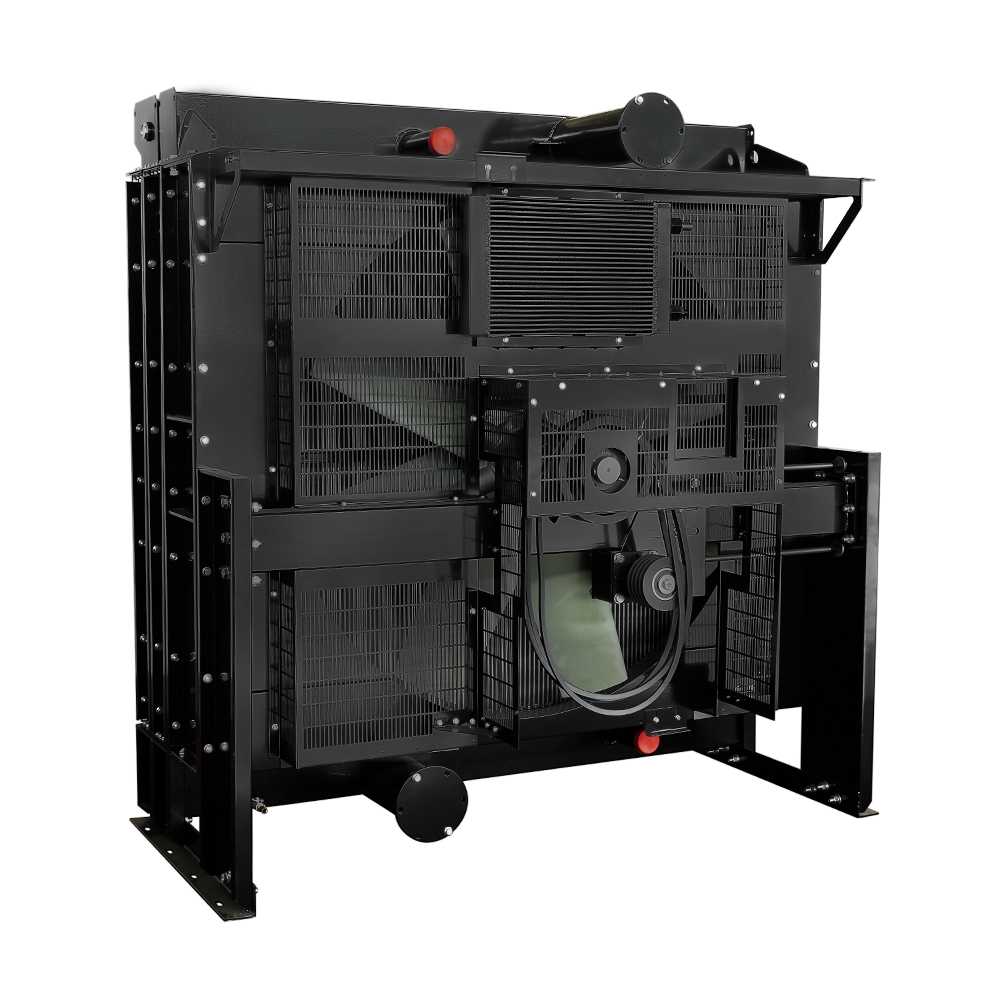 Emergency Standby Generator RadiatorsEngine-mounted radiators for standby generators, with aluminium or copper cores, 20–1500 kW cooling capacity, and OEM replacement or retrofit mounting options.View Product →
It is not the only answer. When the plant room is tight, when the acoustic canopy cannot pass enough air, or when a radiator would sit in a hot recirculating pocket, a remote or separated radiator moves heat rejection outside the room and changes the whole airflow problem. A heat exchanger becomes interesting on sites with a dependable raw water supply. Each option shifts fan power, static head, coolant volume, and the pipework the installer has to run.
For emergency standby duty specifically, we tend to over-size the core slightly and keep the fin pitch open enough to tolerate dust. A radiator a little larger than the duty point costs less than the service call that follows a nuisance trip.
When the Generator Lives Inside an Enclosure
Sound attenuation and heat rejection compete for the same cubic metres. Louvres, baffles, and turning vanes all restrict airflow, and every restriction moves the fan further along its curve. The common mistake is specifying a standard core and assuming the canopy fans will cope; the honest method is to calculate the pressure drop of the entire air path and choose core face area from there.
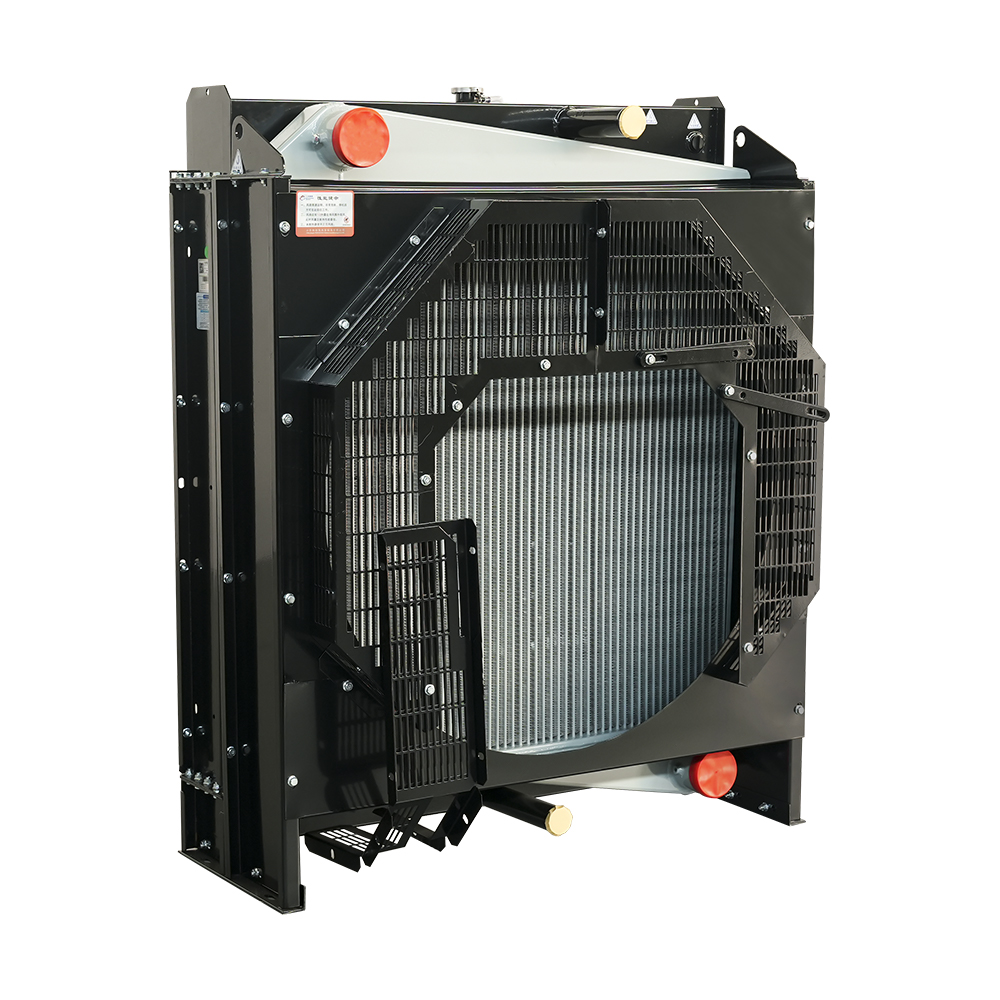 Silent Generator RadiatorsIntegrated radiators for soundproofed generator enclosures, balancing heat rejection with noise reduction and available in 20–1500 kW capacities.View Product →
Silent-rated sets also run hotter inside the canopy, because hot air leaving the core can short-circuit back to the intake when discharge ducting is too short or the canopy has no baffle. On tight urban sites we usually prefer a slightly taller canopy with a clean discharge path over a denser core and a bigger fan.
Heat, Salt, and Dust: Site Conditions That Eat Margin
Radiator ratings are quoted at a reference ambient, often 40 degrees Celsius. Sites in desert regions routinely see 45 to 50, and a core selected at 40 will not reject the same heat at 48. Altitude works the same way on the air side. Coastal installations add salt-laden air, which is a coating and material question rather than a surface-area question, while mining and construction sites add abrasive dust that blocks fins from the outside in.
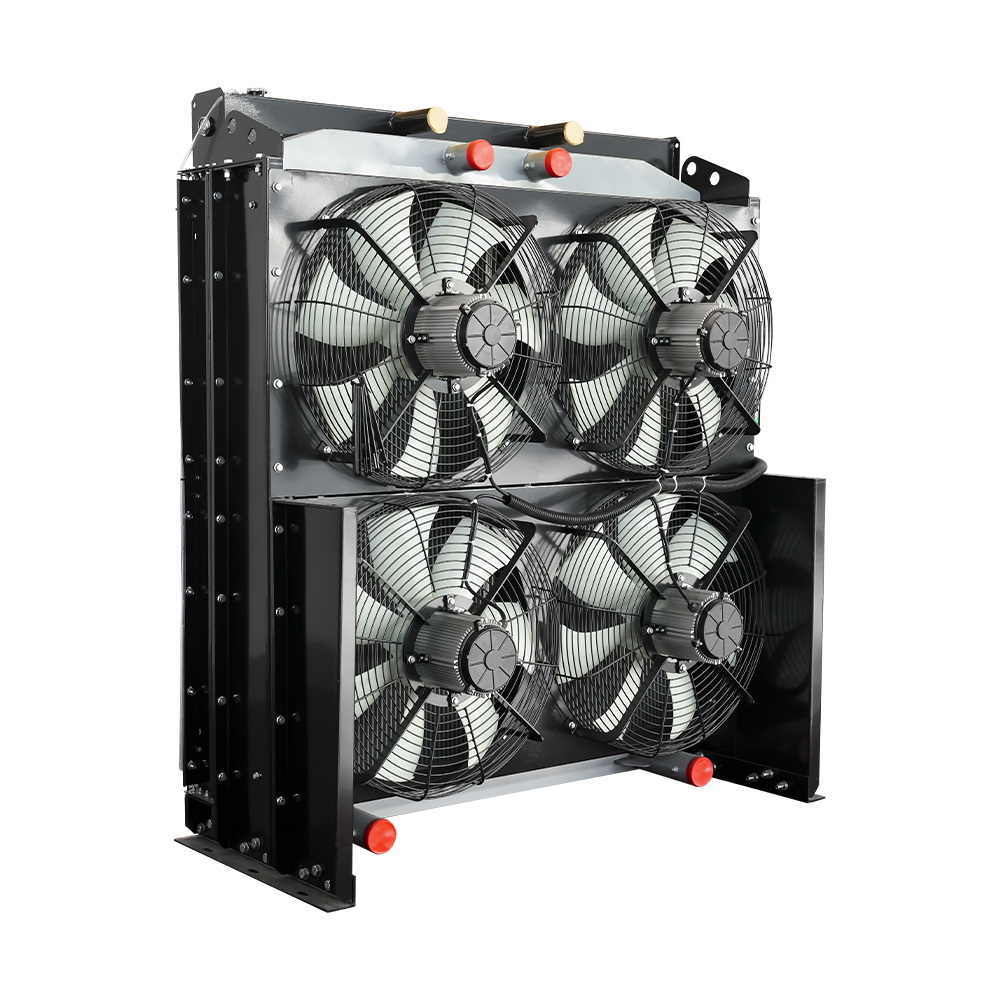 Desert High-Temperature Generator RadiatorsRadiators engineered for desert heat with enlarged cores, high-capacity fans and sand-resistant wide-fin spacing for reliable cooling up to 60°C.View Product →
The practical response is to treat ambient temperature, altitude, and air quality as design inputs rather than afterthoughts. Coating selection, fin pitch, and core thickness all shift once those three numbers are on the table.
Getting the Fit Right Against the Engine
A radiator is a matched part. The same engine family can carry different cores depending on rating, fan ratio, and the OEM's packaging, and two cores that look identical from outside can differ in rows, fin pitch, and inlet position. That is why our first questions are always about the engine tag rather than the radiator.
We hold drawings and tooling for a long list of engine families, which means most replacement enquiries can be matched to an existing pattern instead of being re-engineered from scratch. Where there is no match, we build to sample or drawing. Either way, the fit is confirmed on mounting points, hose positions, and fan centre height before anything is cut.
Maintenance That Keeps a Backup a Backup
A standby generator is only as reliable as its last test. Monthly no-load runs prove the set starts; annual load-bank tests prove it can carry the building. In between, the cooling system needs three things: clean cores, correct coolant chemistry, and a pressure cap that still holds its rating.
We have written a longer piece on the routine tasks that help extend radiator service life, including the checks most often skipped in commercial buildings. The short version is that scale, silt, and the wrong additive mix cause more emergency overheating than mechanical failure does.
What We Ask Before Sizing a Radiator
Whether you are an OEM packaging a new set, a facility team replacing a leaking core, or a contractor quoting a retrofit, the same handful of details decides the answer:
- Engine make, model, and whether the rating is standby or prime
- Design ambient temperature and site altitude
- Mounting method: engine-mounted, remote, or inside an enclosure
- Coolant type, connection sizes, and pipe routing
- Fan drive ratio and available fan power
- Photos of the existing core, or a part number and measured dimensions
Send those across and you will usually get a dimensional proposal back quickly, with the reasoning attached rather than just a price. If you would rather talk it through first, our team is always glad to walk through it with you.
Commercial emergency generators are quiet equipment. They sit in plant rooms and car parks for years doing nothing, and they are judged entirely on the handful of hours when everything else has failed. Getting the cooling right is not the most visible part of that preparation, but it is one of the few parts that decides whether the promise holds. That is the work we do, and we are glad to do it alongside you.

- Product Categories
- Contact Us
-
- wcradiator@jswcsrq.com
- +86-514-400-180-4088
- +86-15152759383
- +86-15152759383
- No. 6 Road, Shaobo Industrial Concentration Zone, Jiangdu District, Yangzhou City, Jiangsu Province, China

