


 English
 русский
 Français
 Indonesia
 عربى
 中文简体


Genset coolant: Applications, Selection Criteria, and Practical Guidance
Content
- 1 What Genset Coolant Is Actually Doing
- 2 Base Fluid and Additive Package: Reading the Label
- 3 Comparing the Main Coolant Families
- 4 Mix Ratio, Water Quality and the Error Everyone Makes
- 5 Site Conditions Change the Answer
- 6 Watching Coolant Over Time
- 7 Mistakes We See Most Often
- 8 When the Coolant Is Telling You the Radiator Is Tired
Ask five people in a maintenance workshop what genset coolant should be and you will usually collect five answers: green, red, pink, plain water in an emergency, or "whatever was left in the drum." That gap between opinion and specification is where most cooling problems begin. Coolant is a working fluid, not a top-up commodity. In a diesel genset it carries heat away from the liners and cylinder head, holds that heat under pressure until it reaches the radiator, keeps the block free of scale and corrosion, and quietly lubricates the water pump seal. Get it right and the cooling system becomes boring, which is exactly what you want from a standby set that has to start at two in the morning.
What Genset Coolant Is Actually Doing
Water alone is a remarkably good heat-transfer fluid. It is also a remarkably good way to destroy an engine. A 50/50 glycol and water mix does four jobs at once. It lowers the freeze point to roughly -37 °C, so a cold snap cannot crack a block or a core. It lifts the boiling point from 100 °C to about 106–108 °C at atmospheric pressure, and to roughly 125–130 °C once the system is sealed under a 1 bar cap. That margin matters more than the gauge suggests, because localised boiling at the liner surface creates vapour pockets and hot spots even when the temperature reading looks calm.
The additive package is the second job. It holds scale and corrosion in check across a mixed-metal loop of cast iron, aluminium, brass and solder, and it keeps the water pump seal lubricated. The third job is cavitation protection, which is where coolant specification starts to matter a great deal on wet-sleeve diesel engines.
Base Fluid and Additive Package: Reading the Label
Ethylene glycol versus propylene glycol
Both are glycols, but they behave differently. Ethylene glycol is the default for generator sets: better heat transfer, stronger freeze protection per unit of volume, lower cost. Propylene glycol is noticeably less toxic, which matters where spill risk reaches soil, drains or water, but it needs a higher concentration for the same freeze point and it carries heat less efficiently, so the system runs with a slightly narrower margin. Switching between the two without recalculating the mix is a common and avoidable mistake. How glycol is stored, handled and disposed of matters as much as which one you buy, and our ethylene glycol handling and safety guide goes further into that side of the job.
The additive package
Conventional chemistry leans on silicates, phosphates, borates and usually nitrite to protect iron and aluminium while suppressing scale. Extended-life organic acid technology replaces most of that with organic acid salts, which gives a longer service life and cleaner heat-transfer surfaces, but some formulations are softer on cavitation protection unless a nitrite or molybdate component is specified. Hybrid coolants sit between the two. The practical rule is simple: use what the engine manufacturer validated for that engine family, because liner protection, seal compatibility and aluminium passivation were all tested against a specific chemistry, not a colour.
Cavitation and wet-sleeve liners
In a wet-sleeve engine, combustion pulses make the liner wall vibrate. That vibration boils microscopic amounts of coolant at the outer surface, and the collapsing bubbles erode the liner. Supplemental coolant additives build a protective film that resists this. On a genset that runs long hours at light load, the effect is amplified, because low-load running produces more vibration and sharper load swings. Test strips keep the additive inside its working range — overdosing is as harmful as neglect, since excess solids drop out of suspension and settle in the core.
Comparing the Main Coolant Families
Most of the generator sets we see fall into one of five fluid families. The table below is a starting point for a conversation with the engine manual, not a replacement for it.
| Coolant family | Additive chemistry | Typical service interval | Where it fits | Watch out for |
|---|---|---|---|---|
| Conventional low-silicate with SCA | Silicate and phosphate base plus nitrite and molybdate | 2 years or 2,000–3,000 hours with strip testing | Older wet-sleeve engines whose manual calls for supplemental additives | Additive depletes quietly; test every 500 hours or six months |
| Extended-life OAT | Organic acid salts, silicate-free | Up to 6,000 hours or 4–6 years with an extender | Modern engines approved for OAT; larger fleets | Some formulations need a nitrite boost for liner protection |
| Hybrid HOAT | OAT base with a small silicate dose | 3,000–5,000 hours | Mixed fleets and aluminium-heavy cooling systems | Blending with pure OAT blurs the chemistry |
| Propylene glycol | Same additive families, different base fluid | Same as the base family | Sites with spill sensitivity or groundwater concerns | Higher mix ratio needed; weaker heat transfer |
| Water only (emergency) | None | Days, not months | Getting a unit back to the workshop | Scale, corrosion and early pump seal failure |
Mix Ratio, Water Quality and the Error Everyone Makes
Concentration is a trade-off curve, not a straight line. Around 30 percent glycol is the practical floor for additive carry and pump protection. Fifty percent is the sensible default for most sites. Sixty percent is close to the ceiling, because beyond that heat transfer drops and additives begin falling out of suspension. Push past roughly 70 percent and freeze protection actually gets worse, which is the opposite of what the person topping up with neat concentrate intended.
Water quality is the second half of the mix and the half that gets skipped. Distilled or deionised water is the safe choice. Hard water leaves calcium deposits on core tubes that no flush will fully remove, and elevated chloride accelerates corrosion from the inside. Where field water is unknown, pre-mixed coolant removes the variable entirely; the freight cost is usually smaller than the cost of a scaled core. When mixing on site, keep the loop closed and clean: a dirty funnel is a contamination source.
Site Conditions Change the Answer
Ambient conditions shape both the fluid choice and the metal around it. A desert site brings high daytime air temperature and a wide day-night swing, so the margin between normal running temperature and boiling narrows quickly. Operators there often move to a slightly richer mix, verify the pressure cap rating, and confirm the radiator can still reject heat at design ambient. Radiators built for that duty, with oversized cores and high-temperature coatings, carry much of that load; our
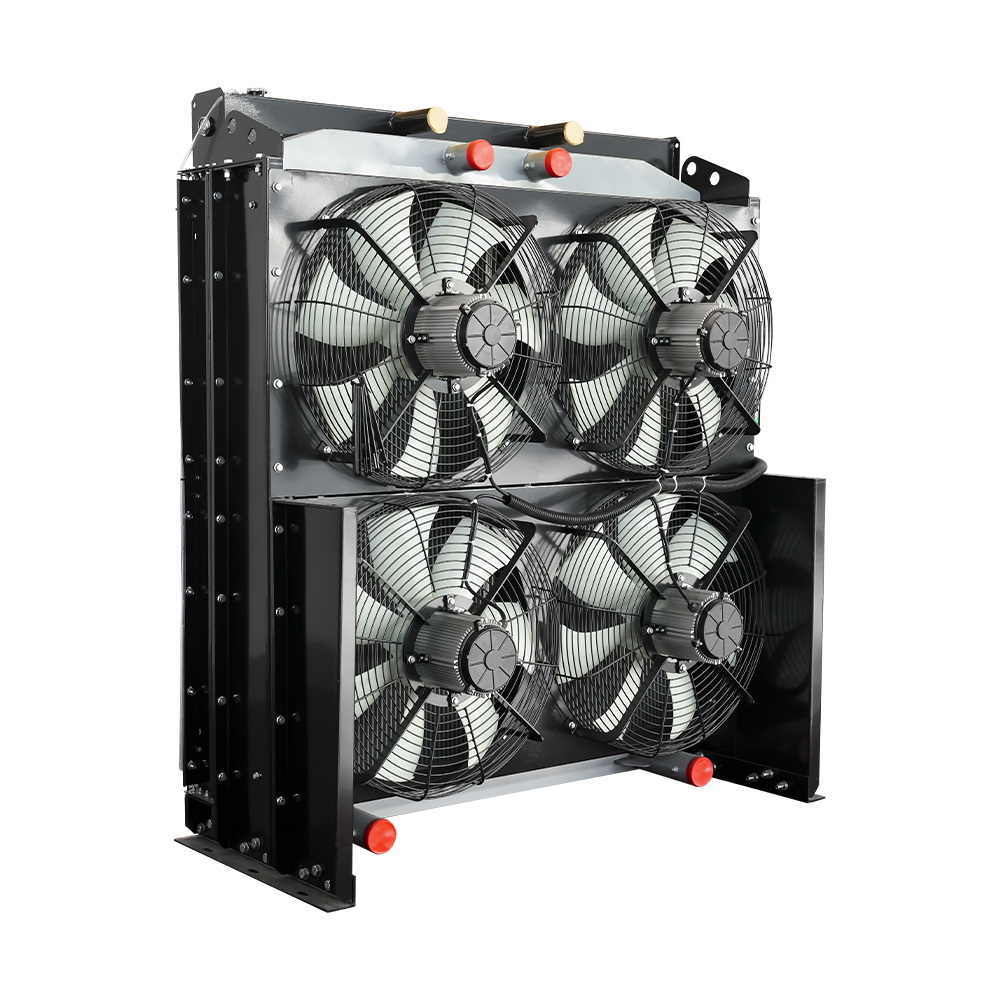 Desert High-Temperature Generator Radiators for Extreme Ambient ConditionsEngineered for desert generator sets above 50°C, with enlarged cores, high-capacity fans and sand-resistant coatings to help maintain stable engine temperatures.View Product →
Coastal and offshore sites flip the problem. The coolant chemistry can be perfectly correct while salt-laden air attacks the radiator from the outside and chloride contamination creeps into the loop through a tired cap or a weeping hose. Keep the system sealed, inspect hoses annually, and treat any unexplained coolant loss as a fault to find rather than a level to top up.
Watching Coolant Over Time
A sample bottle and a test strip cost far less than a head gasket. On standby sets that accumulate only 100–200 hours a year, calendar time matters more than running hours, so a six-monthly check is the right rhythm. What to look at:
- Glycol concentration, measured with a refractometer rather than a guess
- pH, which should stay mildly alkaline; a drop toward neutral hints at additive depletion
- Supplemental additive level, where the specification calls for one
- Appearance: sludge, rust tint, or an oil sheen that points to an internal leak
- Reserve alkalinity and conductivity, if the lab report includes them
Keep a simple log. Trends tell you more than a single reading, and a rising temperature under steady load, paired with clean coolant, usually points at the radiator rather than the fluid.
Mistakes We See Most Often
- Topping up with neat concentrate, pushing glycol above 60 percent
- Mixing an organic acid coolant with a conventional one, which can gel and drop additives out
- Using automotive coolant in a heavy diesel as a permanent solution
- Filling with tap water because it is available and the engine is "only a backup"
- Ignoring the pressure cap, which quietly lowers the boiling point
- Assuming an old "water only" habit still applies to a modern engine
When the Coolant Is Telling You the Radiator Is Tired
Sometimes the fluid is fine and the problem is the metal. Repeated sludge that returns after a flush, scale that will not shift, solder bloom around the seams, or a slow weep at the bottom tank all point the same way. So does a temperature that climbs under load while the coolant tests clean. At that stage the question is repair or replace, and the economics usually favour replacement once tubes have softened or a core has been rodded twice.
For ageing units where the original part is no longer available, a matched replacement keeps the set in service without compromising the rest of the loop. Our replacement solutions route is built around exactly that situation.
 Industrial Generator Radiators for Continuous and Prime-Power SetsHeavy-duty radiators for continuous or prime-power gensets, with reinforced tanks, customizable cores and options suited to matched replacement in ageing industrial units.View Product →
Coolant is the cheapest component in the cooling system and the most influential one. Choose the chemistry the engine was validated for, mix it with water you would be willing to drink, keep the concentration in the sensible band, and test it twice a year whether the hour meter moved or not. That routine will not make a genset interesting, and it is not supposed to. It keeps the set ready, the radiator clean, and the maintenance budget predictable — which is how a cooling system should behave.

- Product Categories
- Contact Us
-
- wcradiator@jswcsrq.com
- +86-514-400-180-4088
- +86-15152759383
- +86-15152759383
- No. 6 Road, Shaobo Industrial Concentration Zone, Jiangdu District, Yangzhou City, Jiangsu Province, China

