


 English
  русский
  Français
  Indonesia
  عربى
عربى  中文简体
中文简体


Industrial Custom Aluminum Radiators: A Complete Guide for Generator & Heavy Equipment
Content
- 1 Why Choose a Custom Aluminum Radiator?
- 2 Key Parameters for Custom Aluminum Radiator Design
- 3 All-Aluminum vs. Aluminum-Plastic: Which Material to Choose?
- 4 The Custom Order Process: From Drawing to Delivery
- 5 Custom Radiators for Extreme Environments: Desert, Coastal & Mining
- 6 Cost Factors & Typical Lead Times for Custom Aluminum Radiators
- 7 Case Study: Custom Aluminum Radiator for a Cummins QSK60 Generator
An off-the-shelf radiator fails to fit the engine bay of a 20-year-old mining truck. A standard unit cannot handle the sustained 50°C ambient heat of a desert generator compound. These are not hypothetical corner cases — they are daily realities for fleet managers and power generation engineers. When a catalog part comes up short, custom aluminum radiators become the only viable path to reliable cooling.
Aluminum radiator fabrication has matured from a niche motorsport service into a precision industrial solution. Modern brazing technology, CNC-cut end tanks, and controlled-atmosphere furnaces allow shops to build one-off cores that match the heat rejection, pressure, and envelope constraints of heavy equipment just as precisely as they serve a 900-horsepower drag car. This guide walks through the design decisions, material trade-offs, ordering process, and cost levers that shape every successful custom aluminum radiator project — with a focus on diesel generators, mining machinery, and other industrial applications where downtime is measured in dollars per hour.
Why Choose a Custom Aluminum Radiator?
A production radiator is built to cover a range of conditions at the lowest possible unit cost. That works until you confront a non-standard mounting footprint, an upgraded turbocharger that dumps extra heat into the coolant loop, or a site where ambient temperatures regularly exceed 45°C. A custom aluminum radiator eliminates the compromises.
In the industrial space, the decision rarely starts with performance gains alone. More often, it is driven by obsolescence: the original OEM radiator is no longer manufactured, and a direct replacement does not exist. Custom fabrication solves that problem while simultaneously upgrading the core to modern standards — higher fin density, wider tubes, and all-aluminum construction that resists corrosion better than older copper-brass designs. For generator operators, a custom core can be designed to accept electric fans instead of an engine-driven fan, reducing parasitic load and improving fuel consumption without re-engineering the entire enclosure.
The table below captures the practical differences between a standard catalog radiator and a purpose-built custom unit.
| Factor | Standard Radiator | Custom Aluminum Radiator |
|---|---|---|
| Fitment | Fixed dimensions; may require brackets or shroud modifications | Built to exact chassis/enclosure dimensions |
| Cooling capacity | Designed for a broad power band; often compromised at extremes | Matched to specific heat rejection requirements (kW) |
| Lead time | Off-the-shelf; immediate to a few days | Typically 3–6 weeks after design approval |
| Material options | Usually aluminum-plastic or copper-brass | Full alloy choice; all-aluminum or specific fin alloys available |
| Cost | Lower unit price | Higher due to engineering and low-volume production; longer service life often offsets initial cost |
Key Parameters for Custom Aluminum Radiator Design
Placing a custom order starts with a handful of dimensional and performance decisions. Manufacturers use these five inputs to generate a build sheet and thermal model. Getting them right removes the need for later modifications.
- Core size (height x width x thickness). The radiator’s frontal area determines how much air can pass through it at a given speed. Thickness adds rows of tubes, increasing coolant dwell time. Every 10 mm of additional depth typically boosts heat rejection by 8–12%, provided airflow is adequate.
- Number of tube rows. Single-row cores are lightest and least restrictive to airflow, making them ideal for high-speed or forced-air applications. Double-row cores pack more cooling capacity into a smaller frame and are the sweet spot for most industrial generators. Triple-row designs handle extreme heat loads but require high-static-pressure fans.
- Fin density (fins per inch, FPI). Higher FPI increases surface area for heat exchange. In clean-air environments like data centers, 12–14 FPI works well. On dusty mining sites, 8–10 FPI reduces clogging risk without sacrificing too much thermal performance.
- Inlet and outlet positions and diameters. Specifying connection locations relative to the core centerline avoids hose routing conflicts. An incorrectly placed outlet can force a sharp hose bend that pinches flow under suction. Hose barb sizes are typically matched to engine coolant pump flow rates (e.g., 2.5-inch ID for engines above 500 hp).
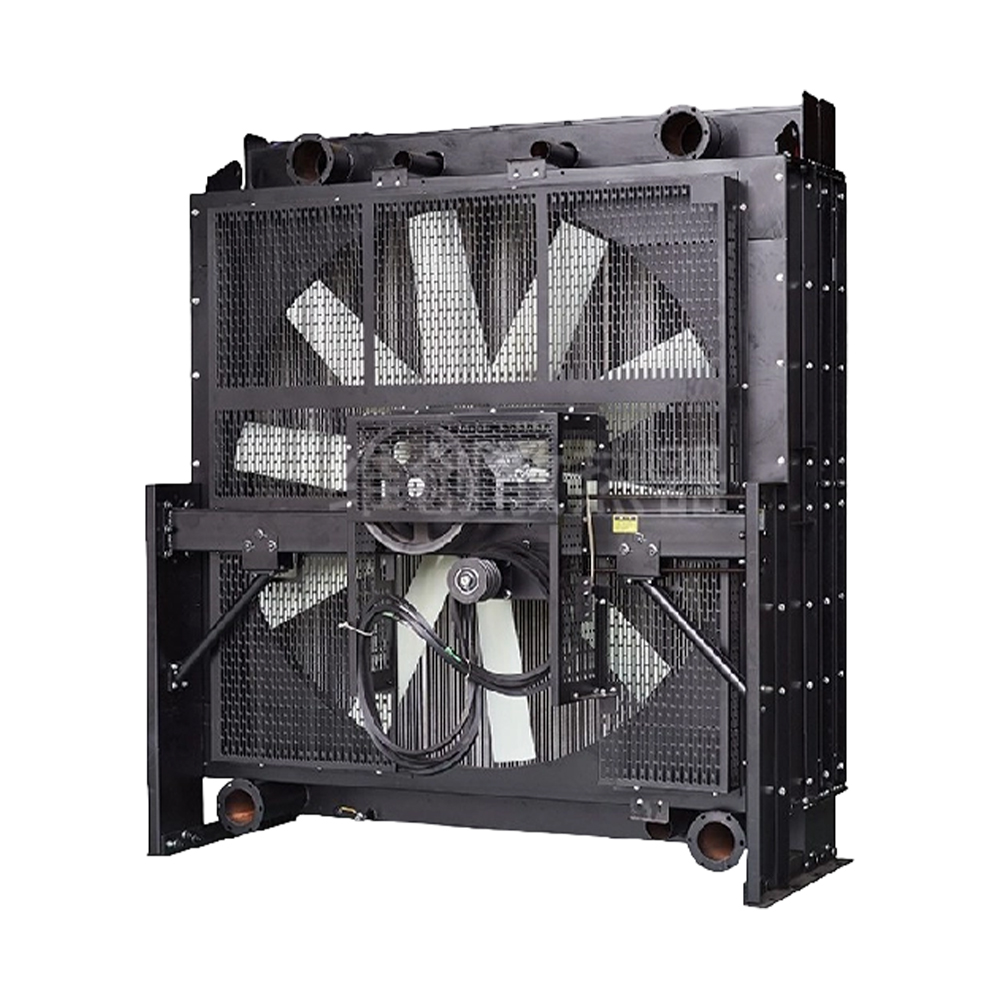
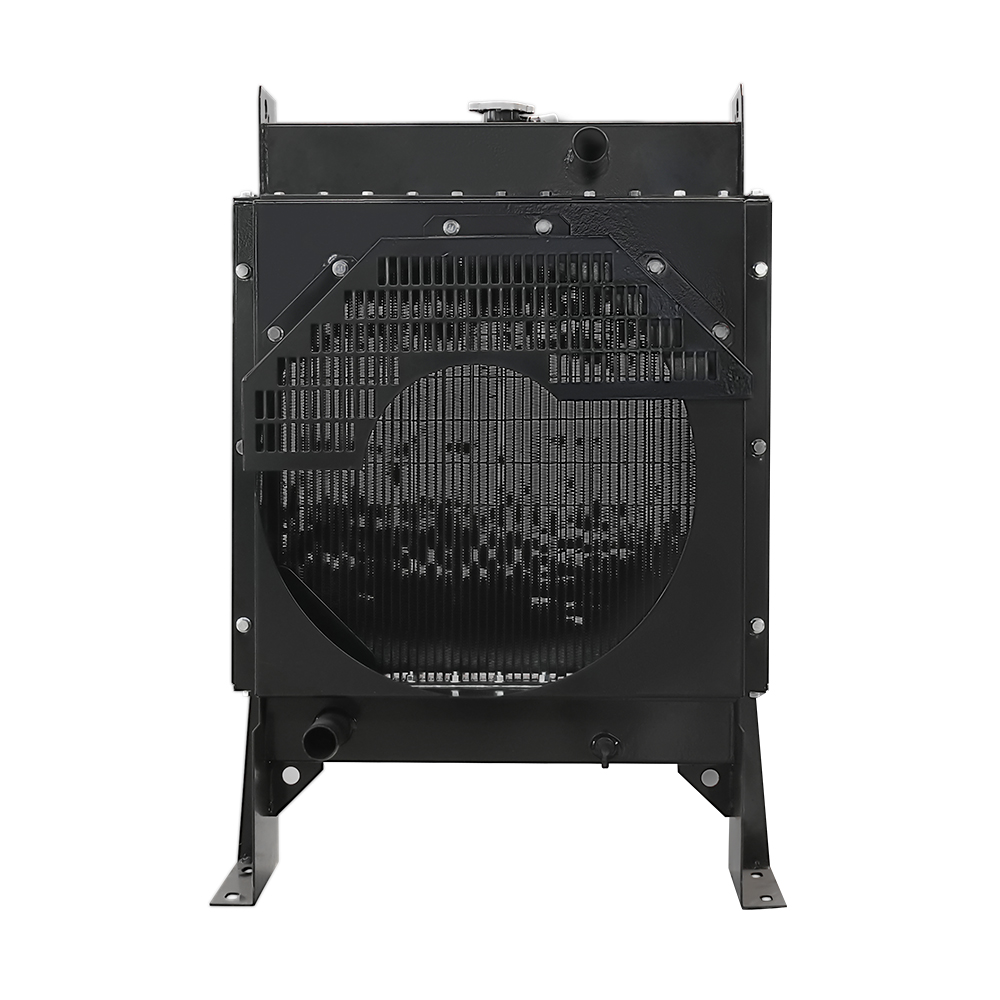
- Mounting bracket style. Pin-mount, cradle-mount, and flange-mount configurations each suit different vibration profiles. A parted-type radiator structure allows flexible placement of the core and tanks relative to the fan drive, simplifying installation in tight generator enclosures.
All-Aluminum vs. Aluminum-Plastic: Which Material to Choose?
Not all aluminum radiators are built the same way. The two dominant construction methods — all-aluminum brazed core-and-tank assemblies, and aluminum cores with crimped-on plastic tanks — carry different strengths that suit different operating profiles.
All-aluminum radiators are furnace-brazed into a single monolithic structure. The entire unit — tubes, fins, headers, and tanks — expands at the same rate when heated, which eliminates the thermal-cycling stress that eventually cracks plastic tanks. This design also permits repairs: a damaged tank can be cut away and TIG-welded with a replacement. On the other hand, aluminum-plastic radiators are lighter at the point of manufacture and less expensive to produce. Their weakness is the tank-to-header gasket, which hardens over time and becomes a leak path under high pressure. For an engine running continuously at 15–20 psi coolant pressure — typical of a large diesel generator — an all-aluminum core is the safer long-term investment.
All-aluminum radiator cores also provide a measurable thermal advantage. Removing the plastic tank eliminates the insulating effect of the polymer, allowing the tank itself to act as a small additional heat sink. The table below summarizes the trade-offs.
| Dimension | All-Aluminum | Aluminum-Plastic |
|---|---|---|
| Weight | Moderate | Lightest |
| Thermal conductivity | Higher (tank aids heat rejection) | Lower (plastic insulates) |
| Pressure tolerance | 20–25 psi typical; spikes tolerated | 15–18 psi; tank failure risk above 20 psi |
| Repairability | Weldable; tanks replaceable | Typically not repairable; replace whole unit |
| Cost | Higher | Lower |
| Recommended for | Continuous-duty generators, mining equipment, high-temperature zones | Light-duty backup sets, short-run installations with stable pressures |
The Custom Order Process: From Drawing to Delivery
Ordering a custom aluminum radiator follows a structured workflow that turns a concept into a production-ready part. The process below reflects typical practice among industrial radiator manufacturers, with real-world lead times based on current shop capacities in 2026.
- Requirement gathering. Share engine model, maximum ambient temperature, available space, and any existing cooling issues. A photo of the current installation often saves a week of back-and-forth.
- Drawing or template submission. Provide a dimensioned sketch, CAD file, or a physical pattern radiator. The more precise the inlet/outlet locations, the faster the engineering review.
- Engineering review. The fabricator runs thermal calculations to confirm tube count, fin density, and core face area meet the heat rejection target. They may suggest adjustments — for instance, widening the core by 50 mm to remove a need for a third row.
- Quote generation. Once the design is locked, the shop returns a formal quotation with lead time and payment terms. For most industrial projects, approval within 48 hours keeps the queue slot.
- Production. Lead times run 3–6 weeks depending on complexity and material availability. Rush service at 2 weeks is sometimes available at a 25–30% premium.
- Quality inspection. Every custom unit undergoes pressure testing (typically at 30 psi for 15 minutes) and helium leak testing. A test report ships with the radiator.
- Packaging and delivery. Cores are crated in plywood boxes with foam-braced mounting points to survive freight handling. Transit time adds 2–5 business days domestically.
Having a reliable point of contact during production is critical. Most shops provide a weekly build update, and some offer digital renderings of the final design for sign-off before cutting metal.
Custom Radiators for Extreme Environments: Desert, Coastal & Mining
Location determines the boundary conditions of a cooling system design. Three environments push custom aluminum radiators to their limits — and each demands a distinct engineering response.
| Environment | Core Challenge | Design Solution |
|---|---|---|
| Desert (high ambient, sand) | Air-to-coolant temperature differential collapses at 50°C+; airborne sand erodes fins | Oversized core face area with lower FPI (8–10); multi-pass coolant flow; fan shroud optimized for even air distribution; optional sand-resistant fin coating |
| Coastal (salt spray, humidity) | Galvanic corrosion where aluminum meets steel mounts; chloride stress on brazed joints | Full epoxy coating on core and tanks; 3003 or 5052 alloy with high magnesium content; stainless steel mounting hardware and isolation pads to prevent dissimilar-metal contact |
| Mining (vibration, debris) | Constant low-frequency vibration cracks tank headers; rocks and mud block airflow | Reinforced header plates with double-thickness material at tube joints; vibration-dampened bolting points; easily removable debris guards; optional vertical-flow design to reduce core stress |
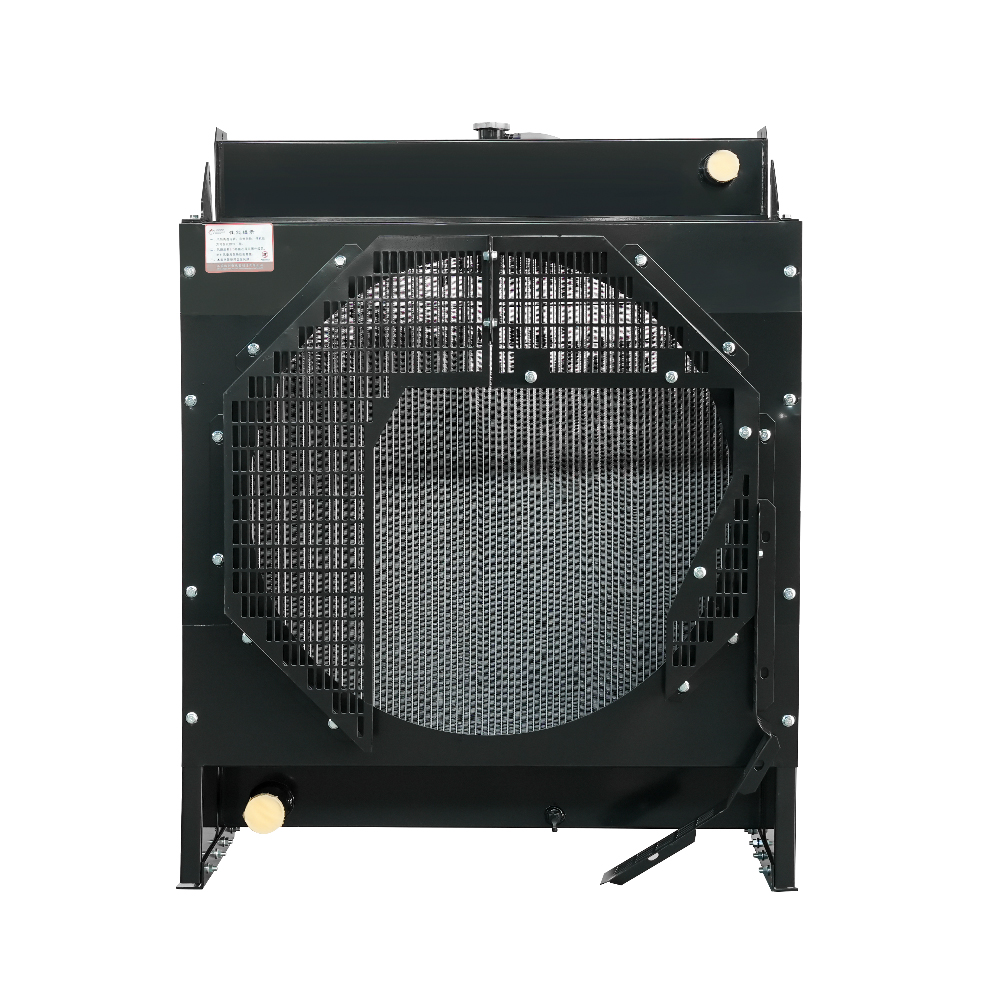
For a silent generator radiator installed in a coastal enclosure, the combination of acoustic insulation and salt-laden air creates a particularly harsh microclimate. The enclosure traps heat, reducing ambient delta, while the insulation retains moisture against the core. In these cases, an all-aluminum radiator with a marine-grade epoxy coating and remote-mounted fan can extend service intervals by 3,000–5,000 hours compared to a standard unit.
Cost Factors & Typical Lead Times for Custom Aluminum Radiators
No two custom radiators carry the same price. However, cost drivers follow consistent patterns, and understanding them helps when comparing quotes.
- Core face area and thickness. Price scales roughly with the square-inch area of the core plus a multiplier for tube rows. A 24x24-inch single-row core might start near $500, while a 36x36-inch triple-row core can exceed $2,000 before options.
- Material and coating selection. All-aluminum construction adds 20–30% over aluminum-plastic. Epoxy or powder-coating for corrosion resistance adds $150–$400 depending on core size.
- Integrated components. Including an electric fan, shroud, and wiring harness in the assembly raises the price but ensures plug-and-play installation. Standalone radiator-only orders save money but require more field labor.
- Quantity. Most custom shops price per unit, but ordering two identical spares can lower the per-unit cost by 10–15% due to shared setup time.
- Lead time. Standard production lead time in 2026 runs 4–6 weeks for industrial radiators. Expedited 2–3 week service is usually available at a premium. Very large cores (above 60-inch diagonal) may require an extra week for furnace scheduling.
While a bespoke aluminum radiator demands up-front investment, calculating total cost of ownership changes the picture. An industrial generator losing a day of production during peak demand can burn $10,000 or more in downtime. A correctly specified custom radiator that eliminates unscheduled cooling failures pays for itself within a single season.
Case Study: Custom Aluminum Radiator for a Cummins QSK60 Generator
A mining operation in Western Australia was experiencing overheat shutdowns on a 2 MW Cummins QSK60 genset during summer afternoons. The original copper-brass radiator, sized for the engine’s prime rating at 25°C ambient, could not maintain coolant temperature below 105°C when site temperatures hit 48°C. Derating the engine reduced power output by 15% during the peak demand window — an unacceptable loss.
The solution was a Cummins generator radiator built as a direct-fit replacement with an enlarged all-aluminum core. Key changes included: increasing the core face area from 1.2 m² to 1.8 m², moving from a 2-row to a 3-row tube configuration, and raising fin density from 10 FPI to 12 FPI with a dust-shedding fin geometry. The tanks were fabricated from 5052 aluminum with an epoxy corrosion barrier to withstand the Pilbara’s combination of heat and airborne salt.
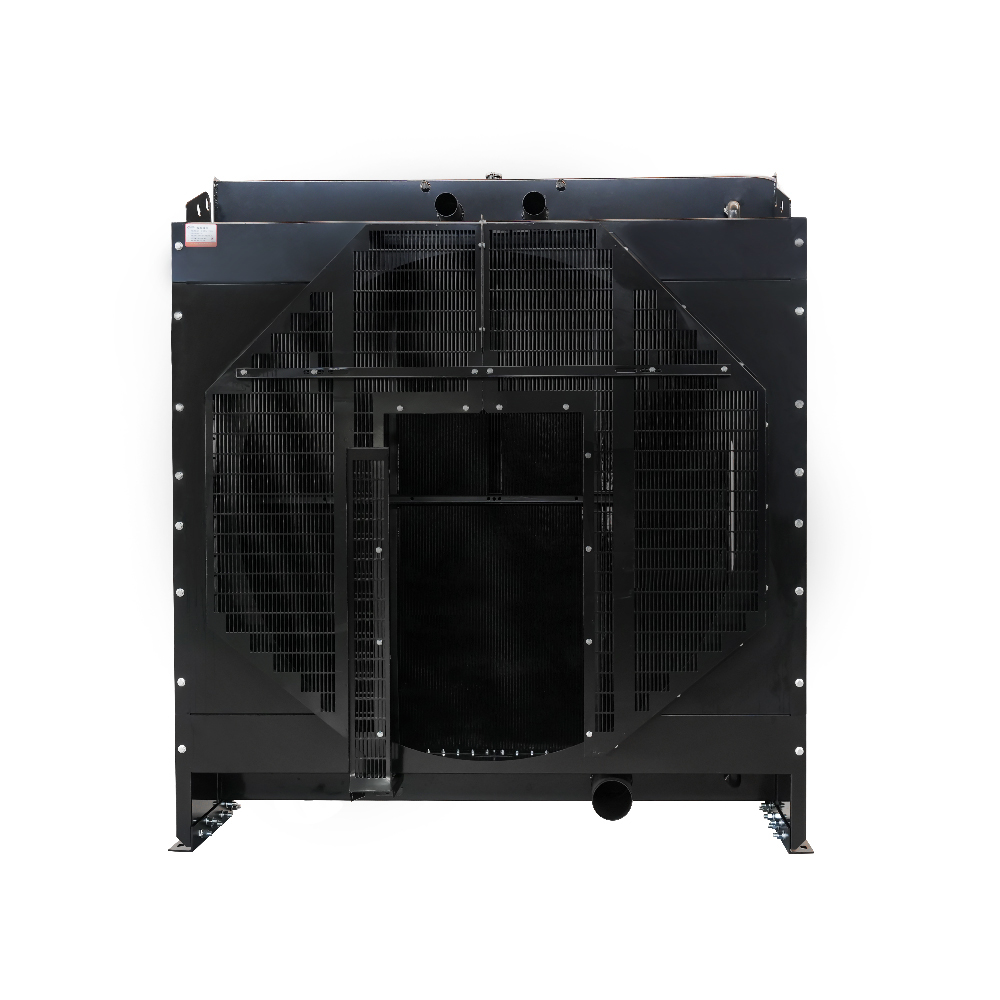
Post-installation data showed a coolant temperature drop of 12°C at full load under 48°C ambient. The engine returned to full rated output with zero unscheduled thermal-related shutdowns in the 18 months that followed. Total project cost, including engineering, fabrication, and remote-site installation support, was approximately $12,000 — recovered in avoided downtime within the first two months of operation.

- Product Categories
- Contact Us
-
- wcradiator@jswcsrq.com
- +86-514-400-180-4088
- +86-15152759383
- +86-15152759383
- No. 6 Road, Shaobo Industrial Concentration Zone, Jiangdu District, Yangzhou City, Jiangsu Province, China

