


 English
 русский
 Français
 Indonesia
 عربى
 中文简体

Off-Highway Cooling Systems: Sizing, Dust, Heat and Uptime in the Field
Content
- 1 What "Off-Highway" Really Changes
- 2 Dust, Heat and Duty Cycle: The Three Loads That Decide Everything
- 3 Sizing an Off-Highway Cooling System Without Over- or Under-Shooting
- 4 Serviceability Is a Cooling Specification Too
- 5 Cooling for Mobile Power and Remote Sites
- 6 Getting the Match Right the First Time
Off-highway cooling systems earn their keep where the road ends. A wheel loader working a quarry face, a hauler climbing out of a pit, a sprayer running twelve-hour shifts in August, a generator set powering a crusher in the middle of nowhere — they all share the same problem. They have to shed heat in conditions that would make a highway truck blush: dust that packs fins solid, ambient air that hovers near 50 °C, vibration that loosens brackets, and service access that was clearly an afterthought.
We build radiators for generator sets, including the mobile and site packages that end up doing exactly this kind of work. That background shapes how we look at off-highway cooling. It is rarely about bolting on a bigger core. It is about matching the whole loop — core, fan, airflow path, coolant and the person who has to clean it — to the duty the machine actually performs.
What "Off-Highway" Really Changes
On-highway cooling has two friends: steady road speed and a clean, high-volume air stream. Off-highway machines have neither. Engine speed swings with load, the fan may be hydraulically driven and variable, and the radiator often sits behind a hood, a grille or a housing that was styled long before it was engineered. Add a dust cloud and the effective airflow can fall away within a single shift.
That is why the same engine can run cool in a test cell and hot on site. The cooling system is not being asked for a few extra kilowatts of heat rejection. It is being asked to keep rejecting heat while its own airside performance quietly degrades hour after hour.
- Airside fouling: dust, chaff, straw and dried mud bridge the gaps between fins and turn a heat exchanger into a solid block.
- Ambient extremes: a core sized for 35 °C has very little margin left at 48 °C, especially at altitude where air density drops.
- Mechanical punishment: torsional vibration, chassis flex and ground shock work on brackets, seams and tank welds.
- Variable duty: a machine that idles for an hour and then pulls hard for ten minutes needs a different fan strategy than one under constant load.
- Service reality: cleaning happens in the field, with a blower and a torch, not in a wash bay with a steam cleaner.
Dust, Heat and Duty Cycle: The Three Loads That Decide Everything
Most cooling problems we are asked about trace back to one of three loads. Dust controls fin pitch and cleaning access. Heat controls core face area and fan power. Duty cycle controls how much thermal margin you genuinely need, as opposed to how much you would like.
A practical way to think about it is to work backwards from the environment rather than forwards from the engine rating. The table below shows how the same requirement is usually answered with different hardware.
| Working condition | What it stresses | Typical design response |
|---|---|---|
| Quarry and mining dust | Fin blockage, fan power, cleaning time | Wider fin pitch, straight-through airflow, removable grilles |
| Desert and high ambient | Temperature differential, coolant boiling margin | Oversized core face, higher-pressure cap, generous deaeration |
| Coastal and salt spray | External corrosion of fins and tanks | Coated cores, corrosion-resistant headers, sealed joints |
| Remote sites and rental fleets | Uptime, repair by swap rather than rebuild | Removable cores, standardised mounts, ruggedised connections |
None of these choices is expensive on its own. What gets expensive is discovering the mismatch after the machine is in service and the season has already turned hot.
Sizing an Off-Highway Cooling System Without Over- or Under-Shooting
Oversizing has a cost too: weight, fan power, noise and a longer warm-up. What we recommend to customers is a staged approach that keeps the numbers honest.
- Start from the worst realistic condition, not the average one. Highest ambient, lowest air density, dirtiest core, heaviest sustained load.
- Add an airside fouling allowance. Ten to fifteen percent of extra rejection capacity is a far cheaper insurance policy than a derated machine.
- Check fan authority against the installed restriction. A fan curve measured on a bench rarely survives a tight hood and a clogged grille.
- Look at the whole thermal loop. Charge air cooling, transmission oil, hydraulic oil and fuel cooling all compete for the same air and the same space.
- Confirm the deaeration path. Air pockets cause local boiling, and local boiling damages cores long before the gauge ever moves.
- Walk the service route as if you were the technician. If the core cannot be cleaned in fifteen minutes, it will not be cleaned.
Serviceability Is a Cooling Specification Too
We have seen cooling packages that were thermally perfect and operationally hopeless. A radiator buried behind a hydraulic tank, a drain plug that empties onto a frame rail, a fan shroud that has to be cut to reach the core — none of these shows up in a heat rejection calculation, and all of them shorten the life of the system.
- Leave enough clearance for a blower nozzle to reach the full core face.
- Use hinged or quick-release grilles rather than bolted panels.
- Put the drain, the filler and the sight glass where a person can actually reach them.
- Keep the pressure cap accessible and specify the correct rating rather than the highest one available.
- Think about the coolant itself: extended-life glycol is a good friend to a machine that only gets serviced between jobs.
Cooling for Mobile Power and Remote Sites
A large share of off-highway work is powered by diesel generator sets rather than the machine engine itself — crushers, screeners, conveyors, pumps, lighting towers and power trucks. Those packages inherit the same dust and heat, but they add their own twist: the radiator is usually the first thing the operator can reach and the last thing anyone wants to open on a windy day.
For these installations, we usually start with the application rather than the engine brand. A skid-mounted package on a mine site needs a core that survives rock dust and can be swapped quickly, while a rental unit needs a rugged, standardised build that holds up to constant transport between jobs.
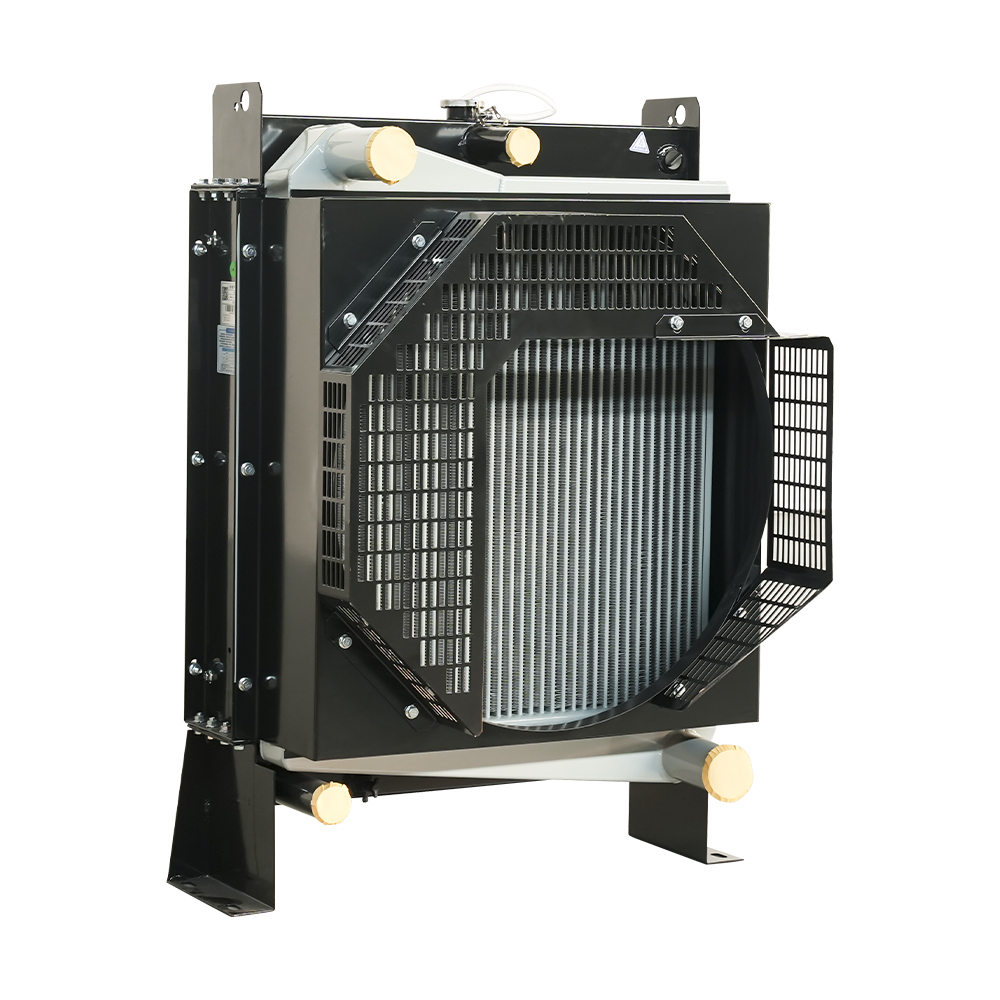 Mining Site Generator Radiators for Dusty, High-Vibration OperationsRadiators built for dusty, high-vibration mining sites, with reinforced frames, anti-clogging fins and easy maintenance for continuous remote cooling.View Product →
Units working in hot, dry regions deserve a different conversation entirely. High ambient temperatures shrink the temperature difference across the core, so face area and fan headroom matter more than nominal capacity on paper. That is where an oversized or specially configured core earns its price back.
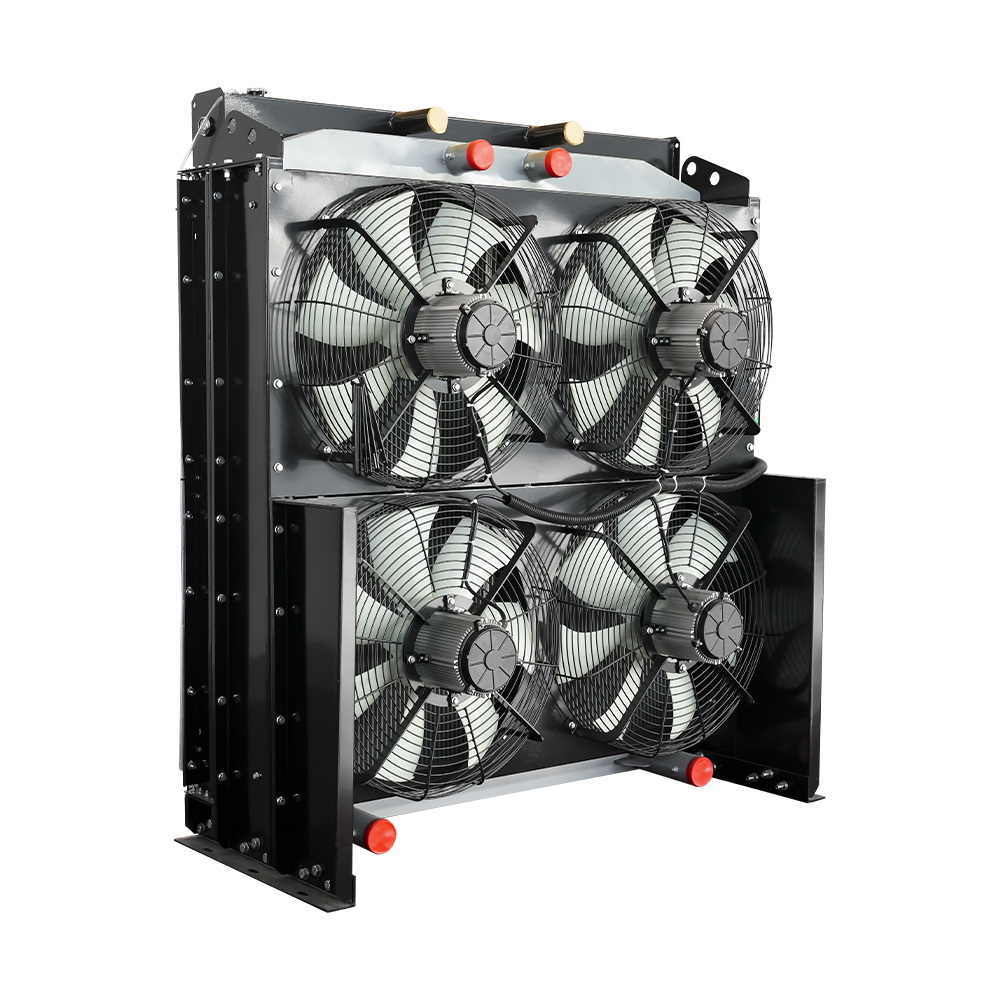 Desert High-Temperature Generator Radiators for Extreme HeatEnlarged-core radiators with high-capacity fans and heat-resistant coatings for desert gensets operating above 50°C in oil field and mining settings.View Product →
And when equipment moves from site to site, the cooling system has to tolerate being drained, transported, refilled and started in a hurry by people who did not build it. Robust mounts and simple connections matter as much as heat rejection figures.
 Rental Generator Radiators for Mobile and Rental Power FleetsRobust, lightweight radiators with interchangeable designs and simple connections to reduce downtime during frequent transport, draining and refilling between rental deployments.View Product →
Getting the Match Right the First Time
Off-highway cooling is a practical engineering problem dressed up as a specification sheet. The machines that stay cool are not always the ones with the largest radiators; they are the ones where the core, the airflow path, the coolant and the maintenance routine were designed as one system by people who had seen the site.
If you are working through a cooling problem on a mobile or remote package, our engineering team is happy to look at your duty cycle and site conditions and suggest a configuration. You can see how we approach system-level work on our cooling solution page, and if the standard catalogue does not fit, we can develop a customised radiator around your mounting points, airflow layout and service access needs.

- Product Categories
- Contact Us
-
- wcradiator@jswcsrq.com
- +86-514-400-180-4088
- +86-15152759383
- +86-15152759383
- No. 6 Road, Shaobo Industrial Concentration Zone, Jiangdu District, Yangzhou City, Jiangsu Province, China

