


 English
  русский
  Français
  Indonesia
  عربى
عربى  中文简体
中文简体


Aluminum Alloy Radiator Guide for Generator Sets: Cores, Alloys, Costs
Content
Most buyers pick aluminum for the price and the weight. The stronger reason is that a properly specified aluminum alloy radiator can be designed around the failure that killed the original unit, whether that is salt-laden air, a 48 degrees C summer ambient, or a fan that moves less air than the original design assumed.
This guide covers what a generator-set aluminum alloy radiator is made of, how tube-and-fin and plate-and-fin cores differ, how to size one from published engine data, where aluminum actually fails, and what belongs on the specification sheet before a purchase order is issued.
What an Aluminum Alloy Radiator Actually Is
An aluminum alloy radiator is a heat exchanger in which the tubes, fins, headers, and tanks are all built from aluminum alloys and joined by brazing, so the finished coolant path contains no brass or copper.
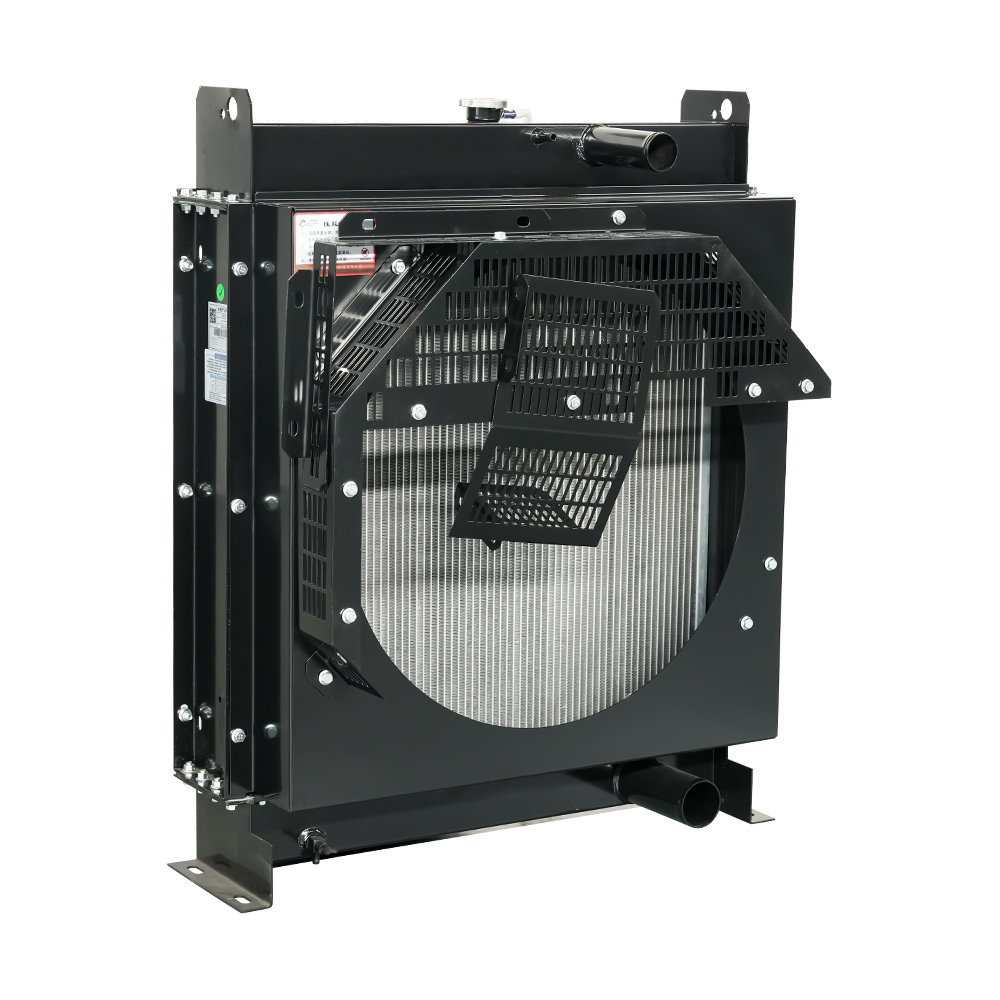 All-Aluminum Radiators ManufacturersFully constructed from corrosion-resistant aluminum alloys, these radiators are lightweight yet durable. Excellent for marine, mobile, and high-performance generators ...View Product →
The alloy list is shorter than most buyers expect. Generator-set cores are built from three families:
- 3003 aluminum for fins and tubes, selected for formability and thermal conductivity in the 190 to 205 W/mK range.
- 4045 or 4343 cladding rolled onto the core sheet, which supplies the brazing filler during the furnace cycle.
- 6061 or 6063 for welded tanks, frames, and brackets, where structural strength matters more than heat transfer.
The joining step separates a real aluminum radiator from an assembled one. Controlled atmosphere brazing (CAB) pushes the entire core through a nitrogen furnace at roughly 600 degrees C, so the cladding melts and every fin-to-tube contact becomes a metallurgical bond. A core that relies on mechanical expansion or epoxy instead loses contact area as it heat-cycles, and lost contact is the fastest path to a hot cylinder head.
Tube-and-Fin vs Plate-and-Fin Core Geometry
Tube-and-fin is the default geometry for diesel generator radiators because it can be cleaned mechanically; plate-and-fin is chosen when a fixed envelope has to deliver maximum heat rejection from clean air.
| Attribute | Tube-and-fin | Plate-and-fin |
| Construction | Flattened tubes through a louvered fin pack, brazed into headers and tanks | Alternating plates and corrugated fins brazed into a single block |
| Heat rejection per volume | Baseline for the same face area | Roughly 20 to 30 percent higher |
| Cleanability | Can be rodded and pressure-washed after tank removal | Cannot be opened or mechanically cleaned |
| Thermal cycling | Good with quality brazing and correct header design | Very strong, which suits high-vibration installations |
| Best fit | Dusty, oily, or high-maintenance sites | Space-limited skids with clean air and controlled coolant |
The gap between the two narrows once maintenance is factored in. A plate-and-fin core that fouls with mine dust can lose more capacity in one season than a tube-and-fin core loses in three, because the brazed plate stack cannot be rodded out and chemical cleaning rarely reaches the lower half of the block. The sizing math behind both geometries is covered in this tube-fin and plate-fin core sizing guide.
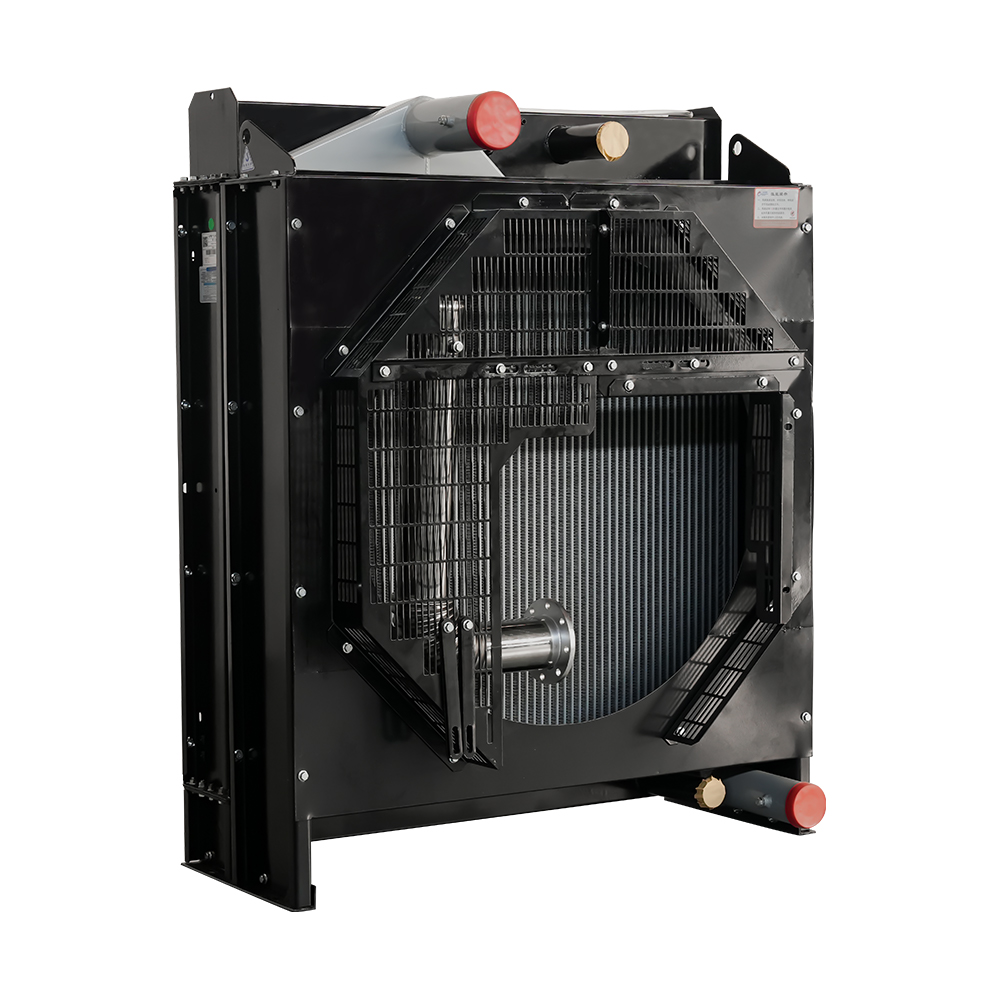 Tube-and-Fin Generator Radiators ManufacturersThis classic design uses durable tubes and closely spaced fins to maximize surface area for heat exchange. Reliable, cost-effective, and easy to maintain, it suits a w...View Product →
Sizing an Aluminum Alloy Radiator From Engine Data
Size the radiator from the engine's published coolant heat rejection, never from the nameplate kW figure.
Engine builders publish jacket-water and aftercooler heat rejection for every rating. On diesel generator sets, the coolant-side load normally lands between 0.30 and 0.45 kW of heat for every 1 kW of shaft output, depending on whether the aftercooler shares the jacket circuit. A 500 kW set therefore pushes roughly 150 to 225 kW into its coolant, and that figure, not 500, is the input for core selection.
Ambient correction is where replacement projects most often go wrong. A core rated for 40 degrees C ambient will not hold coolant temperature at 50 degrees C. Budget 10 to 18 percent more face area, or accept a narrower margin between normal operating coolant temperature and the alarm set point. The fan curve matters as much as the core: denser fins raise air-side static pressure, the same fan then moves less air, and the extra surface area cancels itself out.
Where Aluminum Alloy Radiators Fail
Aluminum alloy radiators fail from the coolant side far more often than from the air side, and the mechanism is almost always chloride contamination or drifting pH.
Aluminum protects itself with a thin passive oxide layer. That layer holds at pH 7.5 to 9.5 with inhibited glycol, and it breaks down when the coolant moves outside that window or when chloride from untreated make-up water climbs past the limit written into the engine maker's specification, which is typically around 40 ppm for aluminum cooling systems.
Controlled coolant circuit
- Chloride held below 40 ppm using deionized or distilled make-up water
- pH tested between 7.5 and 9.5 at every service interval
- Glycol concentration kept at 40 to 60 percent by volume
- Extended-life organic acid technology coolant, checked for inhibitor reserve
Risk conditions
- Top-ups with hard tap water, which add chloride and scale
- pH below 7 from glycol degradation, which strips the oxide layer
- Mixed metals in one circuit, where aluminum becomes the anode
- Coating damage on coastal units, exposing bare fin edges to salt fog
On coastal and offshore sets, air-side protection matters as much as coolant chemistry. A properly applied epoxy or polyurethane coating over a cleaned core extends service life well beyond the five to seven years an uncoated core survives in salt fog, provided the fin edges are fully covered and the coating is not so thick that it bridges the fin gaps.
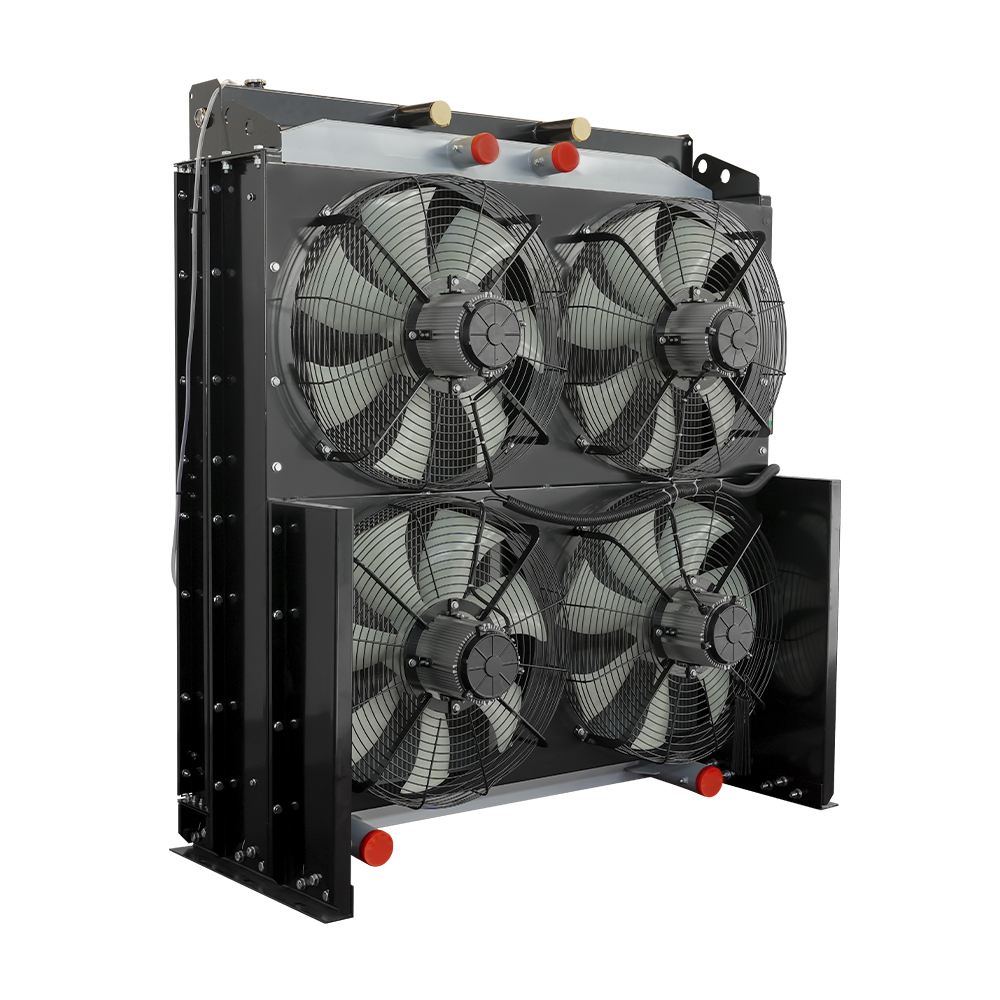 Coastal Environment Generator Radiators ManufacturersBuilt with anti-salt corrosion materials and protective coatings, these radiators provide long-lasting performance in humid, saline environments. Ideal for ports, seas...View Product →
Cost, Lead Time, and the Specification Sheet
A custom aluminum alloy radiator for a 200 to 800 kW generator set usually prices 15 to 30 percent below an OEM-branded replacement core, with three to six weeks of lead time when no new tooling is needed.
Lead time is decided by how complete the specification is. Buyers who supply a dimensioned drawing and a coolant flow figure get a firm quotation within days. Buyers who send a photograph get a week of questions first. Seven items on the sheet prevent almost every delay:
- Core envelope, tank positions, and mounting hole centers on a dimensioned drawing.
- Required heat rejection at the stated ambient, with coolant flow in liters per minute and inlet temperature.
- Air flow in cubic meters per second at the fan's operating static pressure.
- Coolant-side test pressure, normally 1.5 times the pressure cap rating.
- Ports for fill, drain, temperature sensor, low coolant switch, overflow, and deaeration.
- Coating specification if the site is coastal, chemical, or offshore.
- Cross-reference data: OEM part number, engine serial range, and generator set model.
For high-volume engine families, pre-engineered cores already exist and avoid tooling charges entirely, including Cummins-compatible generator radiators that match standard mounting patterns. That route costs less and ships faster than a fully custom core, which makes it the first question worth asking before paying for new tooling.
Frequently Asked Questions
Are aluminum alloy radiators better than copper-brass for generator sets?
For new units, yes in almost every case. Aluminum saves roughly 40 percent of core weight, forms more easily into custom tank shapes, and costs less at equal cooling capacity. Copper-brass keeps one narrow advantage: a legacy installation where the mounting envelope cannot change and a matching copper core is still available off the shelf.
How long does an aluminum alloy radiator last on a diesel generator set?
Eight to twelve years is realistic on an inland site with a maintained coolant circuit. Coastal and offshore sets without a quality coating typically see four to seven years, and any unit topped up with untreated tap water fails sooner than that regardless of where it sits.
Can a leaking aluminum alloy radiator be repaired?
Tube-and-fin cores usually can. A weeping tube is plugged or re-brazed after the tank is removed, and the core can be rodded in the same pass. Plate-and-fin cores are effectively not repairable in the field, because opening a brazed plate stack destroys it, so a leaking plate-fin unit is replaced rather than repaired.
Does an aluminum alloy radiator need a different coolant?
It needs an inhibited coolant rated for aluminum, normally an extended-life organic acid technology formulation with 40 to 60 percent glycol and chloride-free make-up water. Silicate-heavy conventional coolants can drop deposits inside small aluminum tubes, and plain water should never be used in an aluminum circuit.

- Product Categories
- Contact Us
-
- wcradiator@jswcsrq.com
- +86-514-400-180-4088
- +86-15152759383
- +86-15152759383
- No. 6 Road, Shaobo Industrial Concentration Zone, Jiangdu District, Yangzhou City, Jiangsu Province, China

