


 English
  русский
  Français
  Indonesia
  عربى
عربى  中文简体
中文简体


Containerized Gensets: Cooling, Radiator Sizing and Heat Rejection Guide
Content
- 1 A Containerized Genset Trades Airflow for Protection
- 2 How Much Heat a Container Must Reject
- 3 Radiator Sizing and Airflow Rules Inside an ISO Footprint
- 4 What Acoustic Attenuation Costs Your Cooling Margin
- 5 Ambient Temperature and Altitude: The Derating Numbers
- 6 On-Board Radiator, Remote Radiator or Heat Exchanger
- 7 Specifying a Replacement Radiator for a Containerized Fleet
- 8 Frequently Asked Questions
Cooling is usually the last system specified and the first one to fail on site. The radiator has to work with whatever space remains inside the ISO envelope, at whatever ambient the site delivers.
A Containerized Genset Trades Airflow for Protection
A containerized genset gives up roughly 15 to 30 percent of the cooling airflow an open skid set enjoys, and that single trade shapes every radiator decision that follows.
Weatherproofing means louvres, mesh and ducts. Noise attenuation means baffles and splitter paths. Transportability means a fixed footprint of about 6 m by 2.4 m by 2.6 m for a 20 ft unit. Each constraint sits directly in the path of the cooling air.
| Design factor | Open skid set | Containerized genset |
| Air path | Open on all sides | Louvres, mesh and ducts add 75 to 150 Pa |
| Sound level at 7 m | 85 to 95 dB(A) | 65 to 80 dB(A) with attenuation |
| Design ambient | 40 °C typical | 40 to 50 °C on tropical and desert projects |
| Cooling clearance | 1 m or more on all sides | 600 to 800 mm inside the container |
| Capacity per unit | Limited by the skid | 500 to 1,250 kVA in 20 ft, up to 2,500 kVA in 40 ft |
How Much Heat a Container Must Reject
Roughly one quarter of the fuel energy in a diesel containerized genset leaves through the coolant, and that quarter is the only part the radiator controls.
For a 1 MWe set running at about 40 percent efficiency, fuel input is close to 2,500 kW of thermal energy. Electricity takes about 1,000 kW, the exhaust carries 700 to 750 kW, and the jacket water plus aftercooler circuit carries 600 to 700 kW into the radiator. The remainder leaves by radiation and convection from the container skin.
Coolant flow at that output usually runs 900 to 1,200 litres per minute, and the core has to pull 5 to 8 °C out of it at rated load. The margin is thin, so a 10 percent airflow shortfall shows up as 1 to 2 °C on the top tank, which is often the difference between holding 100 percent load at 45 °C and derating to 85 percent.
Radiator Sizing and Airflow Rules Inside an ISO Footprint
Design the air path backwards from the fan rather than forwards from the louvre, and cap the total external static resistance before you choose the core.
- Start from heat rejection at maximum ambient. A set rated 1,250 kVA at 40 °C behaves closer to 1,000 kVA at 50 °C, and the radiator must be sized on the hotter number.
- Respect the fan curve. Most packagers publish an external restriction limit near 125 Pa (0.5 in H2O) for the enclosure, and beyond that airflow falls faster than core area can compensate.
- Add up every restriction. Intake louvres cost 15 to 30 Pa, sand traps and mesh 25 to 50 Pa, a 90 degree bend 10 to 20 Pa, and a discharge louvre another 15 to 30 Pa.
- Give the louvre 1.2 to 1.5 times the radiator face area with at least 60 percent free area.
- Separate intake and discharge. Hot air recirculation can add 5 to 10 °C to inlet air, which is the same as moving the site to a hotter climate.
- Match the fan to the system, not to the core alone. Blade diameter, pitch angle and tip clearance decide whether the airflow survives the enclosure.
What Acoustic Attenuation Costs Your Cooling Margin
Tightening a container from 75 dB(A) to 65 dB(A) at 7 m typically costs 15 to 30 percent of the available airflow, and that loss has to be repaid with core area, fan pressure or both.
Attenuation works by forcing air through baffles and splitter paths, which adds resistance exactly where the fan is weakest. The cooling package absorbs the penalty in one of three ways: more core rows, a larger fan turning more slowly, or moving the radiator outside the container altogether.
75 dB(A) container
- Louvre free area around 60 percent
- Discharge velocity 8 to 10 m per second
- Standard core face area
- No derate below 45 °C ambient
65 dB(A) container
- Louvre free area 45 to 55 percent
- Discharge velocity 5 to 6 m per second
- Core face area 20 to 30 percent larger
- Expect a 5 to 10 percent derate at 45 °C
Purpose-built silent generator radiators use wider fin spacing, thicker cores and higher static fans so the acoustic path does not become a thermal limit. The trade-offs between attenuation and airflow are covered in more detail in this guide to silent generator radiator design and maintenance.
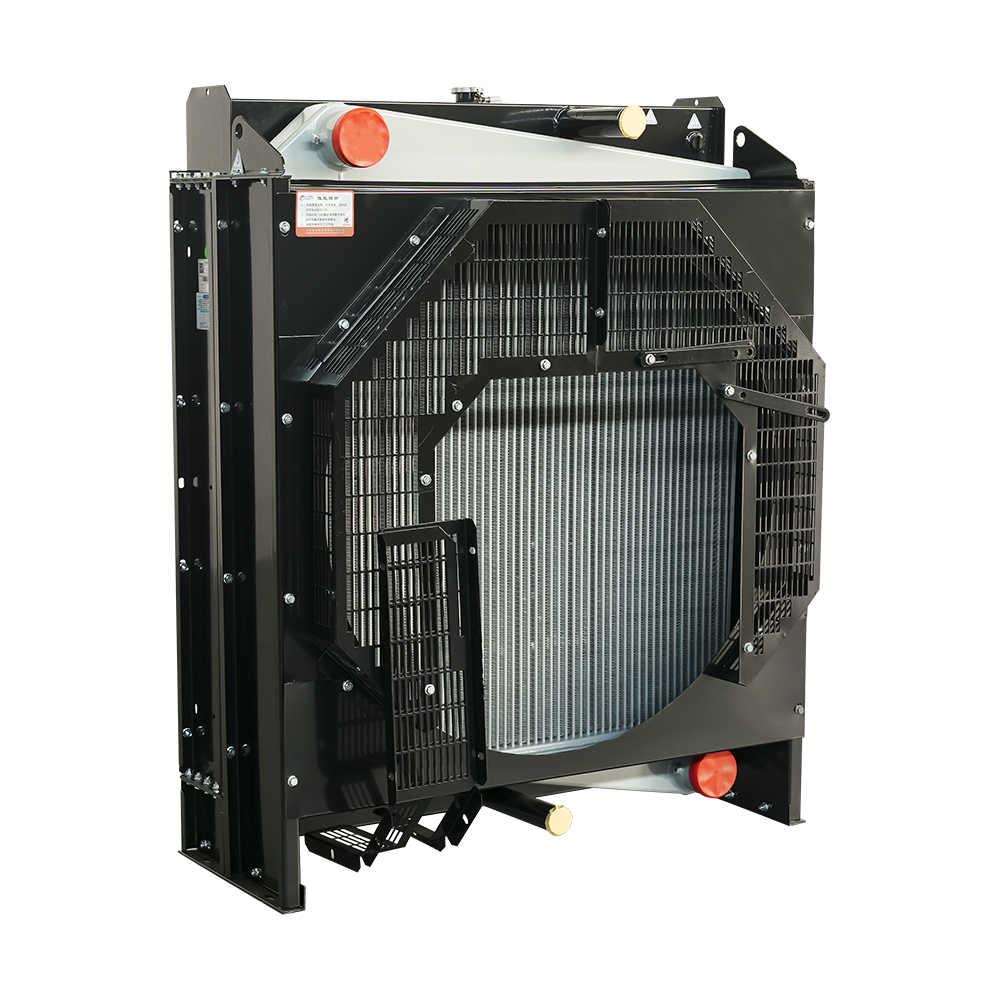 Silent Generator Radiators ManufacturersSilent Generator Enclosure Radiators are integrated cooling solutions designed for soundproofed generator sets. These radiators maintain optimal engine temperatures wh...View Product →
Ambient Temperature and Altitude: The Derating Numbers
ISO 8528 reference conditions are 25 °C, 100 kPa and 30 percent relative humidity, and every degree and every 100 m above those figures reduces both engine output and radiator capacity.
| Condition | Typical derate | Engineering response |
| Ambient above 40 °C | 0.5 to 1 percent of output per 1 °C | 10 to 20 percent more core face area, higher static fan |
| Altitude, turbocharged | About 1 percent per 100 m | Recheck the fan curve at reduced air density |
| Altitude, naturally aspirated | About 3 percent per 100 m | Remote radiator or a lower continuous rating |
| Site at 2,000 m | Air density is about 80 percent of sea level | 20 to 25 percent more core face area |
| Sand and dust | 5 to 15 percent capacity loss from fin fouling | Coarse fin pitch and removable intake screens |
Altitude penalises a containerized genset twice: the engine loses combustion air mass, and the fan moves less mass through the same core. Oversized cooling cores exist for exactly this combination of heat and thin air.
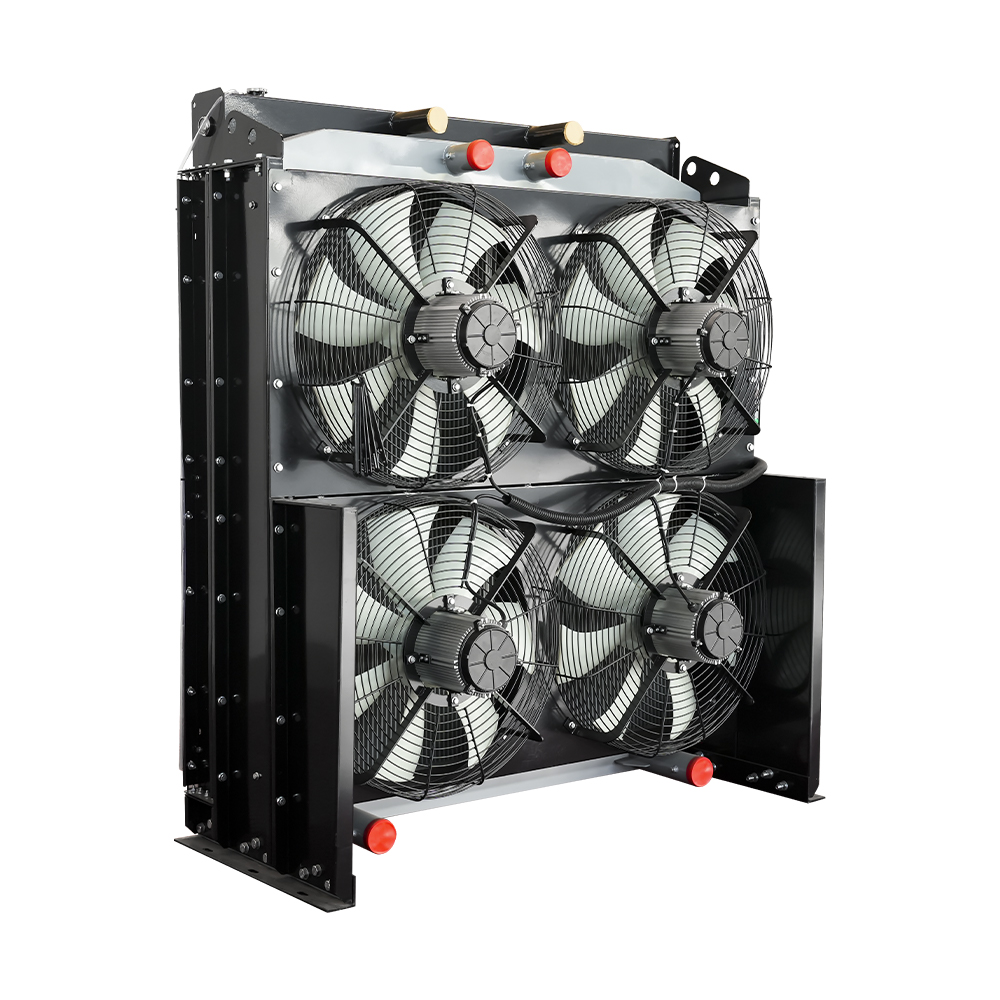 Desert High-Temperature Generator Radiators ManufacturersDesigned for extreme heat, these radiators feature enlarged cores, high-capacity fans, and special heat-resistant coatings. They maintain stable engine temperatures in...View Product →
On-Board Radiator, Remote Radiator or Heat Exchanger
When the ISO envelope cannot hold enough core, move the heat rejection outside the container instead of squeezing more air through a louvre.
On-board radiator
Lowest cost and shortest piping, but it consumes container volume and depends entirely on louvre free area. Best fit for 20 to 1,250 kVA units at up to 40 °C ambient.
Remote radiator
Moves heat and fan noise away from the enclosure and frees the footprint. Needs ducting, longer coolant runs, expansion volume and freeze protection.
Heat exchanger
Dumps coolant heat into a secondary water or seawater loop with no fan power. Adds a second circuit, raw water quality control and fouling allowance.
Remote radiator piping rules are simple to state and easy to break: keep coolant velocity between 1.5 and 2.5 m per second, allow for static head and expansion, and vent the highest point so air locks cannot stall circulation.
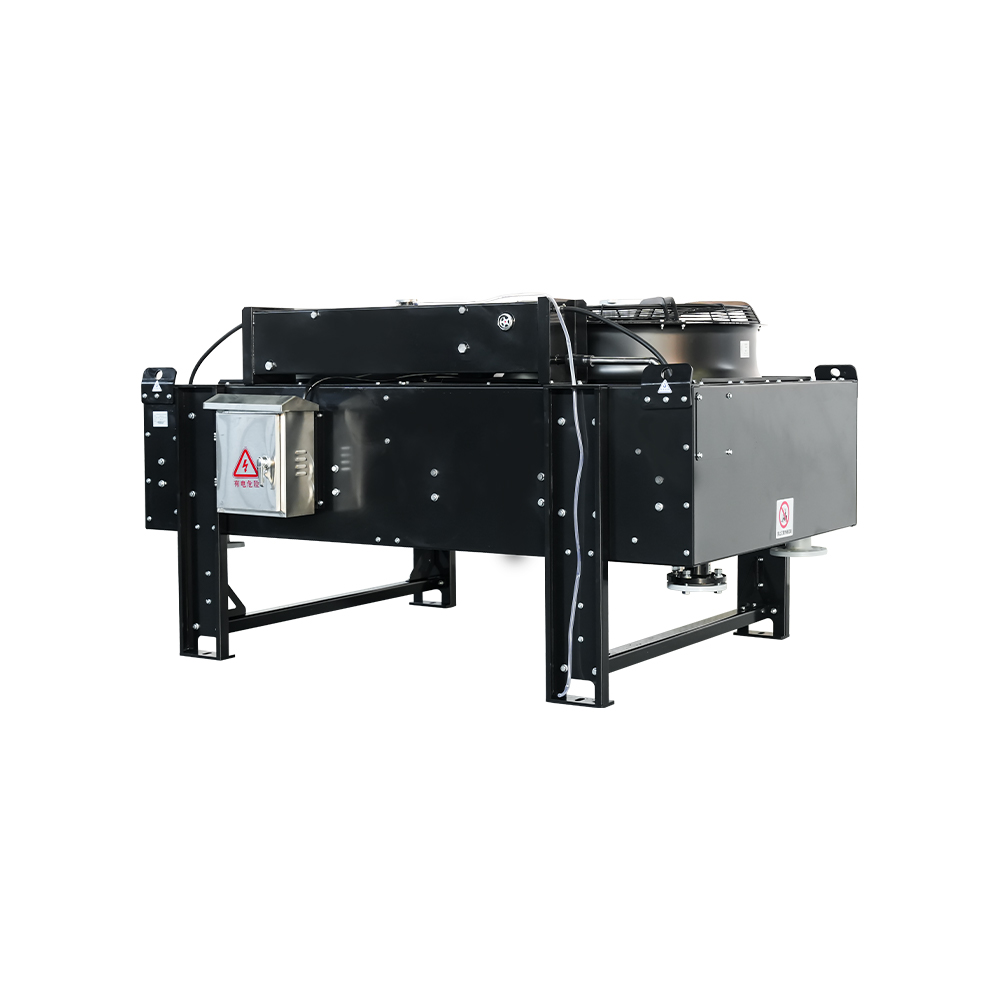 Remote Type Generator Radiators ManufacturersRemote radiators are designed to be installed away from the generator set, connected via coolant piping, to allow flexible installation in constrained or acoustically ...View Product →
Specifying a Replacement Radiator for a Containerized Fleet
A replacement radiator is interchangeable only when seven data points match, and physical fit is just one of them.
- Core dimensions: width, height and depth measured on the unit, not taken from a catalogue page
- Core construction: rows, tube type, fin pitch in fins per inch, and tube-and-fin or plate-and-fin design
- Heat rejection at a stated coolant flow and temperature difference
- Coolant connection diameter, position and thread type
- Fan diameter, blade count, pitch angle and drive ratio
- Mounting flange hole pattern and vibration isolation points
- Surface coating specification for the site environment
Coating and coolant carry the service life. Coastal and offshore containers generally call for a C5-M grade system validated to 1,000 hours of salt spray testing, while coolant should stay within a 40 to 60 percent glycol mix with inhibitor levels checked every 500 operating hours. Jiangsu Weichuang Radiator Manufacturing Co., Ltd., trading as Weichuang Radiator, builds generator radiators for OEM lines, end users and replacement projects across all of these mounting and coating formats.
Frequently Asked Questions
How much airflow does a 1 MVA containerized genset need?
Plan on roughly 1,200 to 1,800 cubic metres per minute through the core at rated load, based on a 20 to 25 °C air temperature rise across the radiator. Total restriction through the enclosure should stay under about 125 Pa so the fan can actually deliver that figure.
Can a containerized genset run at 50 °C ambient?
Only if it was specified for it. A set designed for 40 °C usually needs 10 to 25 percent more core face area, a higher static fan or a remote radiator to hold full load at 50 °C, and many builds also drop the continuous rating by 10 to 15 percent.
Can a non-OEM radiator replace a containerized genset radiator?
Yes, when the core dimensions, heat rejection at a stated temperature difference, fan curve, connections and mounting pattern all match. Insist on heat rejection data at the site ambient, because dimensional compliance alone does not guarantee cooling performance.
Containerized gensets are sold on kVA and judged on cooling. The units that stay online through a 45 °C afternoon and a dusty season are the ones whose cooling package was sized on heat rejection at site conditions, with an air path that was measured rather than assumed.

- Product Categories
- Contact Us
-
- wcradiator@jswcsrq.com
- +86-514-400-180-4088
- +86-15152759383
- +86-15152759383
- No. 6 Road, Shaobo Industrial Concentration Zone, Jiangdu District, Yangzhou City, Jiangsu Province, China

