


 English
  русский
  Français
  Indonesia
  عربى
عربى  中文简体
中文简体


Corrosion Resistant Radiator Guide for Generator Sets: Materials and Coatings
Content
A standby generator can pass every engine check and still fail a load test because its radiator has been quietly corroding for a season or two. The first signs are easy to miss: a crusty residue around a tube-to-header joint, a coolant smell that comes and goes, then a pinhole leak that only shows up when the system is hot and pressurized. By the time the leak is found, the damage inside the core is already well advanced.
Here is the conclusion up front: no single material makes a radiator corrosion resistant. Corrosion resistance is a package deal built from the core material, the coolant chemistry, the external coating, and how well all three match the installation site. Treat them as one decision and a radiator can serve a decade without drama. Miss one leg of the package, and replacement cores quietly become a recurring line in the maintenance budget.
What Actually Corrodes a Generator Radiator
Corrosion needs three ingredients: an anode, a cathode and an electrolyte connecting them. Inside the radiator, the coolant is the electrolyte. Outside, salt-laden humid air, industrial gases or contaminated wash water play the same role. Knowing which side is attacking tells you which defense to prioritize.
Attack from the coolant side
Galvanic corrosion is the main internal threat. Whenever dissimilar metals share one coolant loop — copper in a sensor fitting or heater circuit, aluminum in the radiator tubes — the less noble metal becomes the anode and dissolves into the coolant. Aluminum sits at the sacrificing end of most metal pairings, which is why mixed-material cooling systems tend to consume their aluminum parts first. Depleted inhibitors, top-ups with hard well water and glycol that has broken down into organic acids all speed the process along. In older copper-brass cores, the classic symptom is solder bloom: the solder sealing tubes into headers slowly leaches out, leaving a powdery white deposit and joints that weep under pressure.
Attack from the air side
External attack comes from the environment. Chloride in sea spray breaks down the natural oxide film that protects aluminum and pits the fins, almost always starting at the cut edges where coating coverage is thinnest. Humidity combined with industrial gases such as sulfur dioxide forms weak acids that attack bare metal. Dust, sand and mud hold moisture against the core long after shutdown, which is why radiators in mining and desert sites usually corrode from the bottom rows upward. One culprit is often overlooked: stray electrical current. A missing or corroded ground strap can turn the core into an anode and destroy it in months instead of years.
Core Materials and How They Really Behave
The practical goal is not to find an uncorrodible metal. It is to control where dissimilar metals meet and what chemistry touches them. Three construction approaches dominate the generator market, and each makes a different trade-off.
Copper and brass are naturally resistant to water-side corrosion, which is why they dominated radiator construction for decades and still appear in some replacement work. Their weaknesses are weight, cost and the soldered joints themselves — the solder remains the first place corrosion shows in a copper-brass core.
Aluminum protects itself with a thin oxide film that re-forms whenever the surface is scratched. In a properly inhibited coolant, aluminum cores age very well. The two real risks are chlorides, which attack that film, and contact with more noble metals, which turns the aluminum into the anode of a galvanic couple. The design answer is an all-aluminum core: tubes, fins and headers share one metallurgy, and the number of galvanic couples inside the core drops to nearly zero.
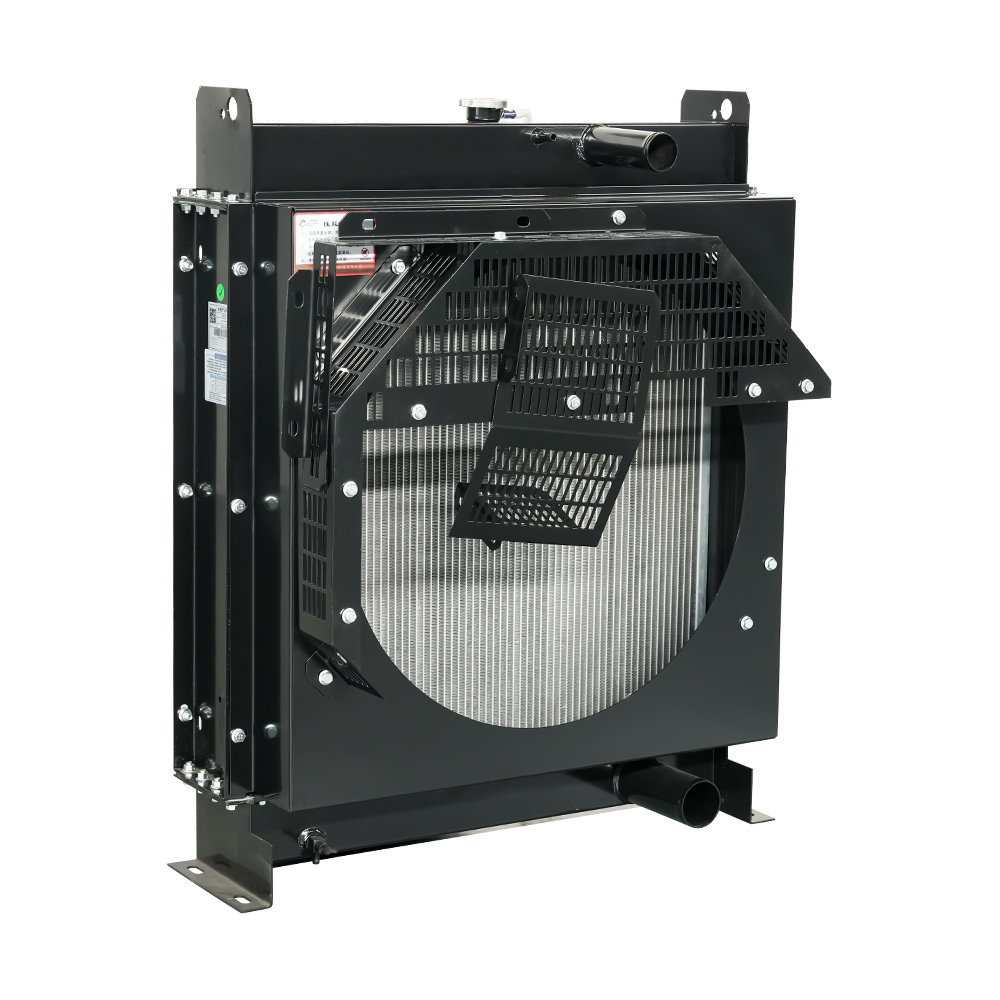 All-Aluminum Generator RadiatorsWith tubes, fins and headers sharing one metallurgy, these radiators minimize galvanic corrosion inside the core. A natural fit after discussing aluminum oxide protection and single-alloy core design for longer service life.View Product →
Aluminum-plastic construction applies the same logic to replacement and retrofit projects. Glass-fiber reinforced plastic tanks replace soldered metal headers, removing another corrosion-prone joint type and cutting weight for easier installation. The trade-off is that tank gaskets and mounting clips become the components to inspect at every service.
| Core material | Corrosion strengths | Watch-outs | Typical fit |
|---|---|---|---|
| Copper-brass with soldered joints | Base metal resists water-side attack naturally | Solder joints leach out; heavy; higher cost | Replacement cores for older sets |
| All-aluminum | Self-healing oxide film; no mixed-metal joints inside the core | Sensitive to chlorides and depleted inhibitors; needs compatible coolant | OEM-style builds; weight-sensitive and high-power packages |
| Aluminum core with plastic tanks | Plastic tanks remove soldered headers and one galvanic couple | Gaskets and clips need periodic inspection | Aftermarket replacement and retrofit radiators |
| Coated aluminum (epoxy, polyurethane or powder) | External barrier against salt spray and polluted air | Damage at fin edges must be repaired; thick films cost heat transfer | Coastal, offshore, mining and desert installations |
Read the table as a reminder that the best material depends on the coolant and the location. A copper-brass core paired with neglected coolant still fails, and an all-aluminum core without the right inhibitors and coating fails faster in a chloride-heavy environment than the alloy alone would suggest.
External Coatings Decide How Long the Surface Survives
Uncoated aluminum fins installed within a few hundred meters of a coastline can show fin-edge pitting within their first year. At that distance, the coating — not the alloy — decides how long the external surface lasts.
Three coating families cover most generator specifications. Epoxy adheres strongly and resists chemical attack, which suits industrial air containing acidic contaminants. Polyurethane handles UV exposure and weathering, so it is usually specified as a topcoat. Powder coating produces a uniform, mechanically tough film that survives handling and vibration. For marine and coastal sites, a common specification pairs an epoxy primer with a polyurethane topcoat. Film thickness on fins always involves a compromise: every extra micron trades a little thermal performance for protection, so thickness should be engineered for the site rather than simply maximized.
When comparing suppliers, ask for neutral salt-spray test results and the hours achieved instead of accepting the word "coated". A core validated to 500 to 1,000 hours of salt-spray testing tells you far more about coastal durability than any brochure photograph. For a detailed comparison of the three systems, our guide to marine radiator coating selection covers where epoxy, polyurethane and powder coat each earn their cost.
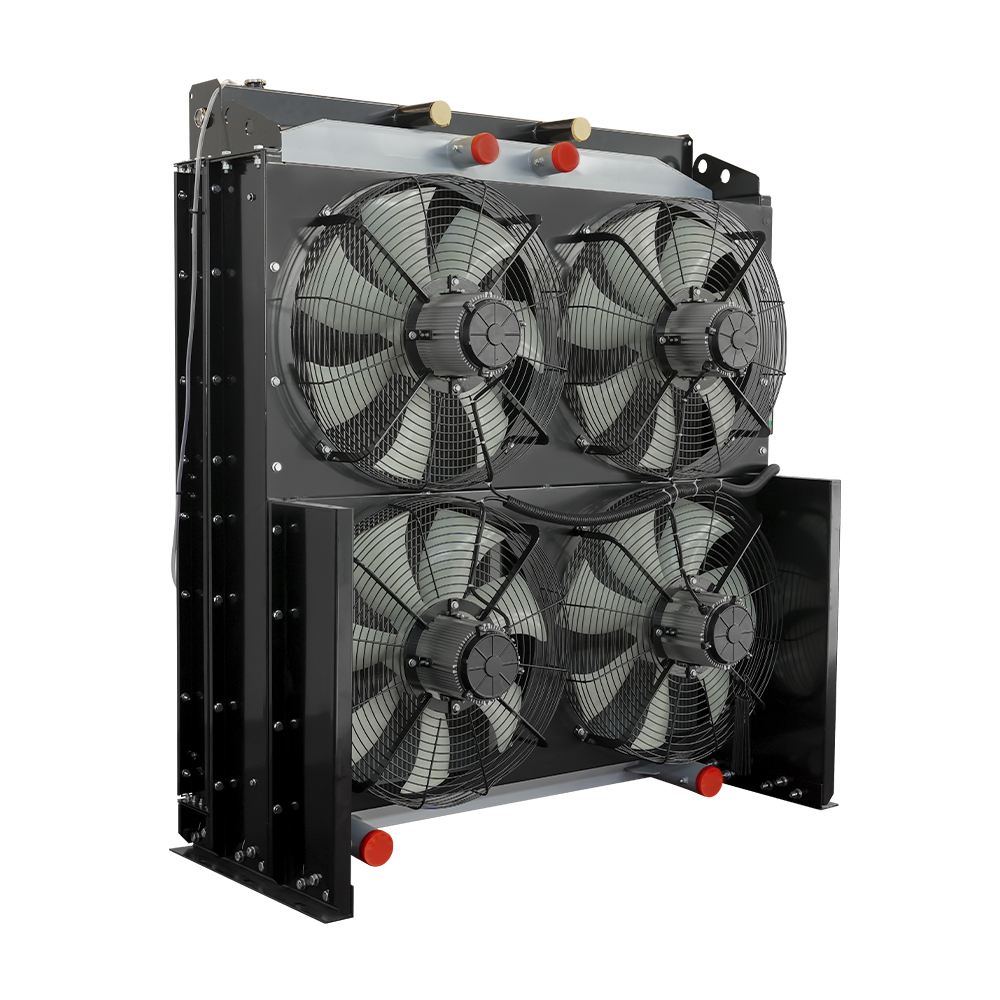 Coastal Environment Generator RadiatorsBuilt with anti-salt corrosion materials and protective coatings, these radiators suit ports, seaside plants and island installations. They follow the discussion of salt-spray testing and coating selection for humid, saline conditions.View Product →
Coatings also need support from housekeeping. A periodic fresh-water rinse of the fin pack removes salt crystals that would otherwise sit on the surface through every humid night, and it costs almost nothing to perform.
Coolant Chemistry: The Half You Control After Delivery
A corrosion-resistant radiator can be undermined by its first coolant top-up. Chemistry is the part of the package that stays under the owner's control, and it is where most premature core failures begin. Five habits make the difference:
- Use a diesel-rated coolant whose inhibitor package is compatible with aluminum. Organic acid technology (OAT) and hybrid OAT formulations are the usual match for all-aluminum cores.
- Top up with deionized or distilled water. Hard well water carries chlorides and hardness salts that attack the protective film and scale the tubes from the inside.
- Keep freeze point and inhibitor concentration inside the specified range, and test the coolant at least once a year. Glycol that has run hot for years breaks down into organic acids, lowers the pH and starts etching aluminum.
- Never mix coolant chemistries. Combining incompatible inhibitor packages can cancel protection exactly where the metals are most vulnerable.
- Check the ground straps between engine, radiator and frame at every service. Stray-current corrosion stays invisible until the metal is already gone.
Cavitation pitting deserves a separate mention on diesel sets. Engine vibration forms vapor bubbles in the coolant that collapse against metal surfaces and drill microscopic pits; supplemental coolant additives exist specifically to leave a protective film against this. Running straight water, or a mix that has long passed its service life, removes that defense precisely where the engine needs it most.
Match the Radiator to the Site, Not Just the Engine
Two generator sets built around the same engine can legitimately need different radiators when one operates in a desert and the other beside the sea. Site conditions change the material, the coating and even the core sizing.
In high-ambient desert locations, cooling margin shrinks as air temperature climbs, so cores are sized with extra capacity to hold coolant temperature in range at ambients approaching 50°C. Abrasive dust then pushes the design toward fins and coatings that survive repeated cleaning without wearing through.
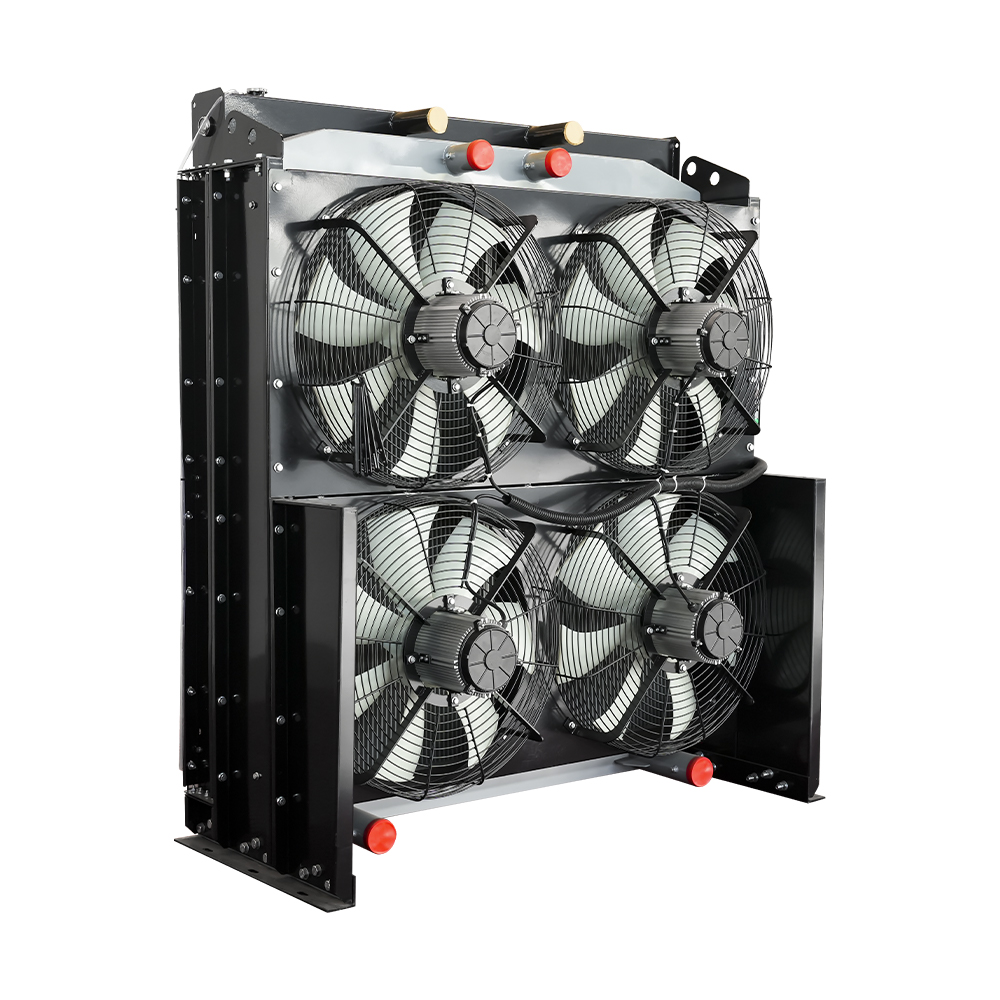 Desert High-Temperature Generator RadiatorsFeaturing enlarged cores, high-capacity fans and heat-resistant coatings, these radiators keep coolant temperatures stable where ambients approach 50°C, addressing the desert cooling-margin and dust-survival challenges described nearby.View Product →
Coastal and offshore installations add salt spray and near-constant humidity, which is why coated cores and routine rinsing are standard practice there rather than optional extras. Mining and construction sites combine vibration, impact risk and dust, while remote and unmanned locations such as lighthouses or telecom stations leave no room for frequent inspection. In those places, material robustness and coating quality have to carry more of the workload, because a small corrosion problem cannot be caught early.
Six Questions to Ask Before You Buy
A short list of questions separates a genuinely corrosion-resistant radiator from one that merely looks the part on a datasheet:
- Which alloys are used for tubes, fins and headers, and are the tanks aluminum or plastic?
- How many hours of neutral salt-spray testing has the coated core passed, and against which standard?
- Which coolant chemistry is the core validated with, and what does the warranty say about coolant use?
- What coating system and film thickness are applied to the fins, and how is coverage at the fin edges handled?
- What service interval does the supplier recommend for coolant testing in my environment class?
- Are replacement gaskets, clips and coating touch-up materials available for the specific model?
A radiator that resists corrosion is never the result of one lucky material choice. It is a matched system: a single metallurgy in the core, a coolant chemistry that protects that metallurgy, a coating engineered for the surrounding air, and sizing that respects the site. When one leg is missing, the failure pattern is predictable — crusty joints, pinhole leaks near the bottom header, and fin rows that pit or rust from the ground up. When all four legs are in place, the radiator disappears into the background of a well-run power system, which is exactly where it belongs. If you are matching a core to a specific engine platform or a demanding site, working with a manufacturer that already organizes its generator radiator catalog by brand, application and environment is the shortest route to a unit that fits both the engine and the air it breathes.

- Product Categories
- Contact Us
-
- wcradiator@jswcsrq.com
- +86-514-400-180-4088
- +86-15152759383
- +86-15152759383
- No. 6 Road, Shaobo Industrial Concentration Zone, Jiangdu District, Yangzhou City, Jiangsu Province, China

