


 English
  русский
  Français
  Indonesia
  عربى
عربى  中文简体
中文简体

How to Choose High Quality Radiators for Wholesale: Generator Buyer’s Guide
Content
- 1 Why Radiator Quality Matters in Generator Wholesale
- 2 Key Material Options: All-Aluminum vs. Aluminum-Plastic
- 3 Structure Types: Tube-and-Fin vs. Plate-and-Fin
- 4 Matching Radiators to Generator Brands (Cummins, Perkins, Weichai & More)
- 5 Special Environment Solutions: Desert, Coastal & Mining
- 6 Customization & OEM Process for Wholesale Buyers
- 7 How to Evaluate a Radiator Supplier: Checklist
Why Radiator Quality Matters in Generator Wholesale
Radiator failures are responsible for 12–18% of generator downtime events. Every unplanned shutdown costs your customer money and erodes trust in your supply chain. In wholesale procurement, the radiator is not a commodity part. It is the thermal gatekeeper of the entire genset.
A cracked core or a leaking tank can lead to catastrophic engine overheating within minutes. The real cost of a low-quality radiator surfaces months after installation: higher field service calls, elevated warranty claims, and damage to your OEM reputation. Wholesale buyers who treat the radiator as a tick-box item risk losing fleet contracts to competitors who engineer cooling reliability from the start.
The link between cooling system integrity and total cost of ownership is direct. A well-built radiator extends service intervals and reduces the auxiliary power needed to drive the fan. Over a 10-year generator lifespan, these savings compound. This is why leading generator packagers scrutinize radiator design with the same intensity they apply to the engine block.
Key Material Options: All-Aluminum vs. Aluminum-Plastic
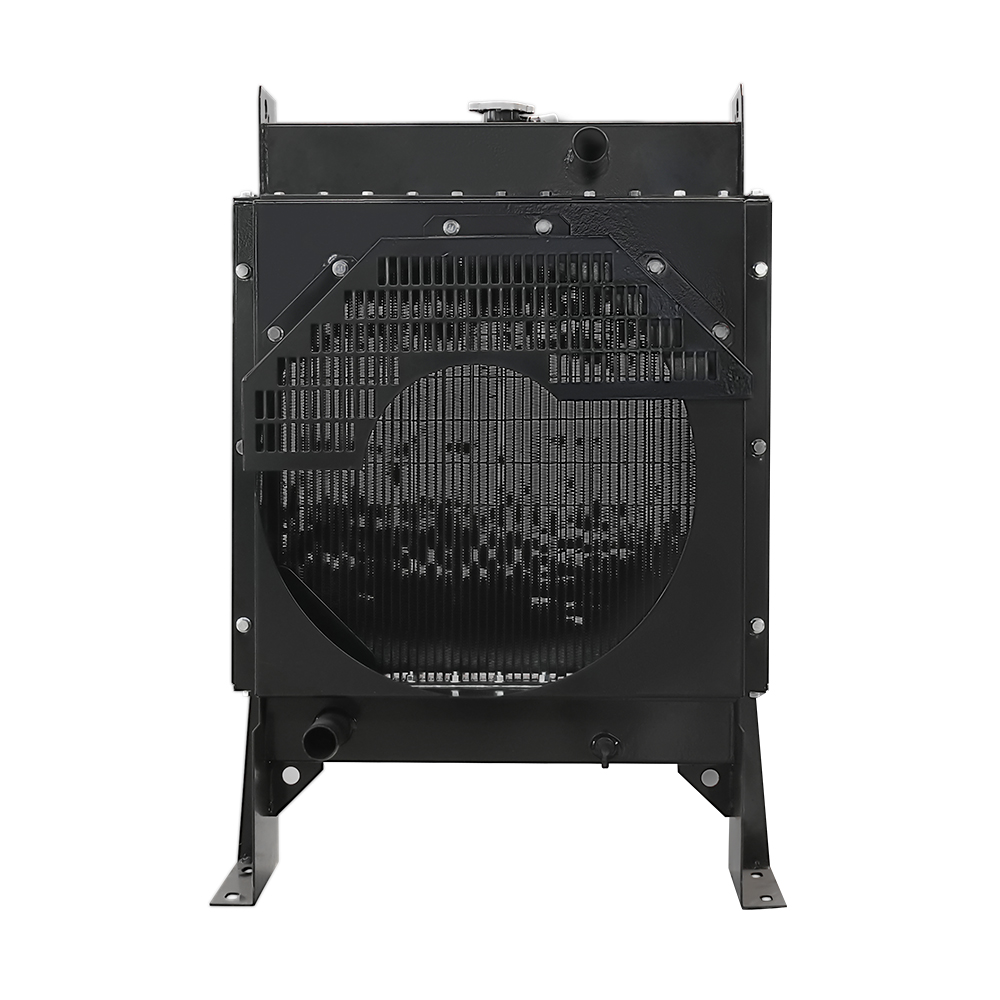
Choice of core and tank material dictates how a radiator performs under thermal stress, vibration, and corrosive attack. The two dominant paths are all-aluminum and aluminum-plastic composite. The price difference is real: all-aluminum units typically cost 15–25% more at the wholesale level. But they return 30–50% longer service life in demanding applications.
All-aluminum radiators use brazed joints throughout the core and tank. This creates a monolithic structure that resists thermal expansion mismatch and eliminates gasket failure points. For data centers in tropical climates or mining sites at altitude, the all-aluminum design is often the only acceptable option. Aluminum-plastic radiators, by contrast, use a crimped-on plastic tank with a silicone gasket. They weigh less and cost less, making them suitable for standby generators that run fewer than 200 hours per year in mild environments.
Corrosion resistance drives the decision in coastal markets. Salt spray testing shows that all-aluminum cores with internal and external conversion coatings survive over 1,000 hours of ASTM B117 exposure without pinhole leaks. Aluminum-plastic combinations can start showing joint corrosion after 400 hours if the gasket is not perfectly sealed. Wholesale buyers supplying marine or offshore applications should default to all-aluminum radiator specifications.
| Factor | All-Aluminum | Aluminum-Plastic |
|---|---|---|
| Unit Cost at MOQ 100 | 15–25% higher | Baseline |
| Typical Service Life | 15,000–20,000 hours | 8,000–12,000 hours |
| Corrosion Resistance | Excellent (salt spray >1,000 h) | Moderate (risk at gasket joints) |
| Repair Feasibility | Brazed repairs possible | Usually replaced as assembly |
| Best Environment | Desert, coastal, mining, high-utilization | Standby, indoor, temperate |
The key for a wholesale buyer is to run the numbers over the installation’s intended lifecycle. A $120 price gap per unit multiplied by 200 generators becomes $24,000 in upfront savings. If those savings trigger just four extra field technician dispatches for leak repairs, the entire margin evaporates. Long-life radiators are a warranty cost reduction tool, not just a component purchase.
Structure Types: Tube-and-Fin vs. Plate-and-Fin
Radiator core structure determines both heat rejection consistency and maintenance behavior. Tube-and-fin cores consist of flat tubes with serpentine fins inserted between them. Plate-and-fin (also called bar-and-plate) cores stack stamped plates with internal turbulators. Both can deliver high thermal performance, but they differ sharply in repairability and vibration tolerance.
Tube-and-fin designs dominate the generator wholesale market for one practical reason: field repairable. A single punctured tube can be isolated or replaced by a technician on-site without removing the entire radiator. This matters enormously for remote telecom towers or village electrification projects where logistics are slow. Plate-and-fin cores, in contrast, cannot be economically repaired in the field. A punctured plate typically means a full core replacement.
- Tube-and-fin advantages: Lower manufacturing cost, easier field repair, lighter weight, proven performance in standby and prime power applications.
- Tube-and-fin disadvantages: More susceptible to fin clogging in dusty environments, slightly lower structural rigidity under extreme vibration.
- Plate-and-fin advantages: High stiffness, excellent vibration resistance, compact package for high-power-density gensets, better performance in multi-pass configurations.
- Plate-and-fin disadvantages: Higher tooling cost, no field repair capability, usually requires factory replacement, heavier.
For wholesale buyers managing fleets across construction sites or mining operations, the choice often tilts toward tube-and-fin for units under 500 kVA and plate-and-fin for high-kilowatt engines above 800 kVA where vibration loads are severe. The cost per repair event in plate-and-fin systems is higher, but the lower failure frequency in heavy-duty applications can justify the premium.
Matching Radiators to Generator Brands (Cummins, Perkins, Weichai & More)
Generator engine OEMs design their cooling circuits around specific coolant flow rates, pressure drops, and mounting envelopes. A radiator that cools perfectly on a Perkins 1106A may bolt onto a Weichai WP10 but fail to maintain thermostat opening temperature because the fin density and pass arrangement are mismatched. Blind interchange leads to warranty-voiding operating conditions.
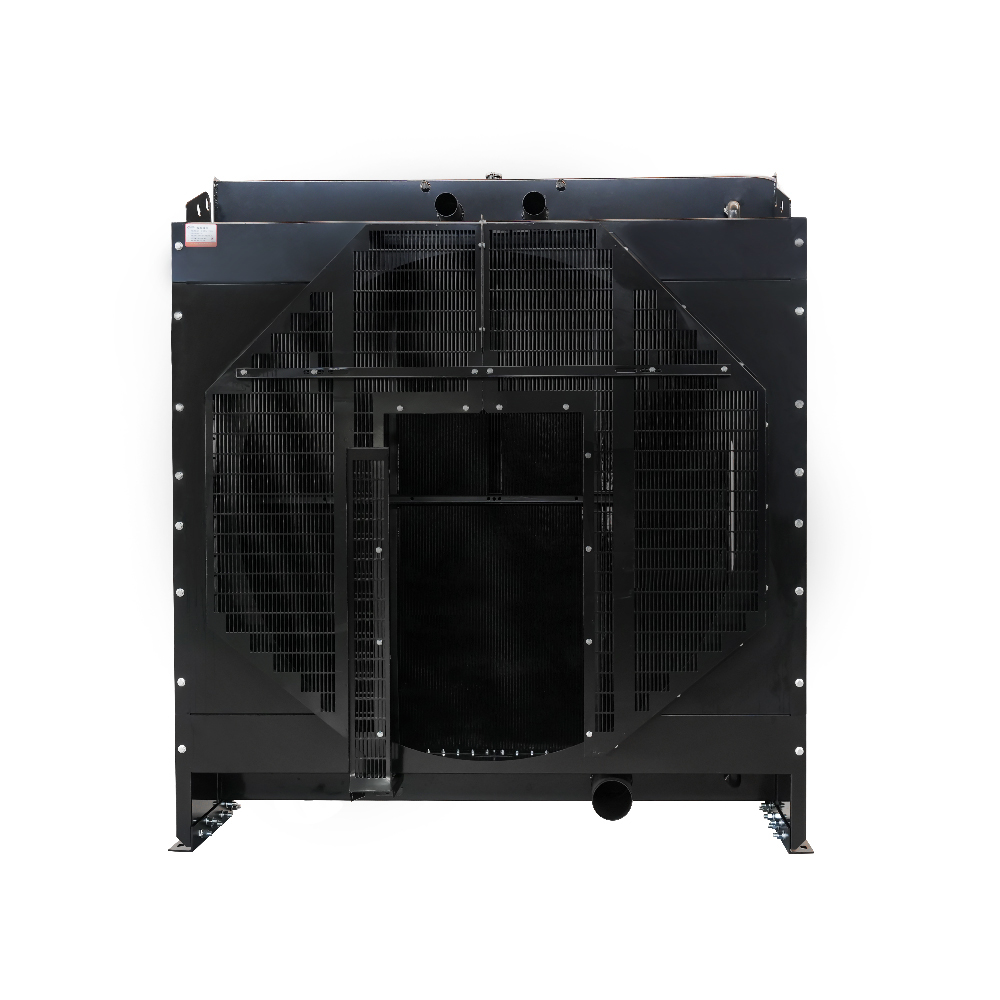
The table below maps common generator engine families to their recommended radiator parameters. Wholesale buyers should use this as a specification checklist when evaluating supplier catalogs. Not all engines need the same core depth or inlet/outlet orientation. For example, Cummins generator radiators frequently require low-fin-height cores on the QSX15 series to allow proper clearance in sound-attenuated enclosures.
| Engine Brand | Example Series | Typical Core Size (mm) | Cooling Capacity (kW) | Common Inlet / Outlet Position |
|---|---|---|---|---|
| Cummins | QSK23 | 1200 x 1200 x 120 | 210 | Top right / Bottom left |
| Perkins | 4006-23TAG3A | 1050 x 1050 x 145 | 195 | Top center / Bottom center |
| Weichai | WP13 | 1180 x 1150 x 110 | 175 | Top left / Bottom right |
| Mitsubishi | S16R | 1350 x 1250 x 150 | 260 | Top right / Bottom right |
| Doosan | DP158 | 1100 x 1000 x 130 | 185 | Top left / Bottom left |
| Baudouin | 6M21 | 1150 x 1100 x 125 | 190 | Top center / Bottom center |
| MTU | 12V2000 | 1400 x 1300 x 160 | 310 | Top right / Bottom right |
| Yuchai | YC6TD | 1100 x 1080 x 100 | 155 | Top left / Bottom right |
| SDEC | SC12E | 1120 x 1050 x 110 | 165 | Top right / Bottom left |
| Kubota | V3800 | 920 x 870 x 75 | 95 | Top left / Bottom left |
Each engine series may have multiple radiator options depending on ambient temperature rating. A standard unit might be rated for 45°C ambient, but a high-ambient version with an enlarged core can push the limit to 55°C. When sourcing wholesale, always specify the target ambient class. A supplier offering only one core size per engine model is probably not engineering a range for your application.
Special Environment Solutions: Desert, Coastal & Mining
Standard radiator specifications fail in environments where dust, salt, or extreme heat become the dominant stressors. Designing for these conditions is not a matter of adding a larger fan. It requires material selection, core geometry, and surface treatment decisions that are baked into the radiator from the first manufacturing step.
- Desert installations: Sand ingestion and high air temperatures demand core face areas increased by 20–40% compared to temperate designs. Fin pitch must be widened to 3.0–3.5 mm to reduce clogging, and the entire core should use tube-and-fin architecture with louvered fins arranged at a shallow angle. High-power generator radiators engineered for Middle Eastern solar-hybrid plants routinely incorporate manual or automatic fin-cleaning access ports.
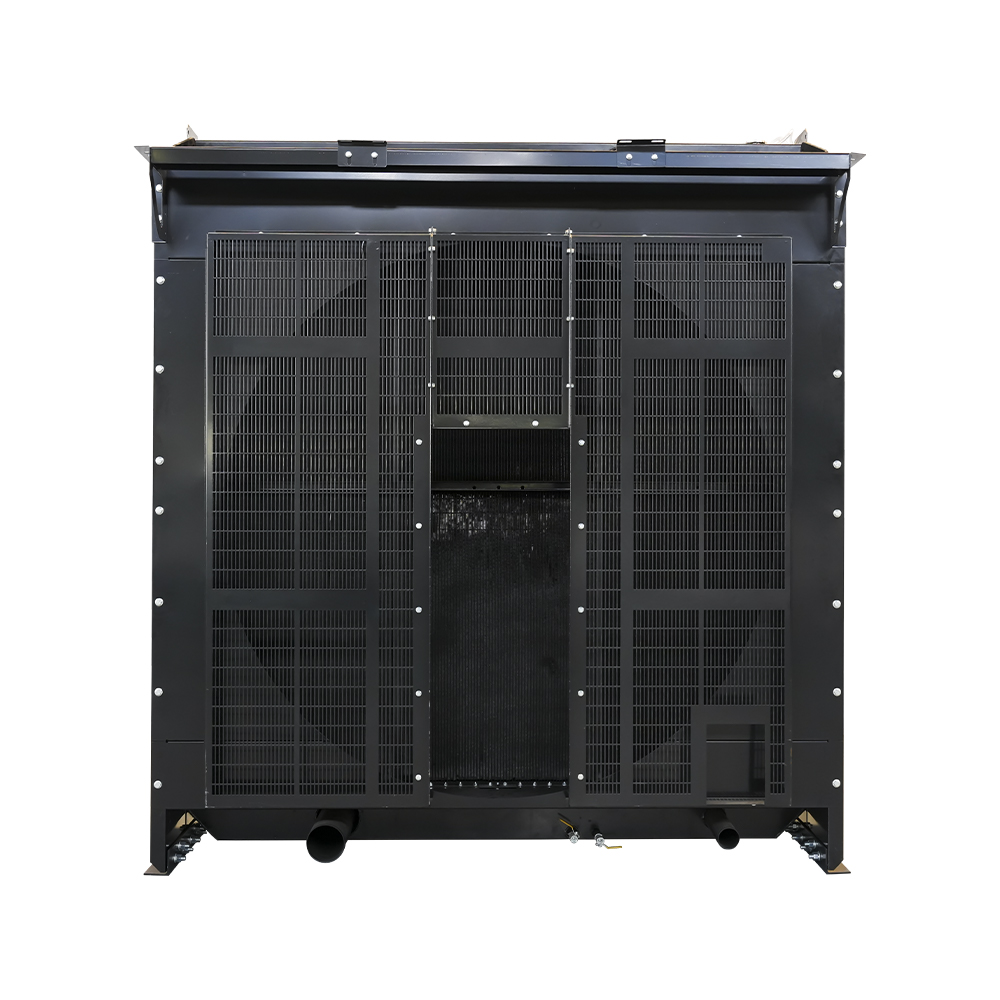
- Coastal and offshore environments: Salt mist accelerates galvanic corrosion wherever dissimilar metals touch. All-aluminum construction with stainless steel fasteners and anodized surface layers is the minimum. Our validation protocol includes 1,000-hour neutral salt spray cycles with visual inspection every 200 hours. Radiators that rely on painted steel frames or zinc-plated hardware consistently fail within two years in Southeast Asian island grids.
- Mining operations: Vibration from blasting and haul truck traffic combines with abrasive coal or mineral dust. Plate-and-fin cores with full header reinforcement and rubber-isolated mounting brackets reduce fatigue cracking. Cooling fans must be reversible or equipped with automatic dust blow-out cycles. In iron ore mines where dust contains magnetic particles, additional shielding over the radiator face protects the fins from being packed solid within a single shift.
The additional cost for these protective measures typically ranges from 10–20% of the radiator base price. Spread over a 10-year generator lifespan with reduced cleaning and replacement frequency, the net present value is consistently positive. For mining and offshore wholesale bids, including the environmental specification in the RFQ separates competent suppliers from those offering generic catalog parts.
Customization & OEM Process for Wholesale Buyers
Wholesale radiator procurement moves into a different tier when you need non-standard inlet diameters, special paint finishes, or integrated expansion tanks. A supplier that can handle OEM customization streamlines your assembly line and reduces the part count you manage. The process is not complicated, but it demands clear communication at each stage.
- Requirement gathering (2–3 days): Share engine model, target ambient temperature, airflow availability, space constraints, and any certification needs (CE, UL, ABS). Include photographs of the installation bay.
- Parameter confirmation and proposal (3–5 days): Supplier returns a thermal calculation sheet and a conceptual layout drawing. This stage locks down core dimensions, fin type, number of passes, and inlet/outlet positions.
- 3D model and drawing sign-off (5–7 days): A detailed STEP or IGS file shows the radiator in its mounted state. Review clearances for fan, belts, and hose connections before release.
- Prototype fabrication (7–15 days): A single sample unit is built and subjected to pressure cycling and thermal shock testing. Test reports are shared with the buyer.
- Batch production and delivery (20–45 days, MOQ-dependent): Once the prototype is approved, serial production begins. Typical MOQ for customized OEM radiators starts at 50 units, with unit price reductions applying at 100, 200, and 500-piece tiers.
| MOQ Tier | Approx. Unit Price vs. Base | Production Lead Time | Standard Warranty |
|---|---|---|---|
| 50 units | +30% (tooling amortized) | 35–45 days | 18 months |
| 100 units | +15% | 30–40 days | 24 months |
| 200 units | +5% | 25–35 days | 24 months |
| 500+ units | Baseline price (tooling absorbed) | 20–30 days | 24 months |
The capability to provide short prototype loops and documented test reports is what distinguishes a manufacturing partner from a reseller. When evaluating an OEM radiator supplier, ask to see the instrumentation they use for thermal validation. Airflow benches and calibrated temperature data loggers are non-negotiable for volume production.
How to Evaluate a Radiator Supplier: Checklist
Not all claims of “factory direct” withstand scrutiny. A wholesale buyer needs a structured way to compare suppliers before committing to container loads. The checklist below covers critical dimensions of manufacturing depth, application engineering, and after-sales support.
- Does the supplier have dedicated generator radiator engineering staff, or are they adapting automotive designs?
Adapted designs often miss the airflow and cooling capacity specifics of stationary gensets. - Is the factory equipped with controlled atmosphere brazing (CAB) furnaces for all-aluminum cores?
CAB is the industry benchmark for leak-free aluminum heat exchangers. - Can they provide a salt spray test report (ASTM B117) for their standard corrosion protection?
Ask for a minimum of 720 hours with no red rust on critical surfaces. - Do they offer at least three core depth options for the same engine model?
A single core option suggests a repackaged catalog, not engineering capability. - Have they completed projects in extreme desert or coastal environments with verifiable references?
Request a case study or client contact for a similar application. - Is the warranty explicit about hours and application?
Standby-only warranty is different from prime power. Check the fine print. - Can they support multi-language technical documentation for your installation teams?
Arabic, Spanish, or French documentation reduces field errors significantly. - Do they stock common service parts (caps, gaskets, drain valves) for quick dispatch?
Lead times on spare parts are as important as lead times on complete radiators. - What is their production scalability?
Confirm maximum monthly output and the surge capacity for short-lead emergency orders. - Do they have third-party certifications such as ISO 9001 or pressure equipment directives (PED)?
Independent audits add a layer of confidence for regulatory compliance.
Running through this checklist with two or three potential suppliers exposes gaps quickly. A supplier that answers all ten points with specific data and documented evidence is equipped to manage your wholesale radiator program. Those who deflect toward generic sales brochures are unlikely to meet the reliability demands of modern generator fleets.

- Product Categories
- Contact Us
-
- wcradiator@jswcsrq.com
- +86-514-400-180-4088
- +86-15152759383
- +86-15152759383
- No. 6 Road, Shaobo Industrial Concentration Zone, Jiangdu District, Yangzhou City, Jiangsu Province, China

