


 English
  русский
  Français
  Indonesia
  عربى
عربى  中文简体
中文简体

Radiator Part Number Cross-Reference: A 3-Step Guide for Generators & Fleets
Content
- 1 Why a Simple Part Number Match Isn’t Enough
- 2 Step 1: Locate & Decode Your Radiator Part Number
- 3 Step 2: The Online Cross-Reference Process
- 4 Step 3: The Physical & Performance Verification Checklist
- 5 Material & Structure: The Hidden Variables in Cross-Reference
- 6 How to Handle “No Match” or Partial Matches
- 7 B2B Best Practice: Batch Cross-Reference for OEMs & Rental Fleets
Why a Simple Part Number Match Isn’t Enough
A maintenance supervisor in a remote mining camp stares at a faded Cummins radiator tag. The online database returns one matching entry. He places the order, confident the part will slide right in. Three weeks later, the replacement arrives—and the bolt holes are off by 18 mm. The generator stays offline for two more days.
This scenario plays out across industrial sites, rental yards, and data centers every month. Relying on a part number alone ignores the physical and thermal variables that turn a paper match into a real-world failure. A cross-reference succeeds only when it validates dimensions, interface geometry, mounting layout, and cooling capacity alongside the numeric identifier.
Common mismatches include inlet diameters that differ by 6 mm even when the catalog says “compatible,” core thicknesses that interfere with fan shrouds, and pressure ratings that can’t handle the generator’s coolant flow. An aluminum-plastic tank rated for 15 psi will crack beside a 20-psi system. A copper-brass core that matches the original part number may weigh 30% more than a modern brazed-aluminum design, stressing mounting brackets on a mobile generator trailer.
A physical match is the only confirmation that matters. The part number is the starting point, never the final answer. In the sections ahead, you’ll get a repeatable three-step method to move from a paper number to a working radiator—without the costly trial and error.
- Dimensional drift: OEMs revise bracket positions or core depth without changing the base part number. A suffix change like “-02” can signal a 12 mm shift.
- Interface surprises: Hose nipples, NPT threads, SAE flange sizes, and JIC 37° fittings vary across builds. A cross-reference that ignores connection type leads to plumbing nightmares.
- Cooling gap: Two radiators sharing a part number may differ in fin density and tube count, yielding a 10–15% gap in heat rejection.
- Material mismatch: An OEM aluminum-plastic unit swapped for a copper-brass “equivalent” triggers galvanic corrosion if coolant chemistry isn’t adjusted.
- Mounting ghosts: Side brackets, bottom pins, and fan shroud clips often change between production batches. Parts lists don’t always capture these silent revisions.
Step 1: Locate & Decode Your Radiator Part Number
Start with the hardware, not the paperwork. Labels fade and service manuals get lost, but the metal usually carries a clue. Look first at the top tank. Many generator radiators from Cummins, Perkins, Doosan, and MTU have a laser-etched plate or silver sticker on the tank face. If that’s gone, check the vertical side channels and the bottom rail. Stamped digits often hide under paint or grime—a quick wipe with solvent reveals them.
On remote-type radiator packages, the part number may sit on a separate frame tag near the lifting eye. For units that have been repainted, use a flashlight at a shallow angle. The shadow cast by the stamping will pop even if the paint is thick.
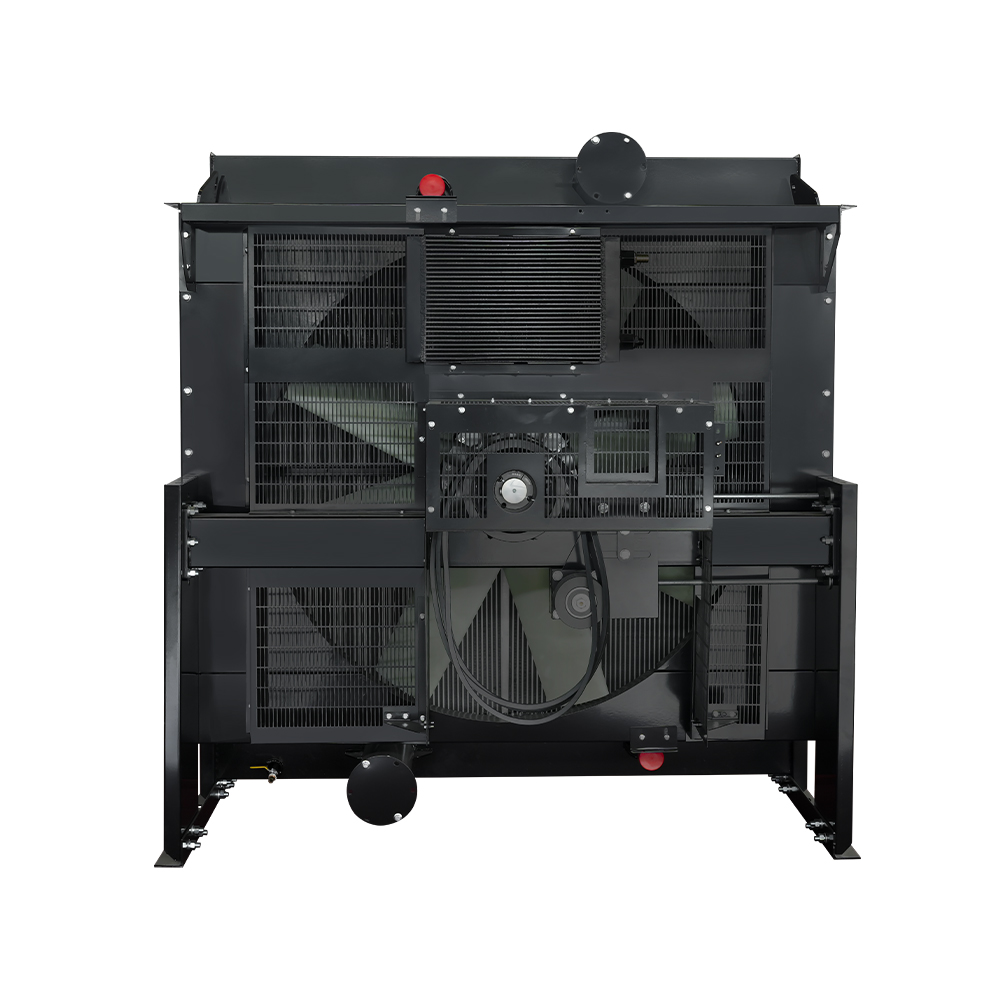
Once you have the string of letters and numbers, break it down. OEM part numbers are not random. A Cummins code like “RA-0123-04” typically segments into function (RA = Radiator Assembly), a series identifier (engine platform), and a revision or customer-specific suffix. Understanding this structure helps you spot what’s critical versus what’s a packaging variant. Our Cummins generator radiator catalog maps many original part numbers directly to our models, showing which suffixes indicate dimensional changes.
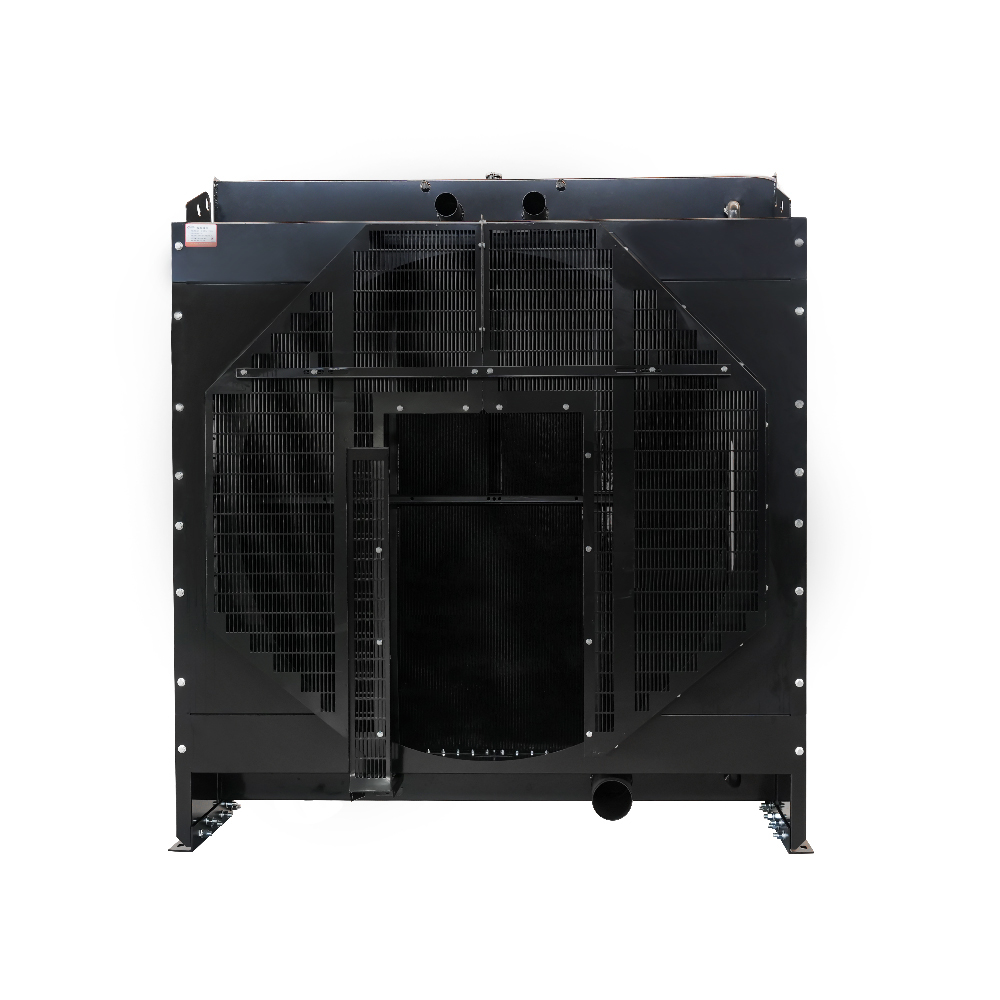
Perkins uses a different logic: the first two digits often tie to the engine family (1100 Series, 2300 Series), while the last portion denotes the variant and build standard. If you’re replacing a Perkins Engine radiator, the Perkins radiator page cross-links original part numbers with our replacement units and notes any bracket adjustments needed. Decoding the prefix alone can prevent you from chasing a number that belongs to a completely different cooling package.
| Brand | Prefix/Segment Meaning | Example (Illustrative) |
|---|---|---|
| Cummins | “RA” = Radiator Assembly; numeric block = engine platform + cooling capacity code | RA-0123-04 |
| Perkins | First digits = engine family; suffix = revision and build standard | PK8912/B |
| MTU / Detroit Diesel | “X00” prefix = heat exchanger group; middle digits = model identifier | X00123405 |
| Yuchai / Weichai | Numeric string often includes engine displacement in liters within the first blocks | 300-1002-05 |
Step 2: The Online Cross-Reference Process
With the decoded part number in hand, move to the database. Most industrial radiator suppliers provide a search field that accepts OEM numbers, supplier stock codes, or dimensional specifications. Enter the full number first, including any dashes, slashes, or suffix letters. If the system returns an exact match, don’t stop there. Open the product detail and download the dimensional drawing or specification sheet.
What you’re checking: core height, core width, core thickness, overall length including tanks, inlet and outlet diameters, and the exact center-to-center distance between mounting holes. A genuine cross-reference requires at least 90% dimensional overlap. If the drawing shows a core depth of 135 mm and your original measures 148 mm, the replacement may not seat inside the existing shroud.
When the database returns no direct match, try the partial approach. Drop the suffix and search again. A part number like “RA-0123-04” may match “RA-0123” in the supplier’s system, with the “-04” indicating a different paint finish or a fan guard that doesn’t affect core fit. Read the compatibility notes carefully—many aftermarket equivalents list all known OEM part numbers, but only on the condition that the core dimensions align.
For generator sets that use remote-mounted radiators, especially in rental fleets and power truck applications, cross-referencing by chassis and enclosure model can be faster than chasing a single part number. Our site allows filtering by engine brand, power output, and radiator structure, letting you verify fitment even when the original tag is unreadable.
Step 3: The Physical & Performance Verification Checklist
Before cutting a purchase order, run through this checklist. Tape it to the generator control panel or save it on your phone. Every field must line up.
| Checkpoint | What to Measure / Confirm | Acceptable Tolerance |
|---|---|---|
| Core height | Fin pack visible height (excluding header plates) | ±3 mm |
| Core width | Width from side channel to side channel | ±3 mm |
| Core thickness | Depth from front to rear header plate | ±2 mm; verify shroud clearance |
| Overall length | Tank end to tank end (including any mounting tabs) | ±5 mm |
| Inlet diameter & type | ID/OD and style: straight hose, threaded NPT, flange, JIC 37° | Exact match or adapter available |
| Outlet diameter & type | Same as above; note location relative to tank top/bottom | Exact match |
| Mounting centers | Distance between bolt holes, pin centers, or bracket slots | ±2 mm |
| Cooling capacity | Radiator rated heat rejection (kW or BTU/hr) at design airflow | Must be ≥ engine heat rejection + 10% margin |
| Pressure rating | Tank design pressure (psi / bar) | Equal to or greater than system cap rating |
Never skip the cooling capacity check. A radiator that fits physically but rejects only 85 kW in a 95-kW thermal load application will trip high-temperature alarms within the first hour. Obtain the engine’s heat rejection data from the OEM datasheet. Allow a 10–15% safety factor for fouling, altitude, and ambient temperature. If the replacement radiator’s published capacity doesn’t meet that threshold, it is not a substitute, regardless of what the part number suggests.
Material & Structure: The Hidden Variables in Cross-Reference
Two radiators can share the same core dimensions and the same OEM part number on the box, yet deliver a completely different service life depending on what they’re made of and how they’re built. The original manufacturer may have shipped a copper-brass unit with a solder-bonded header. The aftermarket replacement might be an aluminum-plastic unit with a mechanically crimped tank. The part number alone doesn’t tell you that.
A brazed all-aluminum radiator weighs about 30–40% less than an equivalent copper-brass design. On a skid-mounted generator that gets lifted by crane into a remote well site, that weight reduction lowers center of gravity and eases installation. Aluminum also handles vibration better—there’s no solder joint to crack. For applications in coastal or high-humidity regions, a pure aluminum construction resists the kind of chloride-induced pitting that eats through copper-brass in months. Our all-aluminum radiator solutions are engineered specifically for these harsh environments, with full-tempered cores that maintain pressure integrity even after thermal cycling.
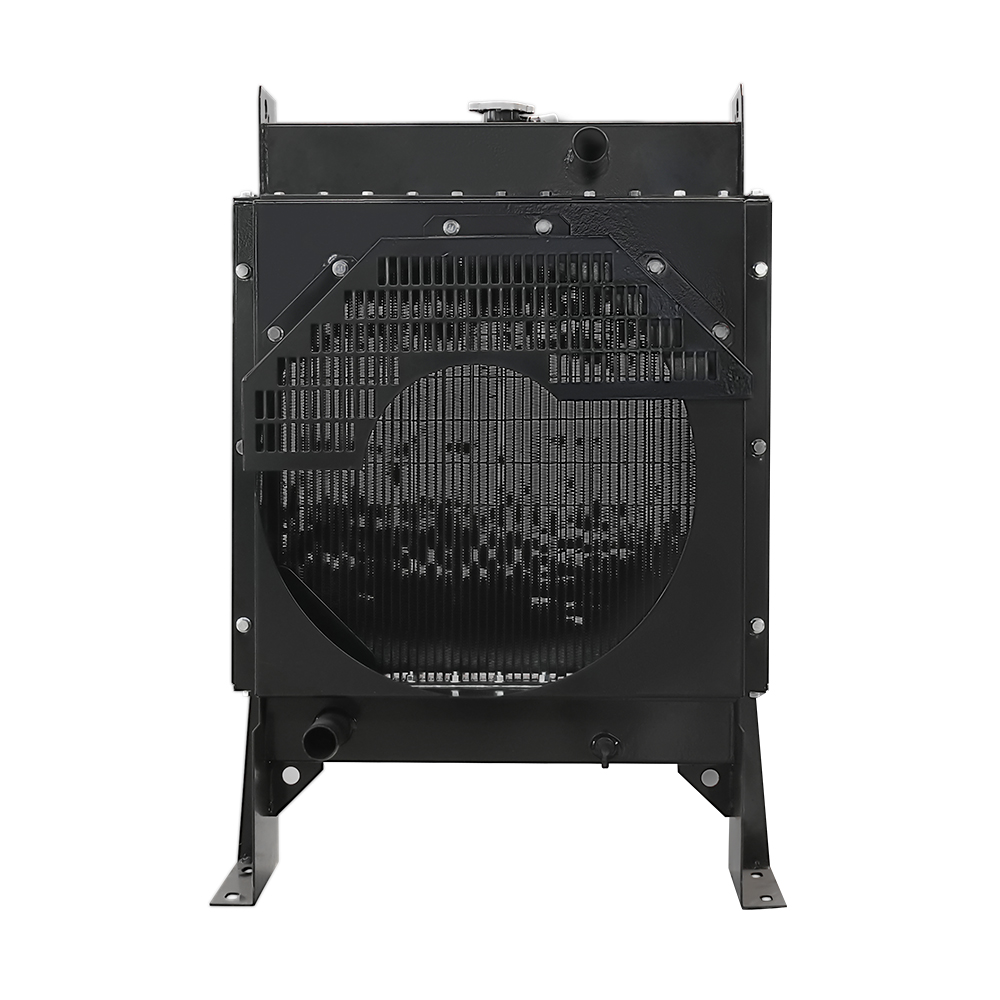
The structure type also matters. Tube-and-fin designs trade off between airflow resistance and heat transfer density. Plate-and-fin or bar-and-plate cores hold higher pressures and survive debris impacts better, making them the preferred choice for mining excavators that regularly face flying rock chips. When cross-referencing a part number, note whether the original unit used bar-and-plate construction. Swapping to a cheaper tube-and-fin equivalent without verifying the pressure and impact environment invites early field failure.
| Type | Typical Pressure Rating | Weight (relative) | Corrosion Resistance | Best Application |
|---|---|---|---|---|
| Brazed all-aluminum (bar-and-plate) | 30–40 psi | Lightest | Excellent (salt spray, humidity) | Mining, coastal gen-sets, mobile power trucks |
| Aluminum-plastic (tube-and-fin, crimp tank) | 15–20 psi | Moderate | Good (coolant side only; external tank can UV-degrade) | Stationary prime power in mild environments |
| Copper-brass (soldered) | 20–28 psi | Heaviest | Fair (galvanic risk with mixed metals) | Legacy replacement where weight isn’t critical |
How to Handle “No Match” or Partial Matches
A blank search screen doesn’t mean the end of the road. It means the part number logic ran out before the engineering logic did. When no database entry surfaces, collect five data points: core dimensions, inlet/outlet size and position, mounting style, pressure cap rating, and the engine’s heat rejection curve. Send these—not just the part number—to the supplier’s applications team.
Partial matches, where the core fits but one interface differs, fall into a decision tree. An inlet that’s 2 mm larger than the original can often be compensated with a short silicone reducer hose, provided the step change doesn’t create an air pocket. A bolt-pattern mismatch of less than 5 mm can sometimes be drilled out on-site if the bracket material allows. But if the mismatch touches pressure integrity, flow direction, or header tank volume, stop. No field modification is worth a coolant leak at 180°F and 12 psi in the middle of a hospital backup power run.
- Exact dimensional match, wrong material? Determine if the operating environment demands the original material. If yes, request a custom build with the correct metallurgy.
- Core matches but tank outlet is on the wrong side? Some radiators allow tank rotation or remanufacturing. Check with the supplier if the tank can be switched without compromising the pressure seal.
- Everything matches except the pressure rating? Never downgrade. A lower-rated radiator will fail catastrophically. Seek a higher-rated alternative with the same envelope.
- Part number suffix differs by one revision? Often a packaging or paint change only. Ask the supplier for a drawing overlay of the two part numbers.
- No part number exists? Supply photos with a tape measure across the core, inlet, and mounting points. Our engineering team routinely reverse-engineers legacy generators from nothing more than a shipping photograph and a sharpie-marked ruler.
B2B Best Practice: Batch Cross-Reference for OEMs & Rental Fleets
When you manage 40 generator packages spread across three provinces, you can’t afford to cross-reference one radiator at a time. Create a master equipment register: each asset ID, engine serial number, OEM radiator part number, measured core dimensions, and any notes on custom bracketry. Import that into a structured spreadsheet and feed it to your radiator partner’s sales engineers.
A batch cross-reference mapping typically takes 48 hours when all fields are complete. The supplier returns a line-item match status: green for direct equivalent in stock, yellow for a dimensional match with minor bracket adjustment, red for a custom build. This traffic-light system allows your procurement team to cut POs for the greens immediately, while engineering focuses on the few reds. Rental fleets that use this method cut emergency downtime events by over 30%, simply because they never wait for a single part number lookup to stall a repair.
OEMs assembling gen-sets for export can take it further. Provide the 3D envelope and thermal spec early in the design phase. The radiator manufacturer can pre-map a family of part numbers that cover all engine options, eliminating cross-reference guesswork at the assembly line. This also standardizes spare parts across multiple projects, reducing warehouse SKUs and simplifying MRO training.
For fleet operators looking to consolidate sourcing, our industrial and rental radiator product lines include pre-verified cross-reference lists for the most common generator platforms. One part number should unlock a supply chain—never hold you hostage.

- Product Categories
- Contact Us
-
- wcradiator@jswcsrq.com
- +86-514-400-180-4088
- +86-15152759383
- +86-15152759383
- No. 6 Road, Shaobo Industrial Concentration Zone, Jiangdu District, Yangzhou City, Jiangsu Province, China

