


 English
  русский
  Français
  Indonesia
  عربى
عربى  中文简体
中文简体

Custom Generator/Genset Solutions: How Bespoke Cooling Design Prevents Overheating
Content
Imagine specifying a 500 kVA generator set for a remote mine site: a reliable engine, a synchronizing controller, a weatherproof canopy. It performs well during the cold months, but on an afternoon when ambient temperature passes 40°C, the coolant temperature creeps up, the unit derates, and the operation loses load. The engine is not at fault. The cooling package is.
A custom generator/genset solution is more than a larger fuel tank or a different paint color. The real customization begins when the radiator is sized for the site, not for a catalogue reference condition. This article explains what that means, how to specify it, and how to avoid the procurement mistakes that lead to overheating after commissioning.
What “custom” really means for generator cooling
When buyers ask for a bespoke genset, they usually focus on power output, enclosure dimensions, and control strategy. From an engineering perspective, the cooling system is just as important. The radiator does not merely cool the engine; it determines the highest ambient temperature at which the genset can deliver rated power without derating.
Standard radiators are typically selected around a reference condition: full engine power at 40°C air temperature, sea-level air density, and clean airflow. On a site with higher ambient temperature, high altitude, or dusty air, that assumption breaks down. Air density drops as altitude rises, so the fan moves less mass of air. Temperature difference between coolant and air shrinks as ambient rises, so the core rejects less heat. The result is a rising coolant temperature, a derated engine, or a hot alarm on the controller.
For that reason, a custom cooling solution is not an upgrade; it is a requirement for any project outside a mild indoor environment.
How much customization is needed can be understood by comparing three levels:
| Option | What changes | Best suited to |
|---|---|---|
| Standard OEM-matched radiator | Core dimensions and mounting match the original engine package; conservative ambient assumptions | Indoor standby units in mild climates with regular maintenance |
| Semi-custom radiator | Larger core, different fan, adjusted shroud within an existing frame | Rental fleets and prime power sites with moderate duty cycles |
| Fully custom radiator | Core size, materials, mounting, remote layout, coatings, and fan engineering specified for one project | Desert, coastal, mining, lighthouse, high-power, and marine installations |
Most custom genset cooling projects belong in the bottom row. They need engineering and application experience, not just catalogue matching.
Key decisions in a custom genset cooling solution
1. Application and operating environment
Start with the duty cycle and site. An emergency standby genset may run only a few hundred hours per year, so a compact radiator can be acceptable. A prime power unit running continuously in a hot workshop needs far more heat rejection capacity. The common practice is to design for the worst combination of load and ambient temperature, not the average.
Site type matters just as much as temperature. In a quarry or open-pit mine, airborne dust and vibration attack the fin pack. Wider fin spacing, a stronger tube-to-header joint, and a reinforced core reduce the risk of blocked fins and leaks. A custom-built mining-site generator radiator is built for those conditions rather than for a clean machine room.
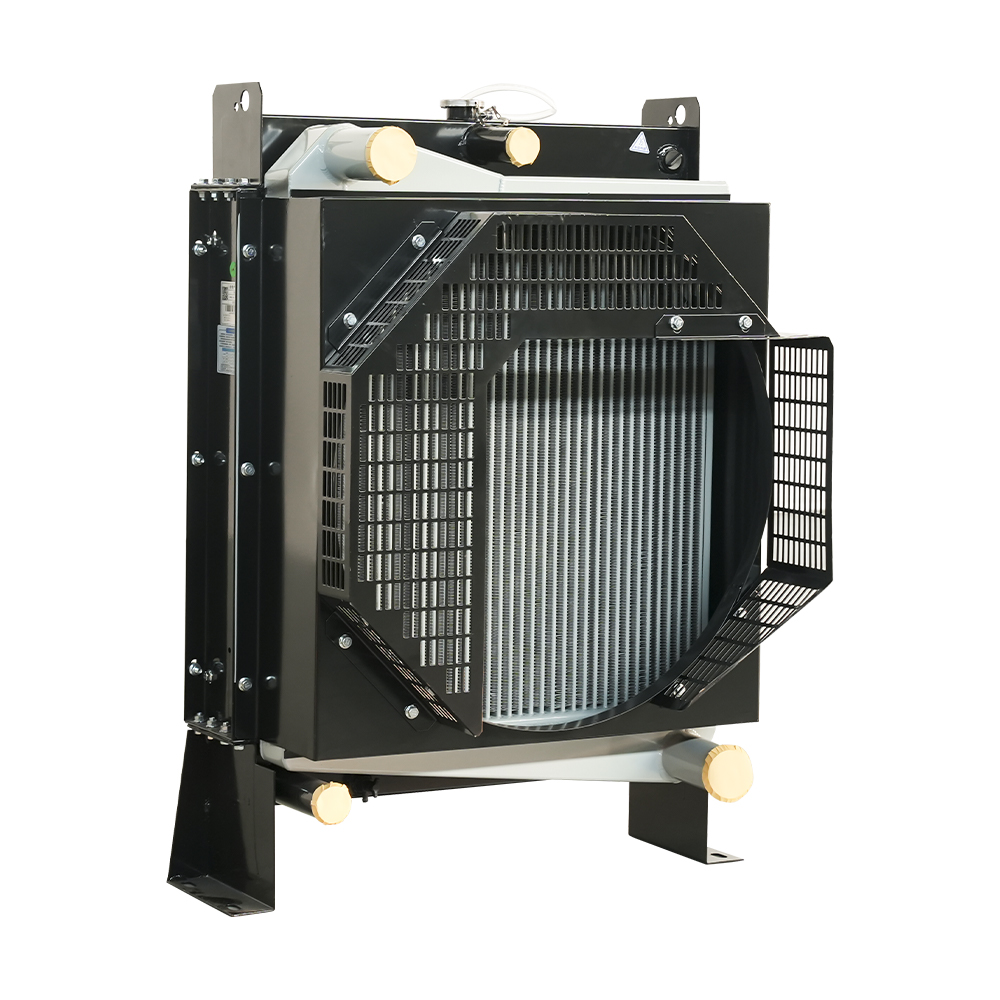 Mining Site Generator Radiators Manufacturers, Suppliers, FactoryAs OEM Mining Site Generator Radiators Manufacturers, Mining Site Generator Radiators Suppliers and Factory in China, Weichuang offer Cus...View Product →
In hot climates, the target is to reject heat with a smaller temperature difference. Oversized cores, higher fan power, or a remote radiator layout are the practical answers. For environments above roughly 45°C, many manufacturers recommend desert high-temperature generator radiators with larger face area and a more conservative fin design.
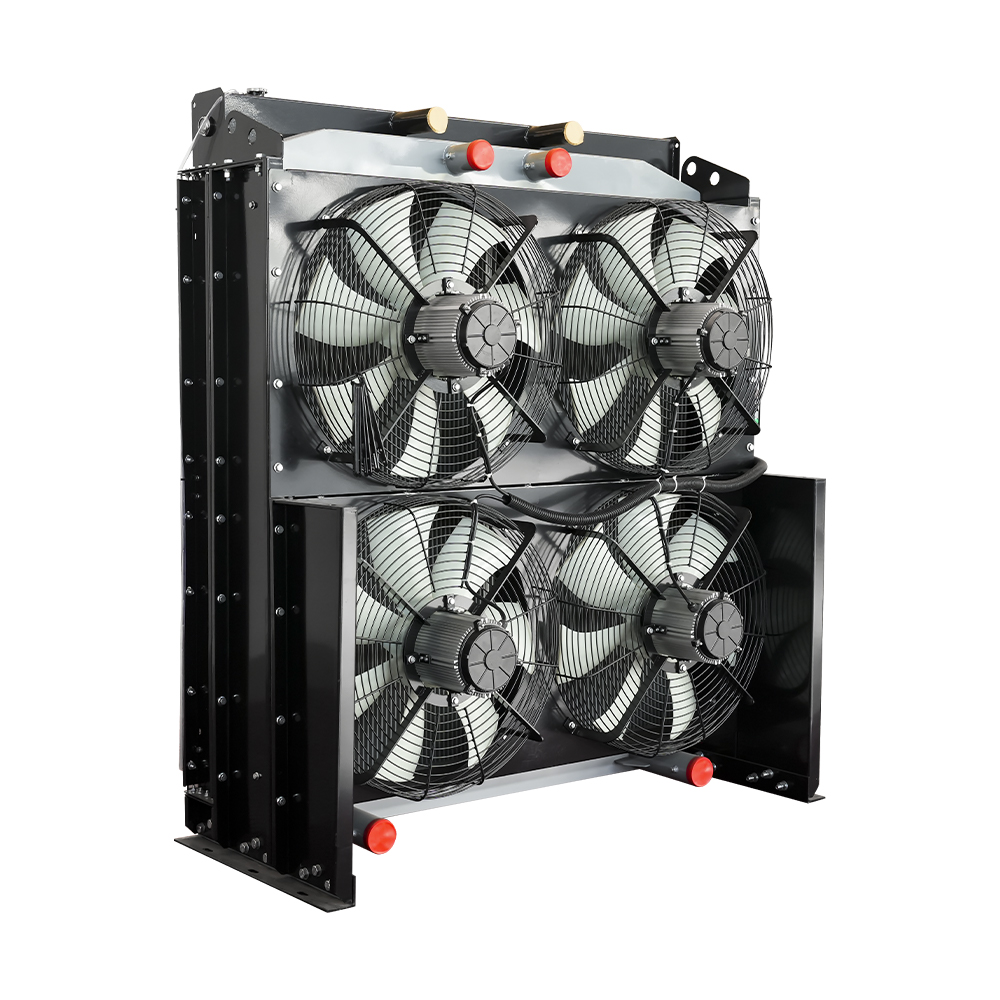 Desert High-Temperature Generator Radiators Manufacturers, Suppliers, FactoryAs OEM Desert High-Temperature Generator Radiators Manufacturers, Desert High-Temperature Generator Radiators Suppliers and Factory in Ch...View Product →
Coastal sites create a different problem. Salt-laden air corrodes bare copper and aluminum surfaces, so the customization is often about protection: e-coated aluminum fins, stainless steel brackets, and drainage points that prevent standing water. A single pinhole leak in a tube can stop a genset for days.
Urban and rental projects often add noise limits that force the genset into a soundproof canopy. That canopy restricts airflow and raises air temperature around the radiator. The solution is not simply a bigger core; it is a balanced combination of fan speed, ducting, and fin spacing. This is why silent genset radiators need their own design logic.
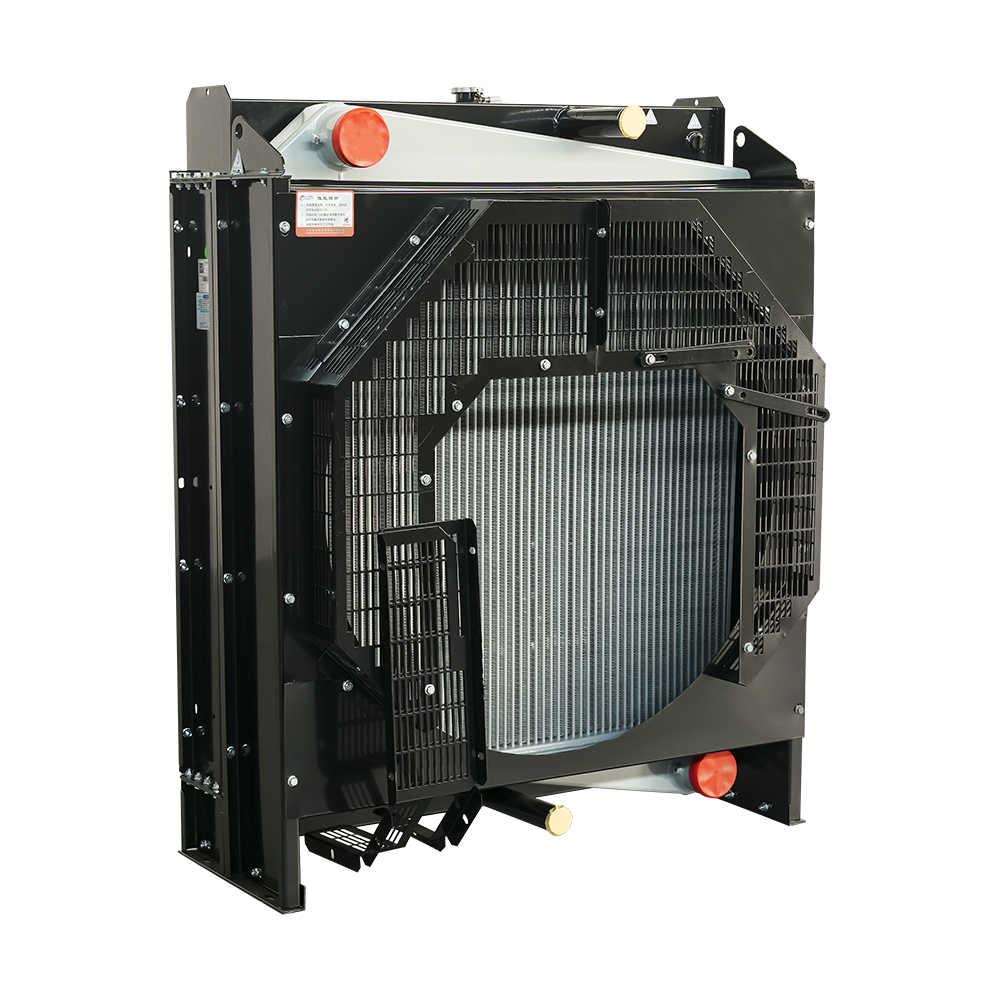 Silent Generator Radiators Manufacturers, Suppliers, FactoryAs OEM Silent Generator Radiators Manufacturers, Silent Generator Radiators Suppliers and Factory in China, Weichuang offer Custom Silent...View Product →
2. Mechanical and structural constraints
The radiator must also fit the physical space and the installation orientation. A low-profile package, a roof-mounted radiator, a corner installation, or a genset placed inside a shipping container all change the airflow path. In some cases, a remote radiator with a separate fan and pump is the only way to bring fresh outside air into the cooling system. Ducting length, static pressure, and fan energy all need to be considered before the mounting drawing is approved. If you are new to this, start with radiator system design principles that explain static pressure and airflow requirements; mistakes made here are expensive to correct on site.
3. Material, coolant, and coating choices
Customization also extends to materials. Aluminum cores are light and offer good heat transfer, but in saline or humid air they need protective coatings. Copper-brass cores have a long service life but are heavier and more expensive. The coolant specification matters too: the correct ethylene glycol concentration, inhibited coolant, and regular sampling all influence how long the core remains free of corrosion. A radiator built for one climate may not survive another, regardless of core size.
Cost, lead time, and procurement risk
A custom radiator can cost more than a standard catalogue part, but a wrong radiator costs even more in downtime and load loss. The real price is whether the unit can produce its rated power on a hot afternoon. If service loss costs thousands per hour, the premium for a correctly sized core is easy to justify.
The main cost drivers are core dimensions, fin density, material, coating, mounting complexity, and order quantity. Remote-mounted radiators add additional components such as pumps, expansion tanks, and motorized louver options. As a rule of thumb, ask for a specification that includes heat rejection, coolant flow, face velocity, static pressure drop, fan power, and maximum ambient temperature. If a quotation does not include those numbers, it contains a risk.
For current reference points on specifications, costs, and lead times, see our guide to custom aluminum radiators for generators. You can use it to prepare realistic expectations before sending an RFQ.
The most common procurement mistake is incomplete site data. If you only provide engine power and a rough sketch, the supplier must guess the cooling design. Prevent that by assembling a complete list of inputs:
- Engine make, model, and rated power with heat rejection data from the engine datasheet.
- Site ambient temperature range, altitude, and humidity.
- Available envelope dimensions and orientation of the installed radiator.
- Fan configuration: belt-driven or electrically driven, permissible fan power, and noise limit.
- Target coolant temperature at rated output and any performance standard such as ISO 8528.
These inputs are the difference between a “custom” label on a standard part and a genuinely engineered cooling package.
Working with a manufacturer that understands genset applications
Custom genset solutions call for a supplier that treats cooling as a system, not a commodity. The same core may need different fin pitches, coatings, and mounting brackets depending on whether it is going into a mine, a hospital, a lighthouse, or a rental fleet. The manufacturer should be able to reference existing applications and adjust engineering without changing the whole package.
Application knowledge is visible in how one manufacturer develops radiators for multiple genset brands across different industries. A supplier with OEM, end-user, and replacement experience will ask better questions in the enquiry stage, which means fewer surprises later.
Bottom line: start cooling early
If you are evaluating custom generator/genset solutions, put cooling on the specification before the order is placed. Provide ambient conditions, duty cycle, installation space, noise limits, and site-specific risks such as salt, dust, or altitude. The result is a generator that produces its full power when the conditions become difficult.
Start with the heat rejection numbers. The rest of the genset specification becomes much easier after that.

- Product Categories
- Contact Us
-
- wcradiator@jswcsrq.com
- +86-514-400-180-4088
- +86-15152759383
- +86-15152759383
- No. 6 Road, Shaobo Industrial Concentration Zone, Jiangdu District, Yangzhou City, Jiangsu Province, China

